
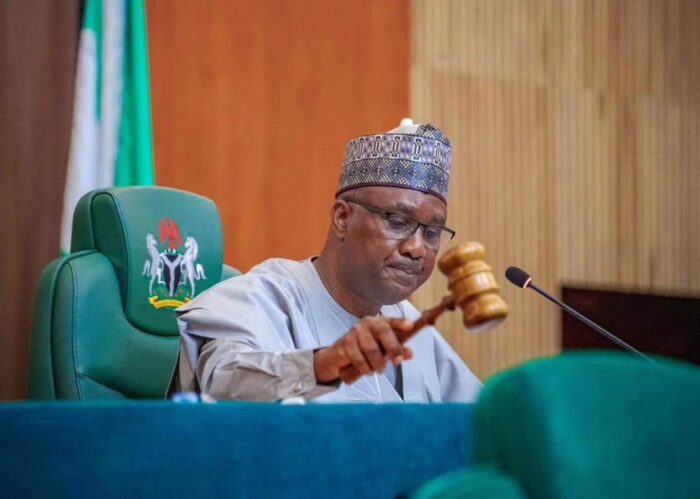
When the 10th National Assembly was inaugurated on June 13, 2023, Nigerians had high expectations from their elected representatives. With the emergence of Rt. Hon. Abbas Tajudeen, Ph.D., GCON, as Speaker of the 10th House, the stage was set for genuine legislative work. This is not only because he was—and still is—a lawmaker par excellence, but also because he enjoyed overwhelming support from his colleagues to get things done. Here was a legislator who broke the lawmaking ceiling by becoming the first and only parliamentarian in Nigeria’s history to have sponsored 74 bills in a single term. What’s more, he had 22 of those enacted into law. So, he came to the job well credentialed and fully ready.
From the onset, the 10th House christened itself ‘The People’s House,’ reflecting its commitment to making Parliament genuinely representative of the Nigerian people. It also established a roadmap for itself through its Legislative Agenda, which centres on eight thematic areas: Social Sector Reform and Development; Economic Reform and Development; Strengthening Good Governance; Law Reform; Enhancing National Security; Climate and Environment; Inclusion and Open Parliament; and Foreign Policy.


Statutorily speaking, lawmakers are tasked with three key functions: lawmaking, oversight, and representation. Thus, any evaluation of their performance should focus on these three key areas.
Three years on, how has the 10th House fared thus far? During the recent unveiling of its 3-year scorecard, the House disclosed that it received a total of 2,747 bills, of which 371 were passed and 72 were signed into law by President Bola Ahmed Tinubu, GCFR. This marks the first time in Nigeria’s democratic history that any Parliament has passed such a large volume of legislation. It is also the first time in history that a president has signed such a large number of bills into law.
In terms of the number of bills passed per thematic area of the Legislative Agenda, the House scorecard, a 128-page document, indicated that 242 (65.2%) fell under Social Sector Reform and Development; 39 (10.5%) were under Economic Reform and Development; 34 (9.2%) were for Strengthening Good Governance; 19 (5.1%) for Law Reform; 15 (4%) for Improving National Security; 10 (2.7%) for Climate and Environment; 10 (2.7%) for Inclusion and Open Parliament, while 2 (0.5%) were for Foreign Policy.
The scorecard, titled ‘Third-Year Performance Assessment,’ further revealed that out of the 2,747 bills received, 2,595 (94.5%) were Members’ Bills, 95 (3.4%) came from the Senate, and 57 (2.1%) originated from the Executive branch. Again, out of the 371 bills passed by the House, 341 (91.9%) were private Members’ Bills, whereas 30 (8.1%) belonged to the Executive branch.
It is worth noting that some landmark laws enacted by the 10th House include the Student Loans (Access to Higher Education) Act, 2024; the four Tax Acts of 2025 (Nigeria Tax Act, Nigeria Tax Administration Act, Nigeria Revenue Service Act, and Joint Revenue Board Act); the Regional Development Commissions Acts covering North-West, North-Central, South-East, South-South, and South-West regions; the Electoral (Amendment) Act; the Cybercrimes (Amendment) Act; and the National Anthem Act, among others.
Next up is oversight. Over the three-year period, different House committees conducted a total of 766 oversight activities, including 480 oversight or inspection visits, 135 familiarization or courtesy visits, 84 investigative hearings, and 67 public hearings.
These oversight engagements were far from futile, leading to the recovery of billions of naira in taxpayers’ funds. For instance, the 3-year assessment report revealed that in March 2025, the Public Accounts Committee (PAC) of the House reported cumulative recoveries amounting to N50.1 billion from unremitted royalties and taxes by oil and gas companies. By June 2025, Speaker Abbas put the figure at N61.5bn.
In the realm of representation, this is where citizens’ motions and petitions take effect. Over the course of three years, the House deliberated on a total of 1,320 motions and matters of urgent public importance, most of which reflected the interests of various constituents or aimed to tackle issues directly affecting citizens’ lives. A total of 1,302 motions were addressed and referred to various committees, with 460 identified as matters of urgent public importance.
The 3-year assessment report revealed that 458 motions (34.7%) addressed Social Sector Reform and Development; 255 (19.3%) focused on National Security; 186 (14.1%) pertained to Economic Growth; 178 (13.5%) centered on Good Governance; 151 (11.4%) concerned Climate and Environment; 41 (3.1%) dealt with Law Reform; 38 (2.9%) related to Inclusion and Open Parliament, and 11 (0.8%) involved Foreign Policy.
The report also stated that the House referred a total of 857 petitions to the Committee on Public Petitions. These petitions originated from civil servants, retirees, students, NGOs, professional organizations, communities, and others, addressing grievances such as wrongful termination of employment, unpaid pensions, land disputes, abuse of power, and more. A total of 209 petitions were concluded, with 648 still pending.
Within the three-year period, the House also responded to some national crises, rightly so. For example, in the wake of the killings and abductions in the country, the House convened a special session on security in November 2025. Earlier in 2023, the House held sectoral debates on insecurity and the economy, where the service chiefs and heads of key agencies managing the economy appeared before lawmakers in plenary sessions. The House also suspended the cybersecurity levy and engaged actively during the emergency rule declared on Rivers State in March 2025. A large chunk of the motions it considered also focused on insecurity.
The House has also devoted significant attention to the issue of inclusion. The special seats bill, which is part of the ongoing constitution alteration process, has been on the front burner in the House. Through its Committee on Women Affairs and Social Development, the House has actively engaged with the relevant stakeholders, including CSOs, development partners, women groups, etcetera, as part of efforts to garner support for the bill. Speaker Abbas, a leading advocate for increasing women’s representation in parliament, is also championing special consideration for persons living with disabilities (PWDs).
The youths, often referred to as the leaders of tomorrow, have been actively engaged by the House so as to have a voice in parliamentary matters. Through the annual town hall, starting from 2023, Speaker Abbas has given the Nigerian youths a platform to be heard.
Other notable engagements by the House over three years included Citizens’ Townhall on the 2024 Budget, Disability Townhall, Regional Citizens’ Roundtable with House Leadership, Citizens Townhall on Electoral Reform, National Policy Dialogue on Legislative Agenda, among others.
In its commitment to honesty, the House also sought to gauge public perception of its legislative achievements over the past three years. This aligns with Speaker Abbas Tajudeen’s commitment to making the House responsive, transparent, and accountable to the citizens. Accordingly, the House surveyed a segment of the population.
Regarding the relevance of bills, only 30.6 percent of the sampled citizens rated the House as ‘good or excellent,’ while 34.2 percent considered it ‘poor or very poor.’ Additionally, 21 percent gave a ‘fair’ rating, and 14.2 percent were ‘not sure.’
As for the quality of the debate, while 23.5 percent scored the House ‘good or excellent,’ 36.2 percent rated it ‘poor or very poor.’ Also, 28.6 percent of the respondents scored the House ‘fair,’ while 11.7 percent went for ‘not sure.’
In terms of motions’ effectiveness, 20.6 percent scored the House ‘good or excellent,’ while 22.9 percent considered it ‘fair.’ However, 43.5 percent rated the House as ‘poor or very poor,’ while 13.1 percent responded with ‘not sure.’
All said, the 10th House, under the able leadership of Speaker Abbas Tajudeen, Ph.D., GCON, is poised to move a step further in the remaining period of its 4-year mandate when it reconvenes from its ongoing annual recess.
- Krishi is the Special Adviser on Media and Publicity to the Speaker, House of Representatives, Federal Republic of Nigeria.

