
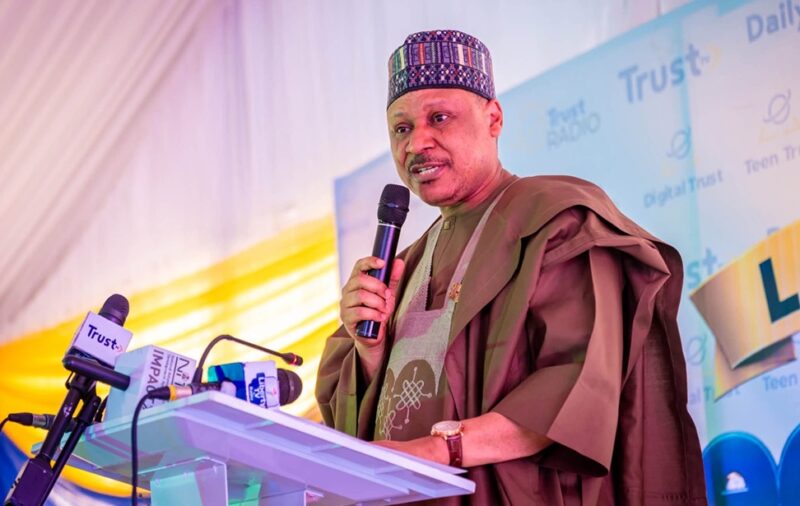
I am delighted to join you for the unveiling of Media Trust Group’s Converged Newsroom, a significant milestone in the continuing evolution of one of Nigeria’s most recognisable media institutions. I congratulate the Board, Management and entire workforce of Media Trust Limited on this remarkable achievement.
From its modest beginnings in the newspaper industry, Media Trust has grown into a formidable multimedia organisation, establishing an enduring presence in Nigeria’s information ecosystem. Through Daily Trust, Aminiya, Trust TV, Trust Radio and its expanding digital platforms, the organisation has demonstrated remarkable enterprise, resilience and commitment to journalism. Its growth reflects the possibilities that exist when vision, professionalism and sustained investment come together.


Today’s unveiling represents another bold step in that journey. By integrating its various platforms into a converged newsroom, Media Trust is positioning itself for a future in which audiences expect credible information delivered seamlessly across print, broadcast and digital channels.
The theme, “Media Innovation, National Development and Responsible Journalism,” is particularly relevant. Technology is fundamentally transforming journalism, creating exciting opportunities through artificial intelligence, data journalism and multimedia storytelling. However, innovation must strengthen, rather than diminish, the professional judgement, ethical standards and human responsibility upon which credible journalism rests.
Under President Bola Ahmed Tinubu, the Federal Government recognises the media as an indispensable partner in national development and democratic governance. The President’s administration has consistently affirmed its commitment to press freedom, constructive engagement and the right of journalists to scrutinise public institutions.
Our responsibility as government is to sustain an environment in which journalism can flourish, while encouraging dialogue and the peaceful resolution of concerns affecting media practitioners.
We also recognise that press freedom must be accompanied by the economic sustainability of media organisations. Journalism is both a public service and an enterprise that creates employment, encourages investment and contributes to national development. For media organisations to function optimally and discharge their duties and responsibilities, the business models they depend on must be sustainable even in the face of changing times, technologies and consumer expectations.
The Federal Government will continue to engage industry stakeholders on ways to strengthen the sector, protect media professionals and support its adaptation to the digital economy.
As Nigeria approaches the 2027 general elections, the responsibility of the media becomes even more consequential. Elections naturally generate intense political competition, competing narratives and heightened public expectations. At such moments, journalism must rise above sensationalism, misinformation, unsubstantiated allegations and the temptation to sacrifice accuracy for speed or commercial advantage.
Journalism has a longstanding responsibility to inform and educate the public, choosing context over confusion and meaning over noise. There is no doubt that in this digital age, there is an intensified temptation to be sensational in the vicious and unending contest for the fleeting attention of often distracted consumers.
Storied media organisations, which have invested time and resources into building credible brands, have no choice but to resist this temptation. More than ever before we must strive to return to the foundational principles – fairness, transparency, and unwavering respect for the dividing line between fact and opinion.
I urge media organisations to provide equitable opportunities for political engagement, interrogate competing claims with fairness and ensure that facts, rather than partisan interests, guide their editorial decisions.
The months ahead will undoubtedly witness an intensification of political activities, accompanied by competing claims and counterclaims that must be subjected to rigorous fact-checking. Bad-faith actors, both local and foreign, will seek to exploit this charged atmosphere to sow tension, confusion, distrust and disunity across the country.
Nigeria’s media organisations must therefore strengthen their capacity to identify and expose these actors, counter their false narratives and minimise their capacity to undermine public confidence and national cohesion.
You owe your staff adequate levels of training and tools to empower them to stand as a trusted bulwark, on behalf of society, against the forces of misinformation and disinformation. The battle against information disorders can be won, but it will take concerted effort and commitment from coalitions of stakeholders. As much as media organizations are in competition with one another, there is also room for cooperation, uniting against the forces that threaten our unity, peace and prosperity.
I must concede that we are in very interesting times, technologically speaking, given the rapid advances in the sophistication of artificial intelligence. The proliferation of artificial intelligence-generated content, manipulated images and deepfakes makes rigorous verification more important than ever.
Consequently, the credibility of our democratic process depends, in no small measure, on the integrity of the information available to citizens.
In this regard, the Federal Government is strengthening media and information literacy initiatives, including efforts that led to the establishment of the UNESCO Category 2 International Media and Information Literacy Institute in Abuja, Nigeria.
We are equally advancing conversations around responsible artificial intelligence deployment in the media space, recognising that technological progress must be anchored in public trust.
Our National Values Charter reinforces the importance of integrity, responsibility, patriotism and mutual respect. These principles should inspire a media culture that promotes national cohesion without compromising the independence and critical scrutiny essential to journalism.
I encourage Media Trust to make this converged newsroom a centre of innovation, investigative excellence and responsible storytelling. Let it strengthen the organisation’s capacity to illuminate national challenges, celebrate Nigerian achievements and contribute meaningfully to informed public discourse.
Which leads me to one very important point. Nigerian journalism can and should tell bold and inspiring Nigerian stories without feeling like it is letting the practice down.
The idea that journalism has to be exclusively adversarial is a myth that needs to be jettisoned – “If it bleeds it leads” should not be the primary determinant of what gets prioritised or highlighted. News that inspires and encourages can also lead, and platforms should endeavour to amplify what is working as enthusiastically as what isn’t. Within this diversity of coverage lies strength and lasting utility to society.
Once again, I congratulate Media Trust Group on this impressive investment in the future of Nigerian journalism, and urge other organisations to emulate these efforts.
May this new chapter bring greater accomplishments to the organisation, its professionals and the Nigerian media industry.
Thank you.
- Full text of the speech by Mohammed Idris, fnipr, is Nigeria’s Minister of Information and National Orientation, at the official unveiling of Media Trust Group’s Converged Newsroom, on Thursday October 22, 2026, in Abuja

