
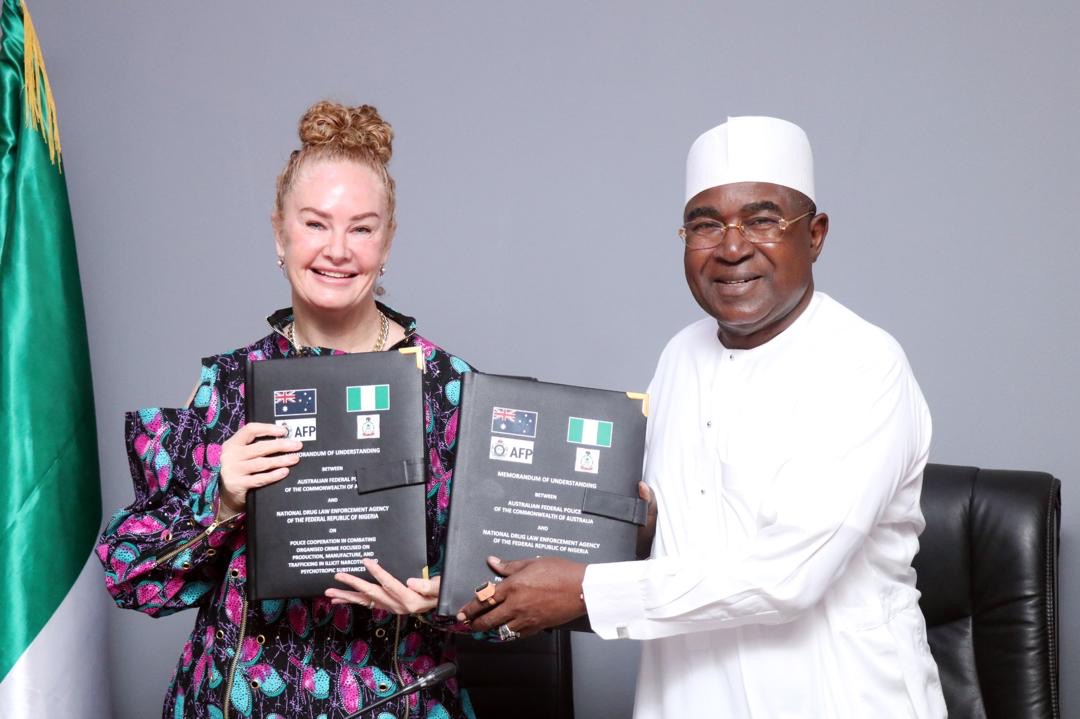
The National Drug Law Enforcement Agency (NDLEA), and the Australian Federal Police (AFP) have signed a Memorandum of Understanding (MoU) formalising existing cooperation into a strategic alliance against transnational drug trafficking networks operating along the Nigeria-Australia route.
The signing ceremony was held at the NDLEA national headquarters, Abuja, on Monday, November 2, 2026, according to a statement by the agency’s spokesperson Femi Babafemi.


Chairman/Chief Executive Officer of NDLEA, Brig. Gen. Mohamed Buba Marwa (Rtd), described the MoU as “a declaration of war against transnational drug cartels that think they can hide between continents.”
According to Marwa, with the AFP’s global reach and NDLEA’s operational doggedness, both agencies would make the Australia-Nigeria drug route “extremely hostile and unprofitable for traffickers.”
Under the agreement, both agencies will cooperate in four critical areas: exchange of information and intelligence; joint and coordinated operations; capacity building and professional development; and controlled delivery.
Marwa said drug trafficking had become highly transnational, highly organised and sophisticated, with Nigerian organised crime groups increasingly linked to the Australia-Pacific drug route, especially for methamphetamine and cocaine.
“Nigeria is being exploited as a transit and sourcing hub, but no single country can fight this alone,” he stated.
He expressed hope that the MoU would lead to major joint seizures, arrests of high-value targets, and successful controlled deliveries, adding that the pact is renewable.
Marwa cited recent successes that underscore the need for the partnership, including the seizure of 184.5 kilograms of cocaine meant for export; the takedown of four methamphetamine laboratories with Mexican nationals embedded in them in recent months, one of which yielded seizures valued at over 360 million US dollars; and the dismantling, after over a year of joint work with the US DEA as well as French, Greek and Swiss police, of the Switzerland-based cartel of a Nigerian, Simon Amadi.
In her remarks, head of the AFP delegation, Ms Sandra Booth, said fighting drugs is a whole-of-society problem that requires a whole-of-society solution. She commended NDLEA for addressing the whole spectrum from prevention to enforcement.
She described NDLEA’s international partnerships as commendable, saying the MoU would serve as “a force multiplier” in the fight against “this abhorrent trade.”
Booth explained that organised crime groups are increasingly using drugs to fund other serious crimes through a “crime as a service” model, drawing young and vulnerable people into offences.
“Whilst Nigeria is a transit country, we are a destination country. And unfortunately for us, people will pay a lot of money for the commodity,” she said.
“It is so absolutely necessary that we work together as a team, that we are forceful, that we are committed, that we show integrity, and we hunt as a pack. And I am very proud that we can now be part of your pack,” she added.
The ceremony was witnessed by Australian High Commissioner to Nigeria, Ms Leilani Bin-Juda; Deputy High Commissioner, Timothy Milikan and other members of the AFP delegation: Andrea Humphrys and Susan Gray, as well as top NDLEA officials.

