
Nigeria is no stranger to the catastrophic potential of zoonotic emergencies. In 2014, when the imported index case of Ebola Virus Disease landed at the Murtala Muhammed International Airport in Lagos, the nation held its breath. Through heroic contact tracing, swift clinical intervention, and widespread public adherence, Nigeria averted what could have been an unfathomable human toll. That hard-won vigilance was tested once again when the recent case marking the re-emergence of the disease in the country was traced to an incoming passenger who flew into Nigeria with the virus.
Yet, memory fades faster than biological reality. While international air travel can introduce a pathogen across borders in hours, the structural conditions that invite Ebola and related viral haemorrhagic fevers right back to our doorsteps are growing more acute by the day. As human populations burgeon, forested frontiers retreat, and urban demand for wild meat rebounds, we continuously expose ourselves to domestic spillover risks.


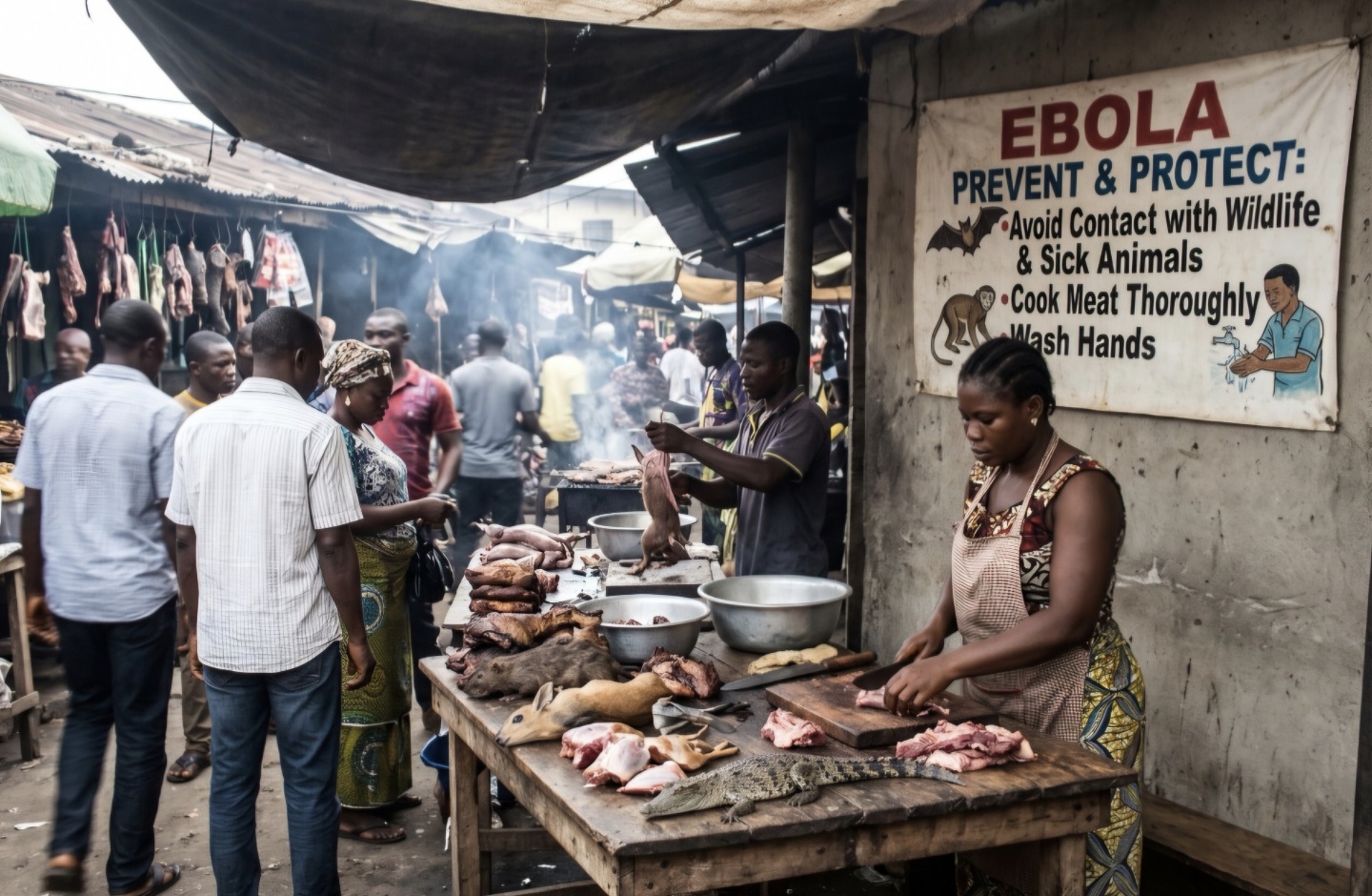
Across West and Central Africa, wild meat—commonly known as bushmeat—is deeply woven into dietary customs, celebratory cuisines, and informal commercial chains. What began as informal trade has evolved into an aggressive commercial enterprise, with upscale restaurants in Lagos and other major cities openly flaunting bushmeat across social media—frequently putting highly vulnerable fauna, such as the African dwarf crocodile and Central African rock python, on display as culinary trophies. While it historically served as an opportunistic subsistence protein in rural forest communities, the trade today has transformed into a high-volume commercial pipeline supplying major urban eateries and wet markets in Lagos, Ibadan, Port Harcourt, and Abuja. What many consumers fail to realize is that every carcass hauled out of an undisturbed canopy carries an unseen ecological and epidemiological receipt.
The Ecological Reservoir and the Spillover Chain
The Ebola virus does not originate within human populations; it circulates naturally in wild ecological reservoirs. Frugivorous and insectivorous bats (family Pteropodidae) are widely recognized as primary asymptomatic reservoirs. The pathogen frequently spills over into secondary wild hosts—including non-human primates (Chimpanzees, Gorillas, and Monkeys) and forest antelopes (such as Duikers). Unlike bats, non-human primates and antelopes are highly susceptible to severe clinical illness and sudden mortality.
Human exposure does not simply happen in the dining room over a cooked meal; high-temperature boiling or roasting generally neutralizes the virus. The critical flashpoint for primary spillover occurs during hunting, trapping, butchering, descaling, and handling raw blood, viscera, and body fluids, to which many handlers are ignorant to its hazards.
A hunter skinning a freshly killed monkey or a trader in an open wet market dressing an intact duiker without protective gear is in direct contact with potentially viremic tissue. Even microscopic abrasions on the skin or accidental splashes into the eyes, nose, or mouth provide the virus a direct gateway. Once a single human host is infected, sustained human-to-human transmission begins through direct contact with blood, secretions, and contaminated surfaces—turning an ecological event into a public health catastrophe.
How Population Growth and Defaunation Accelerate Wildlife Encounters
Nigeria’s rapid demographic expansion compounds this vulnerability. Human settlement expansion, agricultural conversion, infrastructure development, and timber harvesting fragment our remaining natural wildlife resources. When we build roads into previously inaccessible forests and degrade the habitats of bats and primates, we strip away the natural buffer zones that historically separated human society from novel or virulent pathogens.
Stressed wildlife populations facing habitat destruction often experience altered immunity and altered migratory movements, foraging closer to orchards, farm borders, and village trees. Concurrently, hunters penetrate deeper into protected boundaries in search of dwindling game. This escalating frequency of human-wildlife encounters drastically multiplies the statistical odds of zoonotic spillover.
What People Need to Know, Do, and Avoid
Mitigating this risk does not require panicking, but it demands an urgent, evidence-based reset in how citizens, traders, and authorities approach wild fauna.
1. What the Public Needs to Know
- Infected animals can appear freshly dead: Hunters frequently recover wild animals found dead in the forest without an obvious gunshot or trap wound. Handling or salvaging any wild animal found dead of unknown causes is one of the highest documented triggers of historical Ebola and Anthrax outbreaks.
- Urban demand fuels the risk: Bushmeat consumption in urban centers is predominantly a lifestyle choice, status symbol, or culinary indulgence, not a necessity for survival. The commercialization of vulnerable wildlife drives intense extraction that threatens biodiversity while needlessly elevating pandemic risks.
- High-risk taxa: Bats, non-human primates (monkeys, baboons), and forest duikers pose disproportionate transmission risks for viral haemorrhagic fevers and poxviruses.
2. Practical Actions to Take
- Switch to sustainable domestic protein sources: Urban households and food vendors should transition their protein demand toward domestically farmed livestock, poultry, and aquaculture (fish), which carry verified veterinary oversight and supply chains.
- Report unexplained animal die-offs: Forest-adjacent communities, rangers, and hunters should immediately report clusters of dead primates, bats, or forest mammals to the local agricultural extension offices or the Nigeria Centre for Disease Control and Prevention (NCDC) rather than retrieving them for consumption.
- Strict occupational hygiene for handlers: For communities that rely on game for subsistence, anyone dressing raw carcasses must treat blood and internal organs as potential biological hazards—using thick gloves, washing surfaces thoroughly with chlorinated water or soap, and avoiding barehanded contact with mucosal membranes.
3. Critical Behaviors to Avoid
- Never touch or consume found carcasses: Any wild animal that died without visible cause should be reported and safely disposed of by veterinary or health personnel, never dragged home or sold into the market.
- Avoid keeping wild animals as pets: Housing captured primates, wild carnivores, or bats in domestic quarters creates an ongoing domestic interface for zoonotic transmission and behavioral scratches/bites.
- Eliminate bushmeat sourcing for social events: Catering large banquets, weddings, and political gatherings with hunted wild meat incentivizes illegal mass harvesting and distributes unverified carcasses across wide consumer networks.
The One Health Imperative
The health of Nigeria’s human population cannot be separated from the health of our wildlife and the integrity of our ecosystems. By enforcing wildlife protection laws, halting the trafficking of threatened taxa, and ending the casual commercial appetite for wild meat in our towns and cities, especially in states like Lagos, we simultaneously achieve two vital national objectives: shielding our citizens from the next devastating epidemic and preserving the country’s rich, irreplaceable natural heritage for future generations.
- Dr. Abubakar S. Ringim is the Executive Director of Wild Hausa Limited and an environmental conservation scholar. ‘Planet and People Today’ is a biweekly column published in partnership with Dateline Nigeria to promote environmental literacy, biodiversity preservation, and public policy dialogue.

