
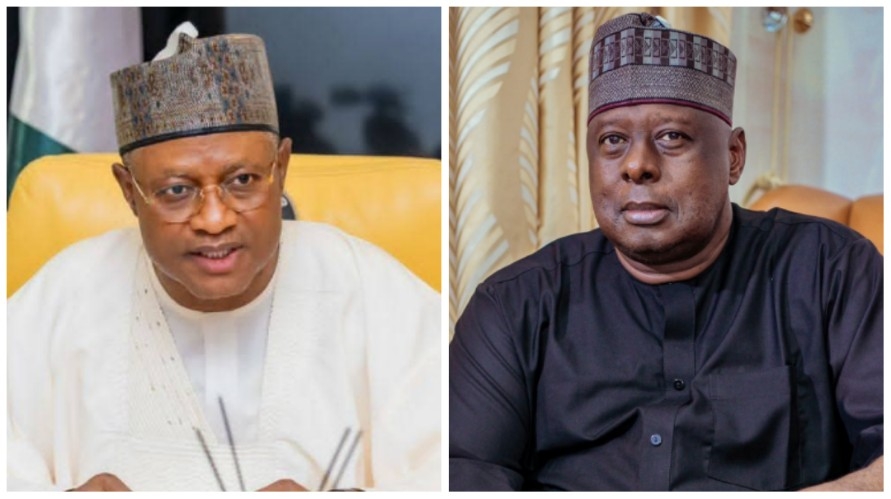
Kaduna State enters the 2027 election cycle with politics reshaped by eight years of Nasir el-Rufai and now recalibrated under Senator Uba Sani. The defining issue remains the same: how to manage Kaduna’s volatile tripod of faith, ethnicity, and region. But the formulas are changing and, to the discerning observer, very visibly too.
The 2027 contest is already shaping up as a two-way race between incumbent Governor Senator Uba Sani of the All Progressives Congress (APC) and Isah Ashiru Kudan of the African Democratic Congress (ADC). The two titans went head-to-head in 2023 even though Isa Ashiru was then in the Peoples Democratic Party (PDP). Perhaps the first major signal from both camps is about running mates — specifically, who gets Southern Kaduna.


Interestingly, post-El-Rufai Kaduna politics has gone full circle: in 2023, el-Rufai fought tooth and nail to deliver the governorship to Uba Sani, while campaigning against Isah Ashiru. Today, he is aligning with the same Ashiru to deny his former protégé a second term.
The El-Rufai era: Breaking and rebuilding the formula
For decades, Kaduna operated an unwritten power-sharing rule: a Christian deputy for a Muslim governor, and vice versa, with Southern Kaduna usually getting the deputy slot. It was almost like a tradition.
El-Rufai’s first term 2015-2019 followed that script. He ran with Barnabas Bala Bantex (now late), a Christian from Southern Kaduna. It was a gesture to what has been described as the politics of inclusion.
However, in 2019, he broke that tradition. El-Rufai dropped Bantex and picked Dr. Hadiza Balarabe, a Muslim from Southern Kaduna. The rationale he gave at the time was competence and loyalty. But many said it was due to political expediency. For the people of Southern Kaduna, it was as a deliberate sidelining, and it deepened mistrust between the government and the predominantly Christian communities of the South. Indeed, the people of Southern Kaduna still accuse the El-Rufai government of unfair treatment, citing political appointments and project executions.
Still, that Muslim-Muslim ticket, which was replicated at the centre through the Bola Tinubu/Kashim Shettima ticket four years later, became the APC template in Kaduna under El-Rufai. When Uba Sani succeeded el-Rufai in 2023, the latter ensured that the former retained the Muslim-Muslim ticket. El-Rufai’s deputy, Dr. Hadiza Sabuwa Balarabe, continued in office.
Uba Sani adopts different approach
While on paper, Uba Sani’s administration appeared to be a continuity of the APC brand, in practice he has governed differently. His administration has prioritized reconciliation in Southern Kaduna, especially with regards to appointments, infrastructure projects, and direct engagement with traditional and community leaders. The goal is clearly to undo the perception of alienation that marked the last four years of el-Rufai.
As a testament to this, Uba Sani is now set to pick a Christian running mate from Southern Kaduna for 2027. But while some may see this as a repudiation of el-Rufai, others see it as a correction. Uba Sani, early in his administration, understood the need to first consolidate his inroads in Southern Kaduna where the APC was weak and, secondly, deny the opposition a monopoly on the “inclusion” narrative.
For an incumbent with federal backing, picking a Christian deputy from the South is both a governance and an electoral calculation.
ADC, Isa Ashiru and the return to the old formula
The biggest threat to Uba Sani is Isah Ashiru Kudan of the ADC, except the onslaught against the party succeeded via the courts. Ashiru, a former PDP governorship candidate, lost narrowly to Uba Sani in 2023. He has now moved to the ADC, which is positioning itself as the main opposition platform ahead of 2027.
Ashiru’s choice of running mate is direct and symbolic: Irmiya Ishaku Kantiok, a Christian from Southern Kaduna. The move is targetted towards reclaims the traditional zoning formula that el-Rufai broke. It tells Southern Kaduna and the Christian minority that “we are returning you to the table” where you deserve a seat.
It is also aimed at consolidating the Southern Kaduna vote bloc which used to PDP’s powerhouse since the return of democracy in 1999. It will also frame the election as a referendum on inclusion — painting APC as a party that abandoned power-sharing for selfish purposes.
For ADC, this is the clearest path to competitiveness. Without Southern Kaduna and parts of Northern Kaduna, it will be really difficult, if not impossible, for any opposition candidate to win Kaduna.
Why 2027 will be a two-way race like in 2023
Kaduna politics has fragmented since 2015. PDP, LP, NNPP have all had a presence. But structurally, 2027 is collapsing back to two poles, with APC’s Uba Sani and ADC’s Isa Ashiru as the main contenders in Kaduna. Other parties lack the structure and funding to compete statewide, except a miracle happens.
The convergence is more than striking, politically speaking. Both leading candidates now see a Christian from Southern Kaduna as deserving of a presence on their ticket. Uba Sani’s outreach and Ashiru’s ticket are both responses to the same voter sentiment. In Kaduna, the 2027 election will not be fought on religion alone, but religion and region will frame it.
My prediction is that the candidate who wins Southern Kaduna by the widest margin, while holding his base in the North, wins Kaduna State.
- Ibrahim Danladi writes from Birnin Gwari, Kaduna State

