
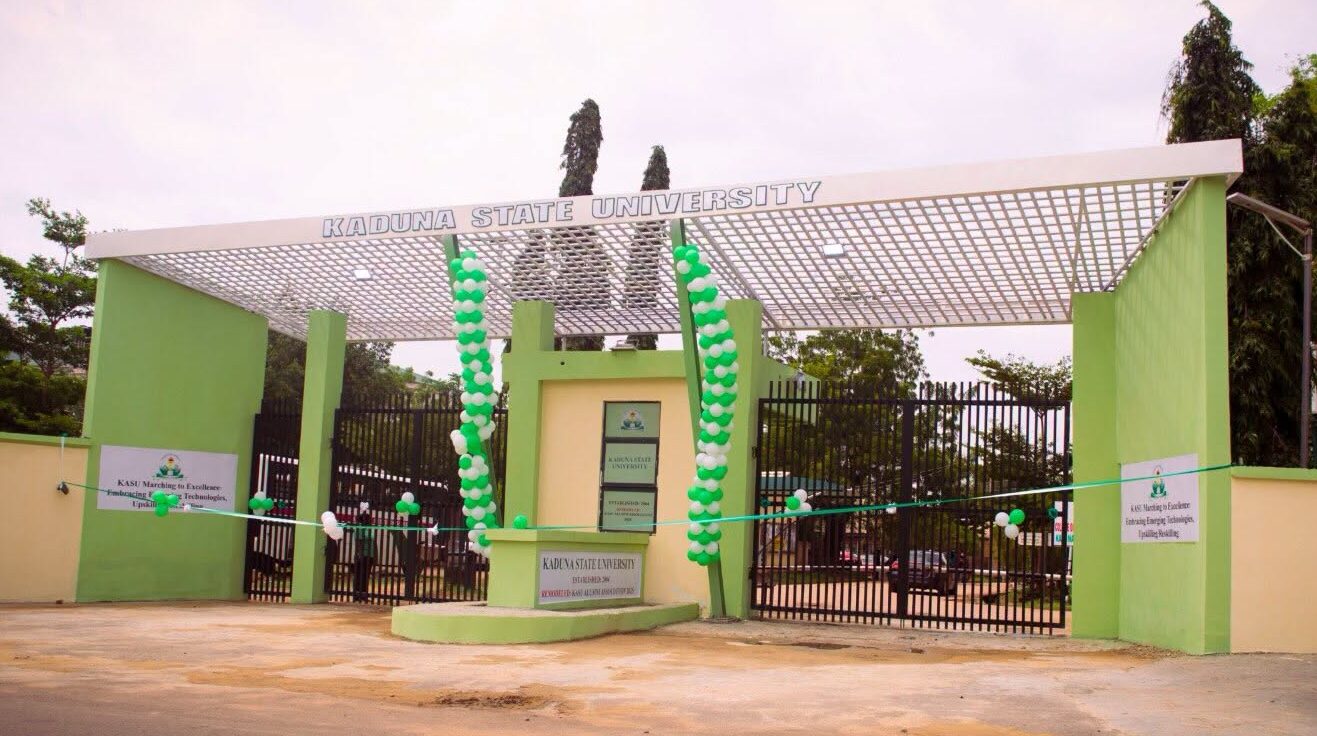
The Kaduna State Government has constituted a nine-member committee to negotiate with the Kaduna State University (KASU) chapter of the Academic Staff Union of Universities (ASUU) and other staff unions over their outstanding demands.
The government also approved the immediate payment of N300m as Earned Academic Allowance to KASU academic staff.


The move came amid renewed concerns over welfare, working conditions and other unresolved issues at the university, after ASUU-KASU issued a two-week ultimatum to the state government and KASU management over the implementation of its demands.
The union has, however, said it prefers dialogue and is ready for negotiations with the government.
In a statement released on Monday, the Secretary to the Kaduna State Government, Dr Abdulkadir Meyere, said the committee was established to comprehensively review the demands of ASUU, the Senior Staff Association of Nigerian Universities, the Non-Academic Staff Union and the National Association of Academic Technologists.
Meyere said the N300m EAA payment was part of the administration’s efforts to address accumulated entitlements and improve staff welfare at the university.
He said, “The intervention demonstrates the administration’s commitment to staff welfare, industrial harmony and the stability of the university through constructive dialogue and sustainable solutions.”
According to him, the N300m payment was in continuation of efforts by the Governor Uba Sani administration to clear a backlog of more than N800m in accumulated entitlements and allowances dating back to 2016.
The SSG added that the government had also settled outstanding withheld salaries and released funds to clear arrears of Students Industrial Work Experience Scheme supervision allowances.
He disclosed that the administration had established a N50m monthly standing order for the systematic settlement of outstanding arrears and staff-related claims.
Meyere further said the government had spent more than N300m on the accreditation of academic programmes and resource verification exercises for postgraduate programmes.
The nine-member committee is chaired by the Commissioner for Education, Prof Abubakar Sani Sambo.
Other members are the Commissioner for Business, Innovation and Technology, Mrs Patience Fakai; Commissioner for Youth, Mrs Gloria Ibrahim; Chairman, Local Government Service Board, Prof Ladan Sharehu; Director-General, Kaduna State Schools Quality Assurance Authority, Prof Usman Abubakar Zaria; KASU Vice-Chancellor, Prof Abdullahi Ibrahim Musa; and Pro-Chancellor, Dr Ibrahim Umar.
The Permanent Secretary, General Services, Office of the Secretary to the State Government, is also a member, while the Permanent Secretary, Establishments, Services and Training, will serve as secretary.
The committee has four weeks to conclude its assignment and submit its recommendations to the state government.
It is mandated to examine the unions’ demands, including the Consolidated Academic Tools Allowance, and compare KASU’s conditions with prevailing practices in other state-owned universities.
The committee is also expected to determine the financial implications of implementing demands arising from the 2025 ASUU-Federal Government agreement.
The government said the panel would recommend “practical, equitable and financially sustainable options” for resolving the outstanding issues.
Meyere urged the unions to embrace dialogue, negotiation and collective bargaining instead of industrial action that could disrupt the academic calendar and affect students and their families.
He said the government’s channels of engagement remained open, assuring the university community of its commitment to strengthening KASU, improving staff welfare and ensuring uninterrupted academic activities.
The intervention follows a recent face-off between the state government and ASUU-KASU over welfare and other institutional challenges.

