

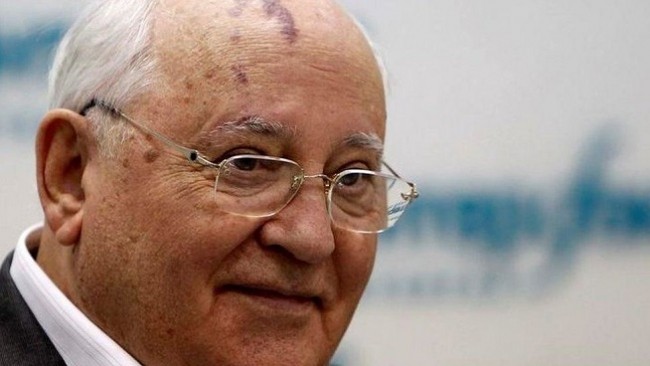
Former Soviet leader Mikhail Gorbachev has died aged 91.
Mr Gorbachev, who took over in 1985, is best known for opening up the USSR and for bringing the Cold War to a peaceful end, but he was unable to prevent his country collapsing in 1991.


Many Russians blame him and his reformist policies for the country’s demise.
The hospital where he died said he had been suffering from a long and serious illness.
Russian President Vladimir Putin expressed his deepest condolences on Mr Gorbachev’s death, his spokesman Dmitry Peskov told Russian news agency Interfax, according to Reuters.
European Union President Ursula von der Leyen praised him as a “trusted and respected leader” who “opened the way for a free Europe”.
“This legacy is one we will not forget,” she added.
UK Prime Minister Boris Johnson said he admired Mr Gorbachev’s courage and integrity.
“In a time of Putin’s aggression in Ukraine, his tireless commitment to opening up Soviet society remains an example to us all,” he said.
Mr Gorbachev became general secretary of the Soviet Communist Party, and de facto leader of the country, at the age of 54.
At the time, he was the youngest member of the ruling council known as the Politburo, and was seen as a breath of fresh air after several ageing leaders.
His policy of glasnost, or openness, allowed people to criticise the government in a way which had been previously unthinkable.
But it also unleashed nationalist sentiments in many regions of the country which eventually led to its collapse.
Internationally he reached arms control deals with the US and refused to intervene when eastern European nations rose up against their Communist rulers.
He is seen in the West as an architect of reform who created the conditions for the end of the Cold War in 1991 – a time of deep tensions between the Soviet Union and Western nations, including the US and Britain.
He was awarded the Nobel Peace Prize in 1990 “for the leading role he played in the radical changes in East-West relations”.
But in the new Russia that emerged after 1991 he has been on the fringes of politics, focusing on educational and humanitarian projects.
He made one ill-fated attempt to return to political life in 1996, receiving just 0.5% of the vote in presidential elections.
In recent years his health has been in decline and he has been in and out of hospital.
He will be buried in Moscow’s Novodevichy cemetery, the resting place of many prominent Russians, next to his wife Raisa who died of leukaemia in 1999, Tass news agency said. (BBC)

