
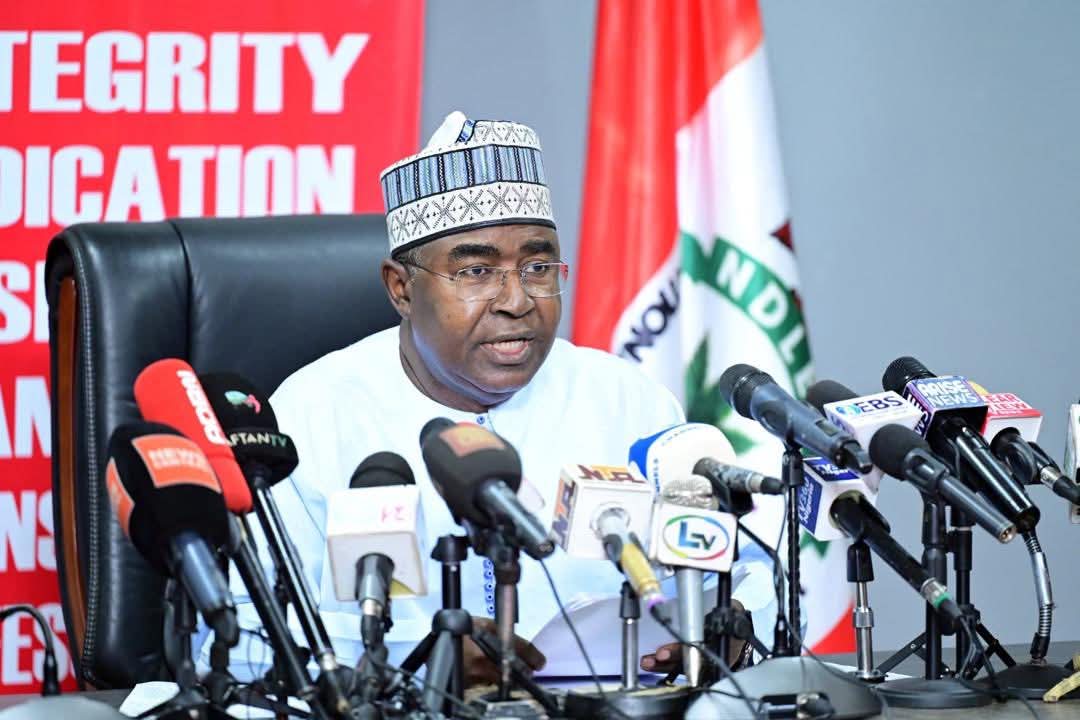
The National Drug Law Enforcement Agency (NDLEA) says it arrested 38,242 drug suspects, seized more than 5.8 million kilogrammes of illicit drugs valued at over N2.5 trillion and secured 6,232 convictions between January 2025 and September 2026.
The Chairman of the agency, retired Brig.-Gen. Buba Marwa, disclosed this while presenting Nigeria’s statement at the 81st Session of the United Nations General Assembly (UNGA) in New York.


This is contained in a statement by the Director, Media and Advocacy, NDLEA, Mr Femi Babafemi on Tuesday in Abuja.
Marwa, who was represented by the agency’s Secretary, Shadrach Haruna, spoke during a session themed, “Restoring Trust, Managing Transformation: A United Nations that Delivers for All”.
He presented Nigeria’s drug control reforms as an example of how institutions could adapt to emerging threats, strengthen public trust and deliver measurable results through coordinated action.
According to him, the NDLEA has evolved from a predominantly enforcement-focused organisation into an integrated, intelligence-led and people-centred agency.
This, he said, was combining law enforcement, public health, technology, financial investigation, alternative livelihoods and international cooperation.
He attributed the transformation to the changing nature of drug-related threats, noting that trafficking networks had become more sophisticated, with technology opening new channels for illicit activities and criminal proceeds being moved rapidly across borders.
Marwa said drug dependence also continued to affect individuals, families and communities, necessitating a broader approach that addressed not only drugs and offenders but also the criminal networks, illicit profits and vulnerabilities sustaining the drug economy.
He said the approach had produced significant results in both drug supply and demand reduction.
The NDLEA chairman disclosed that, within the period under review, more than 16,303 persons received counselling, treatment or rehabilitation, while prevention and sensitisation activities reached millions of Nigerians.
He stressed that the agency’s performance should not be measured solely by arrests and seizures, but increasingly by its ability to dismantle major trafficking networks, organised criminal structures and the financial systems sustaining the illicit drug trade.
Marwa also highlighted the agency’s Alternative Development initiative, which was being piloted in three communities in Ondo State to support residents transitioning from illicit cannabis cultivation to legitimate agricultural production.
He explained that sustainable drug control required more than the removal of illicit crops, adding that affected communities needed credible economic alternatives that would strengthen food security, community resilience and national security.
The NDLEA boss cited the agency’s Drug Integrity Test and Visa E-Administration System as examples of how digital tools could improve accessibility, efficiency, transparency and integrity in public administration.
He said the reforms were being consolidated in the National Drug Control Master Plan (NDCMP) 2026–2030, which provided a framework for coordinated action across six pillars.
“The pillars are drug supply reduction, drug demand reduction, access to controlled medicines, governance and coordination, alternative development, and disruption of the illicit drug economy,” he said.
Marwa said restoring public trust required effective service delivery, while managing institutional transformation demanded strong partnerships among governments, international organisations and other stakeholders.
He said Nigeria therefore urged the international community to strengthen timely intelligence-sharing to prevent criminal networks from exploiting gaps between jurisdictions.
He also called for intensified action against the illicit financial economy through financial investigations, asset tracing and recovery.
He urged countries to strengthen prevention, treatment, rehabilitation and reintegration alongside effective law enforcement, while expanding support for alternative development programmes that provided sustainable livelihoods for communities leaving illicit cultivation.
Marwa called for greater investment in the capacity development of law enforcement officers to enable them to respond effectively to the growing sophistication and innovation of drug cartels.
He also urged international partners to invest in institutions, particularly in developing countries, through technology, training, forensic capabilities, treatment infrastructure and sustained technical assistance.
“Nigeria’s experience is a continuing journey rather than a finished model and the country’s readiness to share lessons, learn from other countries and work with UN member states and international partners.
“Such cooperation is necessary to move from commitments to implementation, from cooperation to collective action, and from transformation to measurable delivery,” he said.(NAN)

