
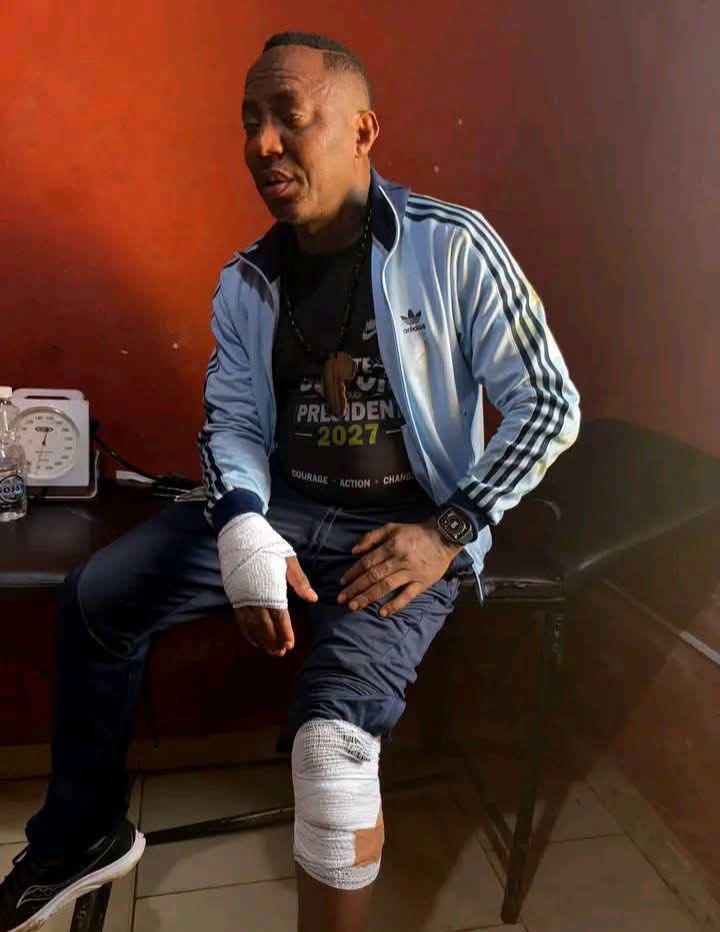
There is something deeply troubling about the ease with which grave allegations are made in Nigeria, the speed with which they harden into public verdicts, and the reluctance of those making them to accept the scrutiny they routinely demand of others. The recent incident involving Omoyele Sowore in Ado Ekiti shows why credibility, consistency and evidence matter, particularly when the allegations concern political violence and security agencies.
Let me be clear. No citizen, regardless of politics, should be subjected to violence, intimidation or unlawful restraint. If Sowore and his team were attacked at Tawakalitu Restaurant, those responsible must be identified and prosecuted. If the attack was politically sponsored, the sponsors must face the law. But these are matters for credible investigation, not social media declarations.


The first question is how a kidnapping became an attack at a restaurant.
Sowore reportedly posted that he had been kidnapped and that his whereabouts were unknown. Within 39 minutes, he posted that he and his team had been attacked. Less than an hour later, he announced that they were receiving treatment at the Police Hospital in Ado Ekiti. The account then settled on Tawakalitu Restaurant, where he said they had gone to eat after a radio programme.
A kidnapping can precede an attack, and an attack can cause confusion. The question is why the first account spoke of an abduction to an unknown location, while the next named a specific place and described an assault.
A report made in confusion differs from a deliberate misrepresentation. We do not yet know which applies. That is why the chronology needs clarification.The police describe the incident as an altercation; Sowore insists it was an attack. The distinction matters, but neither description should be accepted as final.
The police cannot assume their preliminary view settles the matter, and Sowore cannot expect his account to become definitive merely because he is an activist and opposition politician.
The police have since arrested 11 suspects. Arrests are not convictions. They do not establish who started the confrontation, whether it was politically motivated, or whether others were involved. Then comes the allegation against the Department of State Services.
Sowore reportedly accused the DSS of tracking his movements and supplying his location to the attackers. Yet, by his own account, he was sitting in a restaurant.
A restaurant is a public place, not a secret location. What would tracking someone already seated there achieve? Is there evidence that the DSS monitored him or tipped off the attackers? Or is the allegation built on the assumption that because an attack occurred, a security agency must have facilitated it?
These are different propositions requiring different standards of proof.The DSS has been in litigation with Sowore for over a year. That history is relevant, but it proves nothing either way. Litigation does not make unlawful conduct impossible, just as an activist’s history of confrontation with security agencies does not make every allegation credible. Until evidence connects the DSS to the incident, the allegation must remain an allegation.
There is also Sowore’s relationship with the police. He has previously described the police as irresponsible and accused officers of breaking his hand. Yet in Ekiti he reportedly had police protection, was rescued by police officers and was treated at a police hospital. Deji Adeyanju reportedly confirmed that officers were with him but were overpowered.
An injured citizen deserves treatment, and a person in danger deserves protection, whatever his past criticisms. It does, however, expose the weakness of sweeping condemnation. If the police are beyond redemption, why is their intervention accepted without qualification when convenient?
Perhaps institutions can be flawed without being worthless. The same force can contain officers capable of both misconduct and professional service. That nuance is missing from the blanket denunciations dominating public discourse.
Sowore’s accusation against the Ekiti State Government and the Commissioner of Police deserves similar scrutiny. The Commissioner reportedly rejected the kidnapping account, which Sowore sees as an attempt to minimise the attack. He may be right. But a preliminary assessment is not proof of complicity. If the investigation is compromised, the evidence must show it.
Sowore was recently involved in public confrontations at the Federal High Court in Abuja, including one with a lawyer who allegedly called him a tout and another with correctional officers. These incidents do not prove he started the Ekiti confrontation. They do underline the need to examine his conduct with the seriousness he demands of others.
Human rights advocacy cannot be a shield against scrutiny. Nor should controversial conduct become an excuse to deny anyone protection.
The danger in our politics is that allegations are treated as verdicts, with evidence expected to catch up later. Once an agency, a government or an opponent is accused, supporters rush to condemn, opponents rush to celebrate, and the facts become secondary.That is not accountability. It is the politics of accusation.
The police must publish a credible account of their investigation. The suspects must be treated according to law. CCTV footage must be preserved and examined. The allegations against the DSS and the state government must be investigated independently, and anyone found culpable prosecuted.
Sowore, too, must clarify the chronology of his statements and substantiate the grave allegations he has made.
A democracy cannot assume that the loudest accuser is the most truthful, or that the most powerful institution is the most culpable. The right to speak is fundamental. So is the responsibility to speak truthfully.Sowore deserves protection. His allegations do not deserve automatic acceptance.
Credibility is not conferred by activism, opposition or the history of one’s grievances. It is earned through consistency, evidence and a willingness to face the scrutiny one demands of others.
Dr Lemmy Ughegbe, FIMC, CMC Email: [email protected] WhatsApp ONLY: +2348069716645

