
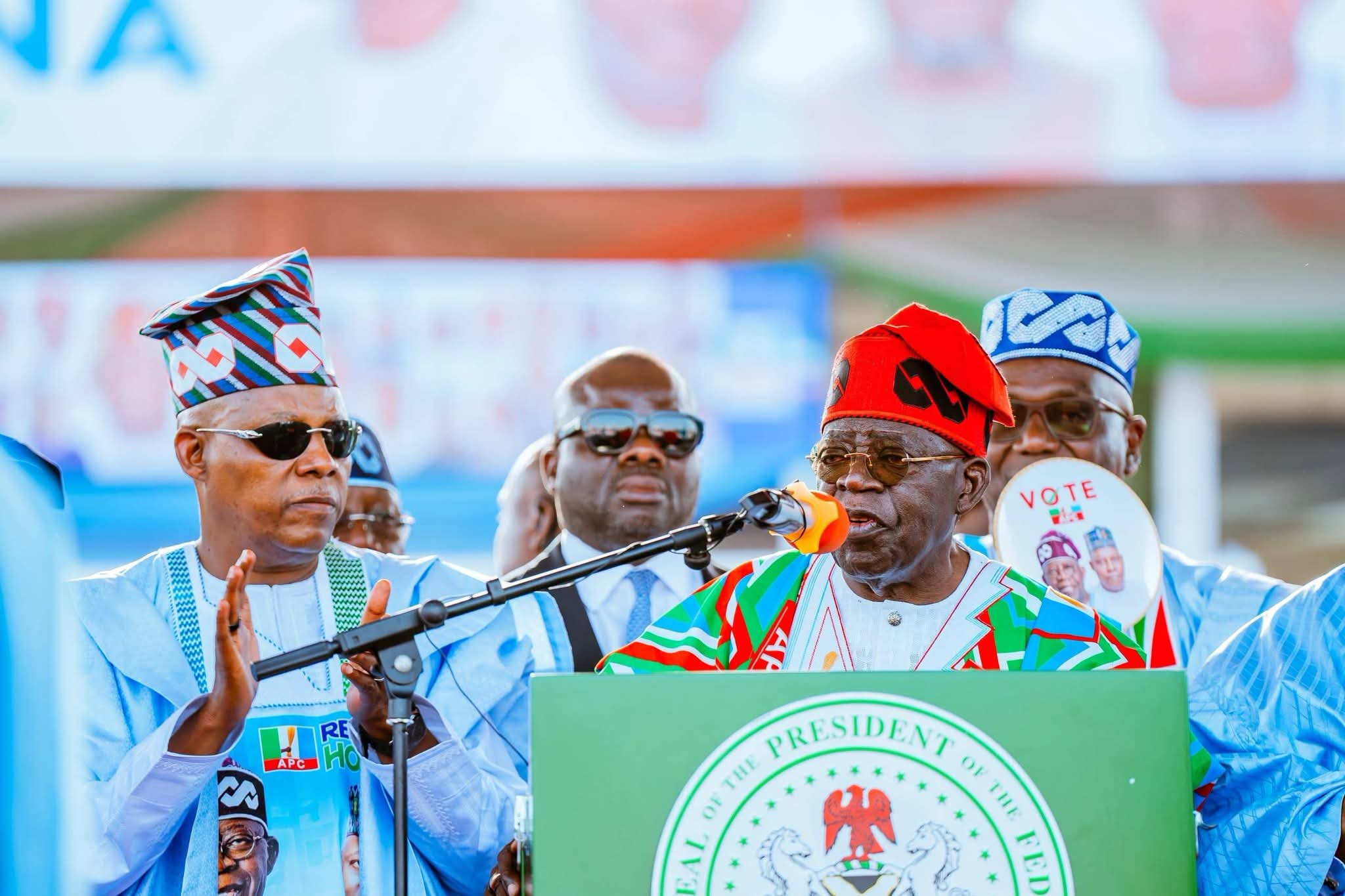
Photographs of Nigerian political rallies often capture the scale of the crowd, but they fail to reveal the individual sacrifices and motivations behind it. Whether it is an elderly citizen enduring the midday sun, a young woman travelling kilometres to attend a rally, or a trader leaving behind daily income to see a convoy, every attendee participates for a distinct reason. Rather than representing a single unified voice, these gatherings reflect a complex intersection of personal hardship, hope and civic expectation.
Buoyed by a triumphant reception and the resounding endorsement of party faithful in Kaduna, President Bola Ahmed Tinubu continues to carry the banner of Renewed Hope to every corner of the country. As the race for 2027 unfolds, his message for a second four-year term remains resolute: guiding Nigeria From Reforms to Prosperity.


From the bustling streets of Kaduna to the shores of Calabar, and across Lafia, Ado-Ekiti, Uyo, Port Harcourt, Abakaliki, Dutse, Akure, Benin City and Jos, the message has echoed across the nation. Flanked by Vice President Kashim Shettima, APC governors, party stalwarts, chieftains and legions of dedicated supporters, the President has carried the campaign directly to the Nigerian people. This opening leg stands as a triumphant, seamless tour de force, uniting regions and energising the grassroots in a powerful, hitch-free start to the journey ahead.
The cheers have been loud. The receptions have been colourful. Yet beneath the spectacle lies something more consequential. It is a conversation about the sacrifices Nigerians have made, the promises of President Tinubu and the kind of country those sacrifices are expected to produce.
Making his economic agenda the centrepiece of the campaign, President Tinubu is counting on his record to win over voters. As his deputy and political partner, Vice President Shettima has taken that message to communities nationwide, spotlighting the administration’s achievements and the unfinished business it intends to complete.
The journey started in Kaduna, where the Nigerian leader formally launched the APC presidential campaign. The choice of venue carried deep political weight. As a historic nerve centre for northern political organisation, national debate and coalition-building, Kaduna set a deliberate stage for the road ahead.
Framing the campaign as the next chapter of a mission launched in 2023, the President confronted the hard realities of his economic reforms head-on. He pledged to turn those difficult choices into lasting progress by driving infrastructure growth, boosting agricultural output, attracting investment and creating jobs. His core message was clear: the sacrifices Nigerians have endured over the past three years must now yield real opportunities and a better standard of living for every citizen.
Invoking a history of political alliances, Vice President Shettima urged the North to remember President Tinubu’s decades of support for northern leaders—from Atiku and Ribadu to the late President Buhari.
In public life, people never forget who stood beside them when the future was uncertain. In a political landscape where alliances shift overnight, those shared memories become the bedrock of trust. Speaking in Kaduna, Vice President Shettima made it clear that loyalty, reciprocity and shared history still carry weight in Nigeria’s democracy. His message also signalled a clear campaign strategy: rallying the deep personal bonds and foundational alliances that first built the APC.
The campaign subsequently moved to Calabar, Cross River State, where the discussion acquired a different character. At the U.J. Esuene Stadium, Senator Shettima spoke about the Lagos–Calabar Coastal Highway and the proposed Bakassi Deep Seaport, linking these projects to the future of commerce, investment and employment in the state.
His argument was straightforward. Economic reforms must eventually create opportunities that people can recognise. For a fisherman in Bakassi, development may mean access to better markets. For a young graduate in Calabar, it could mean a job connected to maritime trade, logistics or tourism. For a small business owner, it could mean dependable infrastructure and a more predictable business environment.
In Calabar, VP Shettima also presented President Tinubu’s economic restructuring as the groundwork for greater prosperity. That commitment found practical expression on Friday, November 13, when the Vice President, representing President Tinubu, performed the groundbreaking ceremony for the $3.5 billion Bakassi Deep Seaport.
For a project that had remained on the drawing board for decades, the ceremony marked a significant milestone. The administration has presented the seaport as part of its wider ambition to expand maritime trade, attract investment, create jobs and open new economic opportunities for Cross River State and the country.
As the campaign rolled into Lafia, Nasarawa State, attention turned squarely to national integration and infrastructure. Senator Shettima spotlighted the Akwanga–Jos–Bauchi–Gombe–Biu–Maiduguri Superhighway as a vital economic lifeline bridging the North-Central and North-East.
Economists often wrap the value of infrastructure in complex jargon, yet the truth about roads is simple: a good road expands what is possible for people. It decides whether a farmer reaches the market before the harvest spoils, dictates what a trader pays to move goods and determines whether a patient arrives at the hospital in time.
This was the larger meaning of President Tinubu’s infrastructure agenda in Nasarawa. The Vice President presented roads as instruments of economic opportunity, connecting communities that have long suffered the consequences of poor access.
The Vice President also visited the Emir of Lafia, where the conversation touched on loyalty, service and the responsibility of political leaders to maintain relationships beyond election seasons.
Then came Ekiti on November 5. If Kaduna emphasised political memory and Nasarawa the economics of infrastructure, Ado-Ekiti brought the language of accountability to the foreground.
“We know the sacrifices you have made, and we are beginning to reap the benefits of those difficult decisions,” VP Shettima told the gathering.
He followed that acknowledgment with a review of federal interventions in healthcare, electricity, roads and education. The conversion of the former State Specialist Hospital in Ikole-Ekiti into a Federal Medical Centre, electricity projects in Ilupeju and Ijesa-Isu, road reconstruction and access to student loans through NELFUND formed part of his account of the administration’s work.
But perhaps the most revealing part of the Ekiti rally was the recognition that government must account for what it has done and what remains unfinished. “We have begun to fulfil those commitments, and we have returned to account for the work already done and the tasks that remain,” the Vice President said.
That distinction matters because citizens do not experience governance as a collection of press releases. They experience it through the availability of electricity, the condition of roads, the cost of education and the reliability of public services.
Ekiti also offered a picture of shifting political relationships. Former governorship candidates of the PDP, SDP and APM publicly declared support for President Tinubu, while Governor Biodun Oyebanji pledged to deliver no less than 90 per cent of registered voters.
On Friday, November 6, attention turned to Uyo, Akwa Ibom State, where President Tinubu was joined by Vice President Shettima, governors, party chieftains and other dignitaries for another round of political engagements and the commissioning of projects undertaken by Governor Umo Eno’s administration.
The visit brought federal-state cooperation into sharper focus. The new international terminal at Victor Attah International Airport, the aviation facilities, road projects and other investments represented the state government’s effort to expand infrastructure and economic opportunities.
Governor Eno’s engagement with the President also illustrated how relationships between Abuja and the states can influence development priorities. For ordinary Nigerians, the constitutional division between federal and state responsibilities matters less than the actual delivery of services. What they want is a road that works, a hospital that functions and public institutions that respond to their needs.
In Port Harcourt, Rivers State, President Bola Ahmed Tinubu took centre stage at the Adokiye Amiesimaka Stadium, where he addressed a massive gathering of supporters alongside Vice President Kashim Shettima and other political leaders. The President thanked the people of Rivers for their support and commended Governor Siminalayi Fubara and the Minister of the Federal Capital Territory, Nyesom Wike, for embracing reconciliation after the state’s political crisis. His message was that peace and political stability remain essential to development.
President Tinubu also spoke about the economic reforms of his administration, assuring Nigerians that the difficult decisions taken since 2023 were laying the foundation for greater prosperity. He highlighted efforts to clear outstanding pensions and gratuities and reaffirmed his commitment to education, healthcare, youth development and citizens’ welfare.
The campaign subsequently reached Abakaliki, Ebonyi State, where President Tinubu’s message centred on the opportunities that better infrastructure and economic integration could create for the South-East.
Ebonyi’s agricultural strength and growing commercial activities give particular meaning to investments in transport and access to markets. For farmers and traders, the value of development is often measured by how easily their goods can reach buyers and how much of their earnings they can retain.
In Dutse, Jigawa State, VP Shettima accompanied President Tinubu as the campaign turned to agricultural production, vocational training, infrastructure and the future of employment. The President inaugurated projects and presented the APC manifesto, From Reforms to Prosperity, setting out the administration’s priorities for the next phase of its economic programme.
The engagements highlighted agricultural mechanisation, skills acquisition, water supply and transport infrastructure. The President’s message was that Nigeria must expand its productive capacity and equip more young people to earn a living through enterprise and skilled work.
Akure, Ondo State, brought the discussion back to the relationship between federal economic reforms and development at the state level.
Representing President Tinubu, VP Shettima highlighted increased Federation Account receipts, rural road interventions, the Lagos–Calabar Coastal Highway, Port Ondo, electricity infrastructure and healthcare improvements.
The Vice President explained that the administration’s reforms were intended to give states greater financial capacity to undertake projects and improve public services. He also acknowledged that several commitments remained unfinished.
In Benin City, Edo State, President Tinubu, through his deputy, Vice President Kashim Shettima, placed particular emphasis on his administration’s infrastructure and industrial development agenda.
Representing the President, VP Shettima spoke about the rehabilitation of major roads, the dualisation of the Ekpoma–Auchi–Okpella corridor, industrial energy supply through the Obiafu–Obrikom–Oben gas pipeline and federal support for healthcare institutions.
The Vice President also reaffirmed the administration’s commitment to the return of the historic Benin Bronzes, recognising the importance of cultural heritage to the identity and dignity of the Benin Kingdom.
“We ask that our stewardship be judged by the lives our decisions have touched and the work we are determined to complete,” he told the gathering.
Then came Jos, Plateau State, on November 14, where VP Shettima joined President Tinubu for another major campaign gathering in the Home of Peace and Tourism.
Plateau’s agricultural potential, security concerns and road infrastructure gave the visit particular significance. The Akwanga–Jos highway and other federal road interventions formed part of the administration’s development agenda for the state.
For Plateau, however, the question of peace remains inseparable from prosperity. Farmers must be able to cultivate their land without fear. Traders need safe roads, and communities need the confidence to rebuild relationships damaged by years of insecurity.
President Tinubu’s commitments to infrastructure and economic development speak to these concerns, alongside his administration’s responsibility to protect lives and restore lasting peace.
Across these states, President Tinubu’s economic agenda has found expression in the different needs of the people. The concerns of ordinary Nigerians are familiar: a father worries about the cost of feeding his family, a mother works long hours to keep her business alive, and a young graduate hopes that years of education will eventually lead to meaningful employment. The President’s economic agenda seeks to address these concerns through infrastructure investment, agricultural development, industrial expansion and improved public services.
For Vice President Shettima, travelling across the country has meant explaining that agenda in the language of the communities he meets. He has spoken about the sacrifices Nigerians have made, the progress the administration has reported and the work President Tinubu has committed to completing. His message has remained consistent: the government recognises the difficulties facing ordinary Nigerians and is pursuing reforms intended to improve their lives.
There is also something deeply instructive about the relationship between the President and his deputy on this journey. While President Tinubu leads the campaign and sets out the direction of his administration, Senator Shettima has taken that message to different parts of the country, engaging traditional rulers, political leaders, traders, farmers, young people and ordinary citizens.
The campaign has offered memorable scenes. Stadiums filled with supporters, traditional rulers receiving the presidential delegation, young people waving flags and elderly citizens waiting patiently to see their leaders. But some of the most important moments have come when the speeches turned to matters that affect daily life: the condition of roads, the cost of living, the security of communities and the opportunities available to young Nigerians.
These are the practical concerns around which President Tinubu has framed his development programme. The administration’s position is that the reforms undertaken since 2023 have created the basis for stronger public finances, increased investment and a more productive economy. Its continuing responsibility is to translate those changes into improvements that reach households and communities across Nigeria.
As the campaign continues towards the 2027 general elections, President Tinubu and Vice President Shettima will have further opportunities to explain their record, listen to Nigerians and set out their priorities for the years ahead.
For the people who have lined the roads, filled the stadiums and welcomed the campaign across the country, the meaning of development remains wonderfully simple. It is the farmer who gets his produce to market without losing half of it on a bad road. It is the student who can remain in school because an education loan has lifted a burden from the family. It is the trader whose business grows because electricity and transport have become more dependable.
They are the lives behind the statistics and the faces behind the crowds. Above all, their hopes give government its purpose. And that, ultimately, is what President Tinubu’s journey across Nigeria is about. It is about the work of turning a national economic programme into opportunities that Nigerians can recognise in their own lives.
- Nkwocha is Senior Special Assistant to the President on Media & Communications (Office of the Vice President) and Chairman of the Media Intelligence Subcommittee of the Strategic Communications Committee of the APC Presidential Campaign Council.

