
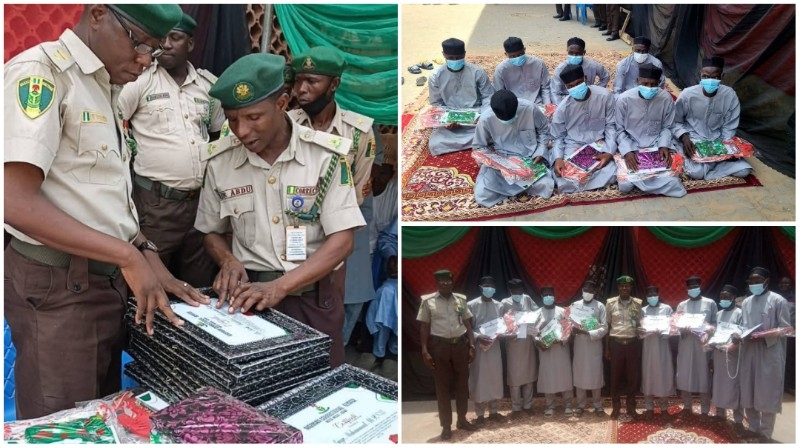
Inside the high walls of the Medium Security Custodial Centre in Wudil, a quiet but powerful transformation is unfolding. Nine inmates, once defined by their crimes, now carry a different title: huffaz — those who have memorised the entire Holy Qur’an.
For some, the journey began with barely a verse. When they entered MSCC Wudil, many could not recite more than a few chapters. Today, after months of discipline, daily recitation, and guidance from correctional staff and Islamic instructors, they can recite the 114 chapters of the Qur’an from memory.


“It was not easy,” said one of the inmates, his voice low but steady. “But in this place, I found purpose. The Qur’an gave me peace I never had before.” Another, who had spent three years in custody, said memorising the Qur’an had become his anchor. “I used to think my life was over. Now I know it can still have meaning.”
Their achievement was celebrated on Saturday during an event that marked both their spiritual milestone and the 50th anniversary of MSCC Wudil — five decades of custodial service, rehabilitation, and hope.
The atmosphere was a mix of pride, reflection, and quiet joy. Families, religious leaders, and officials gathered under the shade of the centre’s courtyard as the nine inmates recited portions of the Qur’an before an audience that included correctional officers, academics, and government representatives.
For Controller of Corrections, Kano State Command, Ahmed Yusuf Lakpene, the moment represented the true spirit of the Correctional Service Act, 2019. “This is what reformation looks like,” he said. “When an inmate leaves here not just as a free person, but as someone with skills, discipline, and a renewed sense of responsibility.”
MSCC Wudil has long been regarded as a model facility in Kano. Beyond custodial duties, it has built a reputation for education and vocational training programmes that equip inmates with skills for life after prison. Over the years, hundreds have left with certificates in carpentry, tailoring, and basic literacy — tools that help them reintegrate into society rather than return to crime.
The Officer-in-Charge of MSCC Wudil, CSC Ibrahim Wada Ibrahim, described the dual celebration as proof that rehabilitation works when given the right environment. “Leadership and commitment matter,” he said. “When inmates are treated with dignity and given opportunities to learn, they respond.”
The Vice Chancellor of Aliko Dangote University of Science and Technology, Wudil, Prof. Musa Tukur Yakasai, who attended the ceremony, said such initiatives were reshaping public perception of correctional centres. “These men are not just being detained. They are being prepared to contribute positively to society,” he noted.
For the Kano State Government, the event was also a reminder of its responsibility toward inmates’ welfare. Chairperson of the Kano State Prerogative of Mercy Committee, Hajiya Azumi Namadi Bebeji, praised Governor Abba Kabir Yusuf for his support of inmate rehabilitation programmes. She congratulated the nine hafiz and urged them to hold on to the discipline they had cultivated. “Continue to pray for the peace and progress of Kano State,” she told them. “You now have a responsibility to be ambassadors of change.”
The story of the nine inmates is more than a religious milestone. It is a human story — of second chances, of dignity restored, and of the belief that no one is beyond redemption. In a society quick to label and discard, MSCC Wudil is showing that even behind bars, lives can be rebuilt.
As the centre marks 50 years, its message is clear: correction is not just about confinement. It is about correction of character, restoration of hope, and preparation for a future beyond prison gates.

