
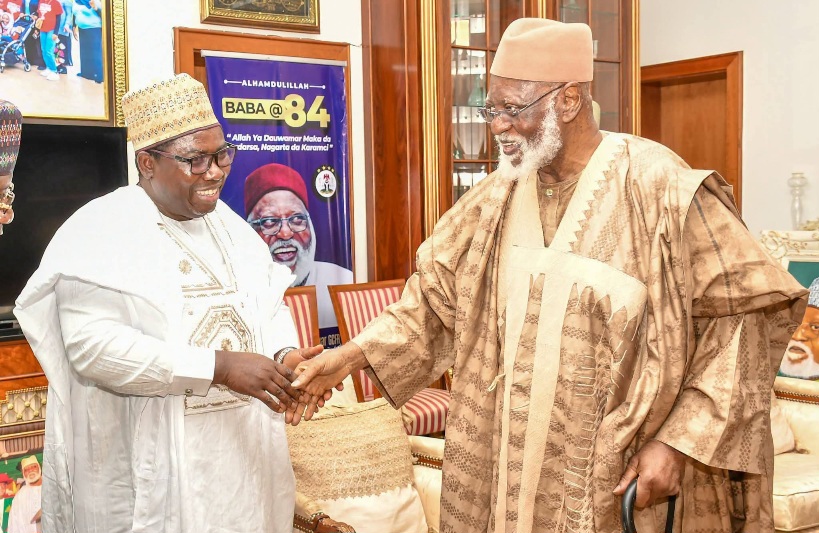
The Independent National Electoral Commission (INEC) has reassured Nigerians that their votes will count in forthcoming elections, as former Head of State and Chairman of the National Peace Committee (NPC), retired General Abdulsalami Abubakar called on Nigerians to rally support behind the Commission ahead of the 2027 General Election.
The assurance was given by the INEC Chairman, Prof. Joash Amupitan, SAN, during a courtesy visit to General Abubakar at his residence in Minna, Niger State, on Friday 24th July, 2026, where he led a delegation comprising National Commissioners, the Secretary to the Commission, Directors and Technical Aides of the Chairman.


In his remarks, Prof. Amupitan described General Abubakar as the father of democracy in Nigeria, noting that his transition to civilian rule in 1999 marked a defining moment in the country’s democratic history.
He said the Commission regarded the former Head of State not merely as a statesman but as a pillar of support for INEC.
The INEC Chairman commended General Abubakar’s role as Chairman of the National Peace Committee, describing his Peace Accord initiative as a moralising influence on Nigeria’s political ecosystem.
He said the initiative had, over the years, provided political actors with a platform to commit to non-violence, thereby strengthening the sovereignty of the will of the Nigerian people.
Prof. Amupitan described the visit as a pilgrimage of appreciation for General Abubakar’s contributions to peaceful coexistence, peaceful elections and democratic stability in the country, and further congratulated him on his recent 84th birthday anniversary.
Prof. Amupitan told the former Head of State that regardless of the pressures confronting the Commission, INEC remained committed to ensuring that the will of the Nigerian people, as expressed at the Election, would prevail.
He said the Commission’s determination under his leadership was to see ordinary Nigerians go out and vote, confident that their votes would be duly counted and reflected in the outcome of elections, describing this as the core assurance INEC owed the electorate.
The INEC Chairman used the occasion to formally confirm that the Presidential and National Assembly election would hold on 16 January 2027, while the Governorship and State Houses of Assembly election would take place on 6 February 2027.
Responding, General Abubakar commended the Commission’s leadership and described the INEC chairmanship as one of the most demanding positions in the country, given the divergent expectations of political actors regardless of whatever direction the Commission takes.
He called on Nigerians to support the Commission and its leadership, stressing that the success of the nation’s democracy depended on the cooperation and confidence extended to INEC by the citizenry and political stakeholders alike.
General Abubakar expressed confidence in Prof. Amupitan’s leadership, urging him to remain firm and impartial in the discharge of his duties, and assured the Commission of his continued support and prayers ahead of the 2027 General Election.
The INEC Chairman thanked General Abubakar for his continued goodwill towards the Commission and reiterated that INEC would spare no effort in delivering free, fair and credible elections in 2027.
Earlier in the day, the INEC Chairman had held an interactive session with staff of the Commission’s Niger State office, where he echoed the same message of commitment to Nigerians, telling personnel that their diligence and integrity in the field were central to ensuring that every vote cast would count.
He described the staff as the grassroots foot soldiers of the Commission and charged Electoral Officers and other field officials to see themselves as ambassadors of INEC, noting that public confidence in the electoral process depended significantly on their conduct at the point of service.
Prof. Amupitan also used the visit to the Niger State office to restate the Commission’s commitment to improving staff welfare, disclosing that a review of welfare packages was underway following his observation that conditions met on assumption of office were among the poorest compared to other public institutions.

