
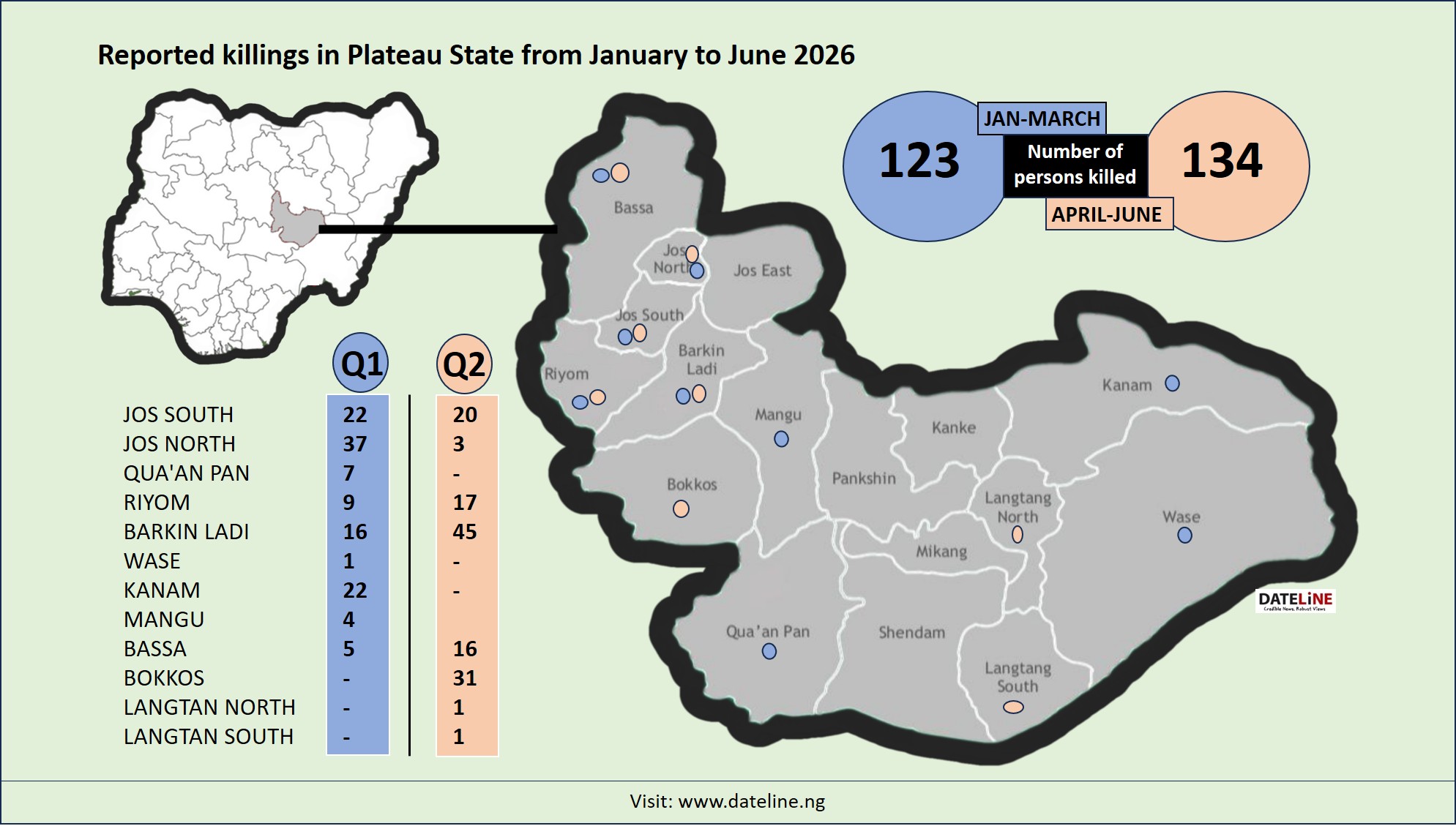
Three months after President Bola Ahmed Tinubu vowed to end the deadly violence plaguing Plateau State in North Central Nigeria and restore it to the path of peace and hospitality, attacks have intensified and spread to new areas. The spike and diffusion of violence coincide with a rise in killings and reprisals that risk prolonging the cycle of bloodshed, Dateline Nigeria’s investigation shows.
An analysis of incidents between April and June (Q2), as reported by the media, indicates a 21.9 percent casualty increase in eight local governments, as deaths jumped from 123 in Q1 (January to March) to 134 in Q2. The escalation of the violence, in spite of Tinubu’s orders, stresses a misdiagnosis of its root causes, leaders of community associations and a peace advocacy organization told us.


President Tinubu promised to halt bloodshed in Plateau during his visit to the state on April 2, following a deadly attack on March 29 in Angwan Rukuba that killed at least 30 residents. The president, while addressing state government officials, security forces, and families of victims, stated that such attacks “will not repeat itself.”
“There is nothing I can give you, whether in billions, that can replace the lives lost. But we will do everything possible to ensure that such tragedy does not happen again,” he added.
Tinubu charged security agencies to “unearth the perpetrators” of the attack and ordered the immediate installation of over 5,000 artificial intelligence (AI)-enabled surveillance cameras in the state, to help law enforcement agencies track criminals in real-time and prevent future attacks.
A total of nine local governments comprising Jos South, Qua’an Pan, Riyom, Barkin Ladi, Wase, Kanam, Mangu, Bassa, and Jos North had experienced violence in the form of attacks by herders, ethnic militias, vigilantes, or criminals prior to President Tinubu’s promise.
Security experts have implicated a range of actors for fueling the violence in Plateau, among them armed bandits, ethnic militias, local vigilantes, and criminal groups.
Dateline’s tracking of incidents that took place in Q2, which is after Tinubu’s visit, indicates a general rise in violence across multiple local government areas. Although only about eight local governments experienced attacks in Q2, which represents a slight decrease in the number of territories affected, the higher fatalities recorded highlight a greater impact of violence. Sharp increases in attacks were recorded in Jos South, Riyom, and Barkin Ladi local governments. Compared to the four incidents that were reported for each of them in Q1, the figures tripled for Riyom with 14 and Barkin Ladi with 18, while Jos South recorded eight.
The number of deaths in the attacks also rose to 20 in Riyom from nine that were documented in Q1. The same was true for Barkin Ladi, where deaths increased significantly to 43 against the 29 in Q1.
In parallel, Q2 saw violence diffusing into territories unaffected in Q1. This means that for the first time in 2026, local government areas such as Bokkos, Langtang North, and Langtang South experienced attacks that resulted in casualties. Bokkos, which had remained volatile throughout 2025, recorded its first resurgence of violence in 2026 in Q2. Gunmen killed 29 people within the space of three months — the largest casualties came from a single attack on June 21 in Kawel village under Mushere district, when gunmen killed 22 residents, among them farmers, health workers, and security personnel.
In contrast to Bokkos, Langtang North and Langtang South lost a single individual each. Although they involved fewer people, the attacks, however, signal an emerging pattern of targeting community leaders in the second quarter. In the separate attacks, gunmen killed a traditional ruler, Ponzhi Kwallak, in Langtang North, and a former councilor in Langtang South.
Another pattern of attack that gained prominence in Q2 is the deliberate targeting of security forces and vigilante members. Following closely is a spike in attacks on herding communities and cattle, which are broadly seen as reprisals. Some of the most prominent assaults on security personnel included the attacks that led to the killing of a soldier at the Federal College of Land Resources Technology, Vom, on April 11, and the killing of two soldiers and a policeman at the National Institute for Policy and Strategic Studies (NIPSS), Kuru, in Jos South, on June 15, after gunmen stormed the apex think-tank and policy research institution, killing two soldiers and one policeman.
In spite of the documented spikes and spread of violence, Wase, Kanam, Mangu, and Bassa local governments bucked the trend by recording no single killing in Q2. This represented a marked shift from Q1, when attacks left a staggering 32 deaths across the four local governments, with most of the casualties coming from Kanam, which lost 22 deaths.
Both the chairman of the Miyetti Allah Cattle Breeders Association (MACBAN) in Plateau, Ibrahim Yusuf Babayo, and the national publicity secretary of the Berom Youth Moulders Association (BYM), Rwang Tengwom, told us that the escalations were not unexpected, notwithstanding Tinubu’s promise and directives.
Yusuf argued that the political leadership in the state has to promote dialogue among the parties involved in the crisis, as was the case under the last administration of Simon Bako Lalong. “When Lalong summoned Fulani and Berom over the crisis and they sat and talked, that helped restore peace,” he said.
According to Tengwom, the attackers have sprung from an identified “safe haven” over the last 20 years and raided communities at night. Any effort at tackling the violence must first dismantle those known hideouts used by the alleged perpetrators, he said.
The youth leader also called for the establishment of a Civilian Joint Task Force, so that the locals’ knowledge of the geography can be leveraged to track and dislodge violent actors.
Both leaders observed that the directive for immediate installation of surveillance cameras had not been implemented over three months after it was given.
The Programmes Manager for Dialogue, Reconciliation and Peace Centre (DREP), Jerry Bulus, emphasized the need for addressing the vexatious issue of indigene and settler in the state. He advocated for a proper language of describing residents that is devoid of the narratives that fuel tensions.
“The indigenes think they are being pushed out of their homes and the settler believes there is an attempt to dislodge them from the property they acquired,” he said, elaborating the picture of mutual suspicion among residents. “There needs to be a clear description of people and punishment for crimes,” he said.

