
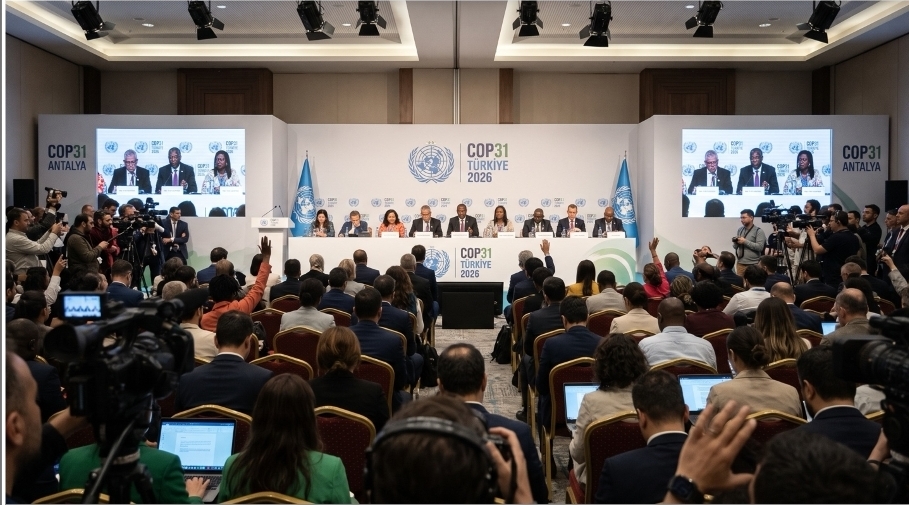
Every November, the world’s diplomatic machinery converges to negotiate the survival of our planet. Yesterday, Sunday, November 22, 2026, the 31st Conference of the Parties (COP31) to the United Nations Framework Convention on Climate Change (UNFCCC) concluded in Antalya, Türkiye, not with celebratory gavels, but with an unprecedented diplomatic breakdown after nearly 48 hours of overtime negotiations.
For Nigeria, a nation simultaneously grappling with coastal erosion in the south, desertification in the north, and heavy economic reliance on hydrocarbons, understanding both the architecture of these summits and the fallout from Antalya is critical for our national growth and ecological survival.


The Origins, Objectives, and Ratifying Parties of COP
The Conference of the Parties (COP) is the supreme decision-making body of the UNFCCC, an international environmental treaty adopted at the 1992 Rio Earth Summit that entered into force in 1994. Its foundational objective is simple yet monumental: to stabilize greenhouse gas (GHG) concentrations in the atmosphere at a level that prevents dangerous human-induced interference with the climate system.
Since the inaugural COP1 in Berlin in 1995, the summit has convened annually to assess global climate progress and negotiate legally binding frameworks. Today, the UNFCCC enjoys near-universal membership, with 198 Parties (197 states plus the European Union) having ratified the Convention. Under the landmark 2015 Paris Agreement, ratified by 194 Parties, nations committed to limiting global warming to well below 2°C above pre-industrial levels, while pursuing efforts to cap it at 1.5°C.
Three Decades of Successes and Persistent Challenges
Over thirty-one sessions, the COP process has delivered major institutional milestones:
- Binding frameworks: From the 1997 Kyoto Protocol (which introduced mandatory emissions targets and carbon trading for industrialised nations) to the 2015 Paris Agreement (which established Nationally Determined Contributions, or NDCs, for all countries), COP created the global rulebook for climate governance.
- Financial mechanisms: Successive summits birthed the Green Climate Fund, operationalised carbon markets under Article 6, and established the Loss and Damage Fund at COP27 in Egypt to compensate vulnerable nations, largely African and Asian countries for irreversible climate destruction.
However, the process remains plagued by structural challenges. Because UNFCCC rules require unanimous consensus, a single country’s objection can derail years of diplomacy. Geopolitical rivalries, disputes over historical responsibility between developed and developing economies, chronic shortfalls in pledged climate finance, and resistance from fossil-fuel-dependent states have consistently widened the gap between diplomatic promises and planetary reality.
COP31 Concludes in Türkiye After the Longest Summit and Deepest Divide
Billed by co-presidents Türkiye and Australia as an Implementation COP meant to turn pledges into action, COP31 (November 9–22, 2026) instead became the longest climate summit in UN history, ending in deadlock.
In the final plenary on Sunday, COP31 President Murat Kurum confirmed that the summit’s final cover decision could not be adopted. Talks collapsed over two irreconcilable fault lines:
- The fossil fuel standoff: A coalition led by the European Union, the United Kingdom, Norway, and Canada outright rejected the final draft text because it omitted explicit commitments to transition away from fossil fuels.
- Climate finance deficits: Developing nations, including the African Group of Negotiators (AGN), expressed deep frustration over weak, non-binding guarantees for adaptation and loss-and-damage financing. Compounded by the absence of a formal United States delegation for the second consecutive year following its withdrawal from the Paris Agreement, consensus proved impossible.
Yet, amidst the diplomatic gridlock, non-state and targeted initiatives still emerged, most notably the launch of a new global foundation and Coordinated Trust platform designed to channel climate finance directly to frontline, locally led organisations rather than trapping funds in bureaucratic bottlenecks.
Why COP31 Matters for Nigeria’s Growth and Climate Resilience
For Nigeria, the collapse of a formal cover text in Antalya is not an abstract diplomatic failure; it directly impacts our economic trajectory, energy security, and biodiversity:
- Financing Nigeria’s NDC 3.0 and green growth: Under our updated Nationally Determined Contribution (NDC 3.0), Nigeria has pledged to cut greenhouse gas emissions by 32.2% by 2035 (against 2018 levels), boost renewable electricity generation from 22% to 52%, end gas flaring by 2030, and achieve net-zero by 2060. Achieving this requires massive capital, estimated at over $336 billion across mitigation and adaptation, with Nigeria actively seeking $20–$25 billion by 2030 alongside operationalising our National Carbon Market Framework. Without stronger multilateral finance mandates from COP31, Nigeria must aggressively leverage bilateral green investments, private-sector capital, and domestic carbon markets to fund clean energy and avoid stranded fossil fuel assets.
- Protecting frontline communities and biodiversity: Nigeria loses roughly four million hectares of forest annually to deforestation, threatening critical ecosystems from the Hadejia-Nguru Wetlands and Sudano-Sahelian savannas to the Niger Delta mangroves. While national negotiators stalled in Antalya, the new global foundation launched at COP31 offers a direct lifeline for grassroots conservationists, traditional institutions, and local communities in the Niger Delta and arid northern states to access funding for ecosystem restoration, mangrove protection, and community-led adaptation.
- Addressing urgent climatic threats: From worsening coastal surges threatening Lagos and the Niger Delta to erratic rainfall and Lake Chad shrinkage driving farmer-herder conflicts and food insecurity, Nigeria cannot afford to wait for global consensus. The failure of COP31 underscores a hard truth: international treaties will not automatically rescue vulnerable ecosystems.
As the global climate spotlight now shifts toward Africa ahead of COP32 in Ethiopia next year, Nigeria must treat the Antalya deadlock as a wake-up call. True resilience will come from enforcing our domestic environmental laws, halting commercial deforestation and wildlife exploitation, scaling decentralised solar energy, and empowering local conservation stewards on the ground.
- Dr. Abubakar S. Ringim is the Executive Director of Wild Hausa Limited and an environmental conservation scholar. ‘Planet and People Today’ is a biweekly column published in partnership with Dateline Nigeria to promote environmental literacy, biodiversity preservation, and public policy dialogue.

