
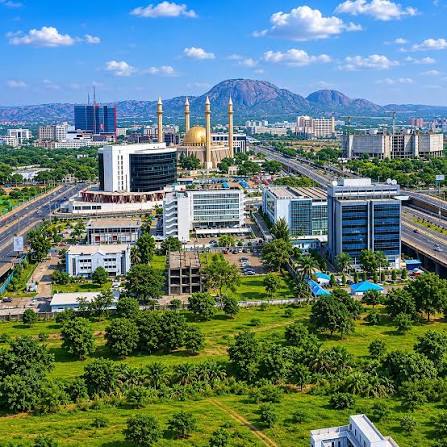
Conceived as a garden city, Abuja was envisioned as a pristine capital where modern architecture would blend seamlessly into lush, rolling green hills.
When the Federal Capital Territory (FCT) was established in 1976, its master plan strictly mandated preserving at least one-third of the landmass as green zones.


These spaces were designed as vital ecological buffers to absorb floodwaters, regulate rising urban heat, and safeguard the local environment.
Yet, decades of weak regulatory enforcement, systemic land misuse, and political pressure have allowed concrete developments to erode these protected corridors.
Similarly, years of rapid urbanisation, illegal structures, and unchecked deforestation have eroded that founding vision, turning the once-vibrant ecological corridors into concrete stretches.
What once made Abuja unique among African capitals – its harmony between nature and development, is steadily being replaced by unchecked concrete expansion.
For instance, recent research shows that Abuja’s designated green areas have severely shrunk, dropping from a 42 per cent green space ratio in the original master plan in 1990 down to roughly 17.9 per cent in 2023.
This development has led to a public outcry by urban planners, civil society groups and residents over what they described as “green genocide”, where protected parks, utility corridors, and natural buffers were systematically paved over.
Laraba Rikko, a Professor of Urban and Regional Planning at University of Jos, described Abuja’s shift towards a concrete jungle as an “experiential crisis in urban planning”.
Acknowledging public scepticism regarding whether town planners even exist in the city, Rikko attributed the perception to a lack of visible planning impacts.
She also pointed to unapproved building plans, weak enforcement, political interference, corruption, and a breakdown of professional ethics as core drivers of the decay.
The professor challenged professionals to take full accountability, emphasising that every official signature and approval either protects or undermines the capital city.
Mrs Zaliha’u Ahmed, former acting Executive Secretary of the Federal Capital Development Authority (FCDA), noted that the Abuja Master Plan was originally designed around a “garden city” concept, where nature and infrastructure coexist.
Ahmed, a town planner, however, expressed deep concern over widespread felling of trees and illegal commercial activities taking over buffer zones.
She warned that these departures threaten the city’s identity and core plan, urging professional bodies to sanction members who facilitate illegal approvals.
Similarly, Chairman of the Nigerian Institute of Town Planners (NITP), FCT Chapter, Mrs Queen Phillips, argued that non-adherence to planning standards contributes to the steady disappearance of green areas in Abuja.
Philips called for urgent action to halt the loss of green spaces in the FCT, through enforcement of strict adherence to the Abuja Master Plan.
According to her, professional standards, ethical practice, and regulatory compliance remain non-negotiable for orderly development.
Aligning with Philips’ view, experts insist that restoring Abuja’s green spaces hinges on decisive policy shifts: enforcing regulations strictly, integrating climate strategies, and holding statutory bodies accountable for urban conservation.
Lately, the FCT Administration under Minister Nyesom Wike, has come under intense criticism, accusing it of converting designated green areas, parks and natural drainage channels into residential or commercial developments.
The criticism reached a new height when parts of the capital city, including some collector roads and major highways experienced flash floods.
Some critics specifically pointed at Wike as the enabler, accusing him of allocating green areas and water ways to his friends and cronies to build estates and other commercial structures.
Responding, the minister denied the claims and challenged the accusers to produce verifiable evidence and building approvals.
He also pointed out that flooding is a global issue driven by climate change that affects even developed nations like the U.S., England and the United Arab Emirate.
The minister, however, agreed with Rikko on the man-made causes through illegal developments, unauthorised conversion of public green areas into commercial parks and indiscriminate dumping of refuse into drainage manholes.
To address the challenge, the minister directed the FCT Department of Development Control to demolish all structures built on water channels across the territory.
Wike, who gave the directive when he inspected some of the flood-affected areas in Maitama District, declared that “no big man or senator will be spared”.
He said that the recent flooding in parts of the nation’s capital was heavily aggravated by man-made factors, particularly illegal developments blocking natural drainage channels.
“People, by their positions, have blocked water channels, believing that nothing will happen; I have told people that nothing happened yesterday does not mean that something will not happen today.”
“You have done your own by blocking the water channel and nothing has happened. Thank God the flood has come and has drawn our attention to the place; now something will happen; I am going to bring those houses down.
“Any house found on the water channel will go down. Some of the owners of those houses are senators; some of them are big men.
“Heaven will not fall; rather, Heaven will be at peace that the right thing has been done.”
Wike reiterated the FCT Administration’s commitment to tackling the man-made factors, stressing that the developments were allowed by previous administrations that lacked the political courage to enforce the Abuja Master Plan.
“Those houses are not houses that were built in hours; those houses were there eight to 10 years ago.
“Previous administrations may not have had the political will. Officers of government may not have been encouraged to do what they are supposed to do. I have the political will to tackle those man-made factors.
“It doesn’t matter who is responsible. It doesn’t matter how highly placed you are. My interest is to continue to do the right thing in the city, and we will not stop.”
Expressing outrage at how green areas across the territory have been taken over by car dealers, Wike announced a crackdown on unauthorised dealers operating in Abuja’s designated green areas.
He added that a task force had been constituted to enforce the total removal crackdown.
Wike advised vehicle sellers to secure legitimate commercial properties for their operations, stressing that the administration would no longer tolerate the misuse of spaces earmarked for ecological balance and public recreation.
The minister blamed the development largely on corrupt elements within the civil service, who issued fraudulent allocation papers to unauthorised operators without approval.
To demonstrate his resolve to reverse the trend, the minister disclosed that the Director of Urban Planning was queried for granting approvals that allowed car dealers to convert designated green zones into auto sales lots.
The minister further suspended a director in the FCDA for allegedly granting building approval on water ways illegally.
“This reflects an ongoing crackdown aimed at holding government officials accountable for issuing fraudulent building permits that compromise public safety,” he said.
To support the minister’s efforts, Nigerian and Ethiopian youths have joined forces to tackle climate change, deforestation and soil degradation in the FCT through a collaborative tree-planting exercise tagged, “Plant Africa Fraternity.”
The move, under the FCT Administration-Ethiopia youths tree planting initiative was themed, “Youth United for a Greener FCT: Renewing Hope through Tree Planting”.
Dr Adedolapo Fasawe, Mandate Secretary, FCT Health Services and Environment Secretariat, said that the planting of Ethiopian indigenous trees in Abuja was a symbol of friendship and common commitment to make Abuja green again.
Fasawe reiterated Wike’s commitment to expanding green spaces and combating climate change.
To further mitigate flood risk during the peak of the rainy season, Wike directed a city-wide desilting of drainage channels.
While inspecting the clearance operations along the Airport Expressway, acting FCDA Executive Secretary, Mr Richard Dauda, explained that the Abuja Master Plan inherently recognises certain areas, including the Airport Expressway axis as flood plains.
He said that while resilient infrastructure was originally built to handle high water volumes, human activities have severely compromised its efficiency.
Dauda also highlighted two major human factors aggravating the flash floods: illegal development and widespread infrastructure vandalism.
He decried the theft of metal gully inlet covers by vandals, which allows large debris to flow directly into underground drains instead of being sieved at the surface.
To permanently curb the theft, Dauda revealed plans by the FCDA to explore replacement materials made from non-recyclable compounds rather than steel or cast iron.
Experts argue that transforming Abuja into a lush, eco-friendly haven requires a careful balance between strict urban planning to protect natural green corridors and grassroots community conservation.
They believe Abuja can still become a model for sustainable cities in West Africa, provided it begins treating green infrastructure as an essential public utility rather than just a decorative feature. (NANFeatures)

