
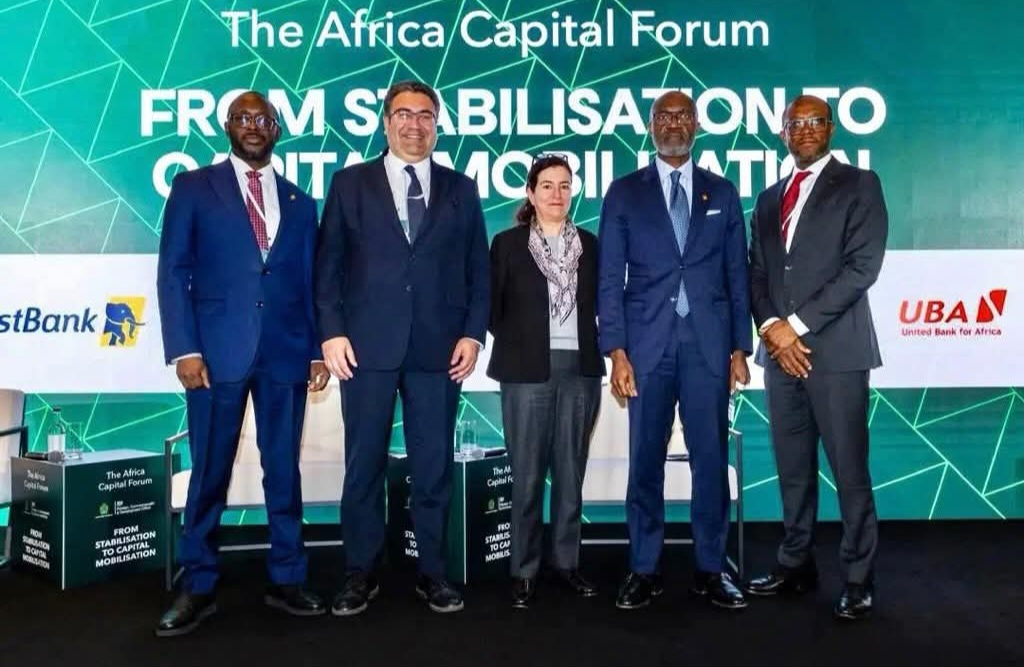
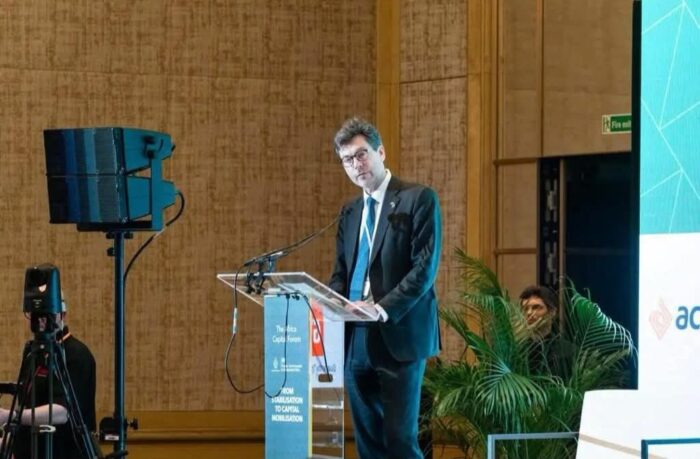
Speakers at the Africa Capital Forum, the theme: “From Stabilisation to Capital Mobilisation” jointly hosted by the Central Bank of Nigeria (CBN) and the UK Foreign, Commonwealth and Development Office (FCDO), at The Peninsula London, on the sidelines of the State Visit of President Bola Ahmed Tinubu to the United Kingdom, have severally commended the reforms in the Nigerian financial sector as credible.
Speaking at the high-level forum, which brought together global investors, development financiers, and fintech innovators for a strategic dialogue to deepen Nigeria’s financial resilience and investor confidence, the British Deputy High Commissioner to Nigeria, Mr. Jonny Baxter, said the United Kingdom remained one of Nigeria’s partners with links in banking and capital markets.
“The next phase of the reforms should be converting renewed investor interest into long-term sustainable investments,” Baxter said, adding that the UK will also support economic transformation to enhance the economic relationship between the two countries.
In her remarks, the President of the European Bank for Reconstruction and Development (EBRD), Madame Odile Renaud-Basso, praised the potential of the Nigerian economy, noting that “we see all the potential in the economic stabilisation in Nigeria, the growth of the population, the appetite, the investment of new technologies, and the ability of the people to embrace the new technologies.”
The Head of West and Central Africa, UKEF, Steve Gray, in his contribution, noted that “Confidence is built through full fiscal transparency. But the reforms in Nigeria are providing transparency and building confidence. “I want to see more reflection of the reality of Nigeria’s strengths so that more can be done to support Nigeria’s priorities,” Gray added.
Also speaking, the Managing Director (Policy Strategy and Delivery) of the European Bank for Reconstruction and Development (EBRD), Melis Ekmen Tabojer, said: “The recent reforms that Nigeria has had have had a huge impact in attracting investors and how policies are made.”
Mrs Sanyade, Okoli, Special Adviser to the President on Finance and the Economy, who represented the Minister of Finance and the Coordinating Minister of the Economy, Mr. Wale Edun, at the event, said the Nigerian government seeks to drive the right quality of growth, but noted that the government alone cannot fund this growth. “We need to work with partners who will bring the sticky, equity capital,” she noted.
Key sessions of the forum featuring the CBN Deputy Governors Dr. Muhammad Sani Abdullahi (Economic Policy) and Mr. Philip Ikeazor (Financial System Stability) among other subject matter experts, examined repricing risk and the reopening of capital markets, Nigerian banks’ presence on the global stage, Fintech and the future of remittances, highlighting the rise of digital platforms, as well as regulation, risk, and resilience.
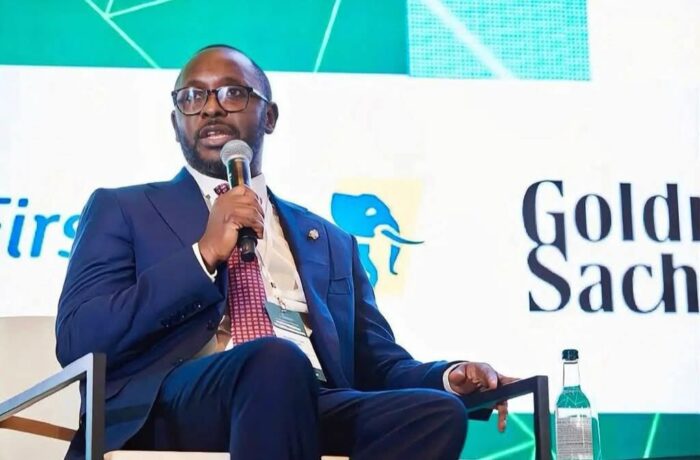
The Central Bank Deputy Governor (Economic Policy), Dr Muhammad Sani Abdullahi, emphasised the level of stability achieved by the CBN, noting that net and gross reserves are high, foreign reserves are over $50bn, the foreign exchange market has stabilised, and inflation is falling, but we are cautious.
Also speaking, the Bank’s Deputy Governor in charge of Financial System Stability, Mr Philip Ikeazor, said that all the reforms that have been put in place are such that they cut across stakeholders, ensuring that even at the end of this particular administration, people will see the need not to reverse these reforms.
In their respective interventions, Segun Alebiosu (MD/CEO of First Bank); Oliver Alawuba (MD/CEO of the United Bank for Africa (UBA); Miriam Olusanya (MD/CEO of GTCO); Yemisi Edun (MD/CEO of First City Monument Bank); Roosevelt Ogbonna (MD/CEO of Access Bank); and Akin Oguranti, the Executive Director of Zenith Bank, who represented the bank’s Managing Director, all commended the banking reforms in Nigeria, noting that the reforms have increased confidence in the economy and allow the banks to fund more projects locally.
Over the past two years, Nigeria has undertaken significant monetary and structural reforms aimed at stabilising its macroeconomic environment. Under the leadership of CBN Governor Olayemi Cardoso, inflation has dropped sharply from 34 per cent to 15 per cent, exchange‑rate volatility has eased, and foreign reserves have risen above US $50 billion. Banking recapitalisation and foreign‑exchange market unification have further strengthened trust in policy consistency.
The Forum assessed the impact of these reforms and highlighted new opportunities for long-term capital mobilisation and diaspora investment.
Framed around three pillars (Nigeria’s macroeconomic reset, strengthening the financial system, and mobilising global and diaspora capital), the Africa Capital Forum seeks to build stronger bridges among Abuja, London, and the global financial community.

