
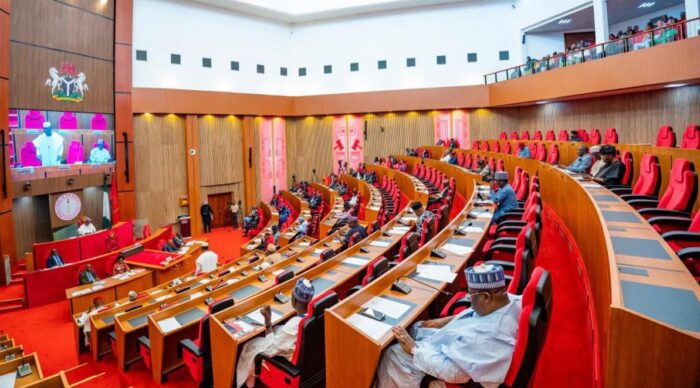
The Senate on Tuesday passed the 2026 revised Appropriation Bill seeking to authorise the expenditure of N65.18 trillion for second reading.
The bill, transmitted by President Bola Tinubu, seeks to repeal and re-enact the 2026 Appropriation Act to align government expenditure with available resources and existing financial obligations.


The proposed N65.18 trillion budget represents a reduction of about N3.15 trillion from the N68.32 trillion approved by the National Assembly for the 2026 fiscal year.
In his letter to the Senate, read by Senate President Godswill Akpabio, Tinubu said the proposed adjustments were necessary to reflect current fiscal realities and ensure the orderly implementation of government programmes.
He explained that the revised budget would accommodate certain expenditures incurred by the Nigerian National Petroleum Company Ltd. on behalf of the federation.
“It will also address under-provided debt-service obligations and recognise issued capital warrants and supplementary commitments,” he said.
The president said the revised capital provisions would prioritise the completion of critical road projects, protection of agricultural production, reduction of production costs, improved farm yields and enhanced market access.
Leading debate on the bill, Senate Leader Opeyemi Bamidele drew attention to the proposed fiscal deficit of 5.64 per cent of Gross Domestic Product (GDP), noting that it exceeded the three per cent benchmark stipulated under Section 12 of the Fiscal Responsibility Act, subject to statutory provisions and exceptions.
He urged the relevant committees to establish the legal and economic justification for retaining the deficit at that level and ensure that the revised fiscal framework complied with existing laws.
Bamidele also called for scrutiny of the projected N33.72 trillion revenue, N26.23 trillion capital expenditure and outstanding contractual obligations.
He cautioned against making budgetary provisions without corresponding implementation capacity, stressing the need to prioritise the completion of existing projects rather than embarking on new ones without guarantees of completion.
“One of the greatest challenges confronting our public financial management system is not always the absence of budgetary provisions, but the gap between appropriation and actual implementation,” he said.
Supporting the bill, Chairman, Senate Committee on Appropriations, Sen. Solomon Adeola, described the proposed review as an effort to reposition the budget for more effective and efficient implementation.
He assured the senate that his committee would submit its report within one week.
NAN reports that this prompted Akpabio to consider suspending plenary to enable the 73-member committee to concentrate on the assignment.
Akpabio said the exercise was a national priority that required lawmakers to put politics aside.
“We do not have time to waste,” the senate president said, adding that the revised budget was intended to align government priorities with current realities and ensure that social services received the necessary attention.
Sen. Garba Maidoki (Kebbi South), while supporting the review, appealed for adequate funding of constituency projects and ongoing infrastructure interventions in rural communities.
Maidoki specifically requested the inclusion of the Birnin Yauri-Zuru Road project in Kebbi, arguing that the two billion Naira previously appropriated for the road was inadequate.
He said the completion of the road would help reduce incidents of banditry and other criminal activities along the route.
Akpabio, thereafter, directed the Appropriations Committee chairman to liaise with the Budget Office to ensure that the project was captured in the revised budget.
The bill was subsequently referred to the Senate Committee on Appropriations for further legislative consideration, with a directive to report back within one week.
Meanwhile, the senate has adjourned plenary till Dec. 1 to enable the committee to conclude its assignment. (NAN)

