
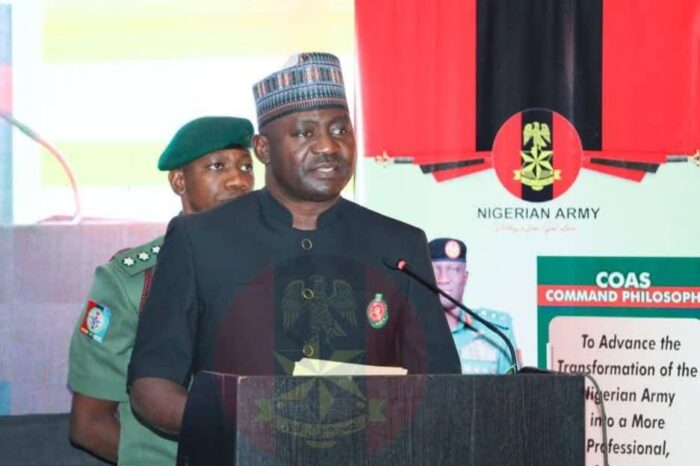
The recent appointment of General Christopher Musa as the new Minister of Defence by President Bola Tinubu must have been informed by certain critical considerations. As the immediate past Chief of Defence Staff (CDS) who, therefore, reached the pinnacle of his career and whose political disposition, even while in uniform, was favourable to the ruling All Progressives Congress (APC), he must have endeared himself to the influencial minds in the government o deserve such a rare recognition at this time of extreme security challenges.
Beyond his unblemished past records as a military man are some realities that have continued to define his personality. A lot of those Nigerians who are not within the official circles, but whose understanding is inherently critical to any fair assessment of professional conduct and social relations of individuals, care more about the social, ethnic and religious components of the foundation upon which his personality rests than his career.


Both the lingering insecurity and the fight against it have a lot of dimensions, each of which requires thorough analysis and effective practical approach. Musa’s metamorphosis from a tough military chief to a civilian and even political party chieftain has quickly given rise to some legitimate expectations regarding the kind of engagement he, as defence minister, will or should have with the various categories of Nigerians.
As a Sokoto-born Kaduna indigene of both Atyaf extraction and Christian faith, the new defence minister is definitely an exceptional person with whom each of the diverse segments of the Northern and, by extension, Nigerian population is genuinely connected. He is more than just a warrior to whom weaker forces may have to submit, but now also a key functionary of government who, in one way or another, belongs to some of the most critical communities in Nigeria.
A soldier of his calibre who is now in charge of security and defence matters, though currently a politician, he, of course, must have to prioritize war against the country’s external and internal enemies. He will naturally consider any more perpetration of violence as an attack on his pride as a trained fighter.
It is even this disposition, which he consistently manifested while in uniform, that is the cause of his popularity among most Nigerians. As victims of various forms of terrorism, people in the North and many other locations have openly and understandably continued to celebrate the appointment of such a battle-ready commander who is also everybody’s brother as the next chief security officer after the president.
It is believed that the multiplicity of his backgrounds and orientations should make him broad-minded enough to appreciate diversities, conscientised enough to demonstrate fairness and conscious enough to identify and abort divisive plots. The appreciation he expressed for the widespread excitement that greeted his appointment was an indication of a readiness for the maximum discharge of responsibilities.
Musa’s consistent call on Nigerians to take part in the fight against terrorism as, according to him, “security is everybody’s business” will hopefully be widely heeded because the confidence in him cuts across all the real and even perceived barriers. The combination of his religious belief which he shares with those Christians who allege ”genocide’ against them, kinship with the Northern minorities who complain of marginalization and bond with Hausa/Fulani Muslims has already translated into an entitlement that should fetch huge support for him.
The unified backgrounds out of which he has emerged are, in other words, a powerful factor that, unless if he changes styles, will effectively compel all categories of Nigerians to patriotically take ownership of the processes of de-escalation of violence and de-radicalisation of the perpetrators. This is a special fact that has made him correspondingly special.
- Shuaibu Gimi [email protected]

