
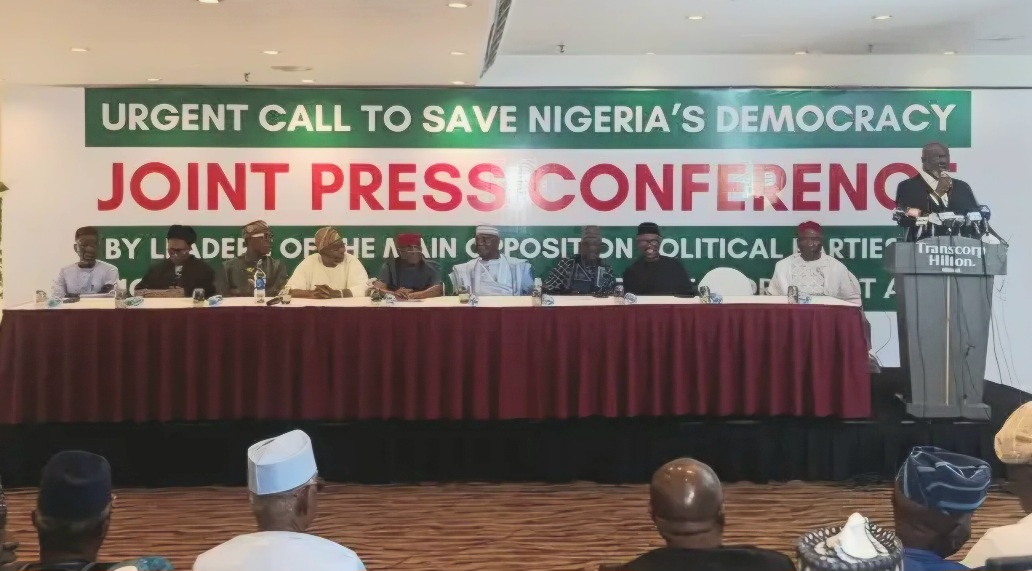
On February 26, 2026, the opposition held a world press conference.
In a healthier democracy, that would be routine. In Nigeria’s current political climate, it felt almost seismic – not because of what was said, but because of what had not been said for so long. For months, perhaps longer, Nigerians have endured an era of accelerated economic and political recalibration. Policies have moved swiftly. Executive initiatives have advanced with striking legislative efficiency. Decisions with far-reaching consequences have been taken in rapid succession. The tempo of governance has been relentless. And yet, for much of that period, the institutional opposition appeared hesitant – cautious to the point of invisibility.


Citizens bore the brunt. The market absorbed the shock. Families recalculated their survival strategies. Businesses adjusted payrolls. Young graduates recalibrated their ambitions. Civil society protested. Commentators analysed. Social media roared itself hoarse. But where was the structured counterweight?
Democracy is not merely about winning elections; it is about sustaining equilibrium. The opposition is not an accessory to governance; it is the constitutional immune system. When it fails to function, the entire body politic becomes vulnerable to imbalance.
On several contentious national questions, the choreography between the executive and the legislature appeared almost frictionless. Bills moved with remarkable speed. Approvals came with minimal visible resistance. Oversight felt subdued. Debate often lacked the sharp ideological clarity that defines robust parliamentary cultures. This is not an accusation; it is an observation of tempo. When power moves quickly and resistance moves slowly, consolidation occurs. And consolidation, once entrenched, is difficult to reverse.
Which brings us back to February 26. Was this press conference an awakening? Or was it an alarm bell ringing too close to the opposition’s own political doorstep? President Bola Ahmed Tinubu is not a novice in the art of political consolidation. He is a strategist of structures, not moments. His politics is incremental, layered, and patient. He builds networks. He aligns institutions. He calculates long horizons. He understands that in politics, vacuum is opportunity.
If the opposition mistook this method for mere confidence or improvisation, it may now be confronting the architecture it allowed to solidify. The deeper concern, however, is not about Tinubu’s ambition. Ambition in politics is neither illegal nor immoral. The deeper concern is about institutional counterbalance.
When ordinary Nigerians “shout themselves into submission” – protesting policies they perceive as harsh, questioning legislative actions they see as complicit, expressing anxiety about economic direction – and the opposition responds with a whimper, a dangerous psychological shift occurs. Citizens begin to internalize futility. A democracy where citizens feel unheard by both government and opposition risks sliding into either apathy or radicalism. Neither is sustainable.
February 26 therefore represents a moment heavy with symbolism. The opposition chose to gather, coordinate, and address the nation in unison. That alone suggests recognition of gravity. It signals that something has shifted – whether internally or externally. But symbolism is not substance.
The true test lies in endurance. Will this newfound assertiveness translate into sustained legislative resistance? Will there be alternative policy frameworks placed clearly before Nigerians? Will parliamentary debates become sharper, more forensic, less ceremonial? Will the opposition step beyond reaction into proposition? Opposition is not merely about saying “no.” It is about articulating a coherent “yes” to a different vision of governance.
Nigeria’s democratic history has often oscillated between executive dominance and fragmented resistance. When opposition forces are divided, hesitant, or excessively strategic in self-preservation, the executive naturally expands. That is not abnormal; it is political physics. But physics can be countered with force.
If February 26 marks the beginning of coordinated force – disciplined, sustained, ideologically grounded – then the country may benefit. Markets respond to predictability. Citizens respond to clarity. Investors respond to institutional balance. A strong opposition does not weaken a country; it stabilizes it. However, if this press conference was triggered primarily by elite anxiety – by the realization that political space is narrowing, alliances are shifting, or future contests are being pre-configured – then Nigerians will detect it. The public is more politically literate than many assume. People can distinguish between courage and calculation.
The opposition must therefore confront an uncomfortable truth: it cannot appear only when its own survival feels threatened. It must speak when market women cannot price their goods. It must speak when graduates cannot find jobs. It must speak when insecurity metastasizes. It must speak when legislative oversight appears diluted. Consistency builds credibility. Sporadic outrage builds suspicion.
February 26, 2026 was a sound. But Nigeria does not need an echo; it needs resonance. The coming months will determine whether that day becomes a footnote or a fulcrum. Will parliamentary sessions now reflect sharper interrogation? Will committee hearings become more transparent? Will Nigerians hear alternative economic roadmaps detailed with the same precision as criticisms?
Power, by nature, respects organized counter-power. It does not retreat before press conferences alone. It recalibrates only when confronted by sustained legitimacy. President Tinubu understands endurance. He understands timing. He understands consolidation. The opposition must now demonstrate that it understands persistence. Because the stakes extend beyond partisan rivalry. They extend to democratic health. A republic where government governs and opposition watches is unbalanced. A republic where both contest vigorously within constitutional bounds is resilient.
February 26 should not be remembered merely as the day microphones were switched on. It should become the day democratic friction returned – disciplined, principled, and relentless. If the opposition sustains this momentum, Nigeria may yet rediscover equilibrium. If it retreats again into caution and calculation, February 26 will be remembered not as an awakening, but as a brief clearing of the throat before another long silence.
And Nigeria, already fatigued, cannot afford another silence.

