
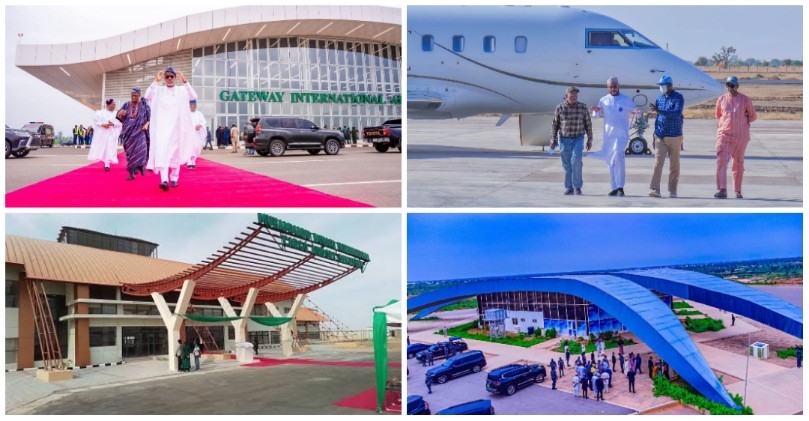
There is a growing trend among state governments to initiate ambitious airport infrastructure projects, regardless of their economic viability.
From cargo airports to international terminals, governors across the country have presented these projects as symbols of development, economic expansion, and modernisation.


However, critics increasingly argue that many of these airports are turning into “white elephant” projects, because they are expensive infrastructure that delivers little practical value while consuming enormous public funds.
Recently, Gov. Hope Uzodimma of Imo said at a gathering of representatives of friendly nations and international institutions that state government collected a net allocation of between N700 billion and N800 billion monthly.
His revelation aligns with figures from the Federation Account Allocation Committee (FACC), which show that allocations to subnational governments have risen significantly.
For instance, compared to February 2025, they saw about 23 per cent increment in their revenues from FAAC in February 2026.
On the average, FAAC revenues have almost tripled since subsidy was removed on May 29, 2023.
However, the debate about the impact of these revenues has intensified as the country faces rising poverty, unemployment, inflation, inadequate healthcare, struggling education system, and poor infrastructure.
An analysis of media content shows that many citizens are questioning whether the billions of naira spent on airports could have been better invested in sectors that directly improve their welfare.
Some of the airport projects already commissioned operate significantly below capacity, while others under construction remain abandoned.
A case in hand is the Ebonyi International Airport initiated during the administration of former governor David Umahi.
Reports indicate that, after spending N63 billion and five years (2019–2024), the airport generated no revenue, while additional billions were spent fixing defective runways and leaking terminal roofs.
Similarly, the Lafia Cargo Airport in Nasarawa State has attracted criticism after reports revealed that the facility remained largely abandoned years after its commissioning, having gulped a whooping N15 billion.
There are many of other such projects dormant, abandoned, under construction or proposed, in Abia, Kogi, Osun, Benue, Taraba and Cross Rivers, among others.
A civil servant based in Abuja, who simply identified himself as Dele, referred to airport projects by states as misplaced priorities.
“There is an airport in Akure which is already underutilised. Akure to Ado Ekiti, the Ekiti State capital, is under 45 minutes’ drive. Please, what does the government need an airport for?
“Also, Osogbo (Osun capital) is just under 90 minutes’ drive to Ibadan, where there is an airport, also already underutilised. Oyo is bigger and more strategic than Osun, yet its airport is not used to full capacity.
“What then is the guarantee that an airport in Osun will be more viable than the one in Ibadan?” he queried.
Like Dele, some stakeholders warned that multiple airports in neighbouring locations could struggle to attract enough passenger traffic to remain viable.
Sen. Smart Adeyemi, former Chairman, Senate Committee on Aviation, once warned that many state governments were embarking on wasteful airport projects while neglecting citizens’ welfare.
According to him, many states will benefit more from smaller and cheaper airstrips rather than full-scale airports costing tens of billions of naira.
He said that most of the airports owned by states were waste of public funds as they lack adequate technical capacity and passenger flow.
“Most of the airports built by the states lack the required facilities and passenger flow to be called airports.
“Aside from Lagos, which has 65 per cent of passengers’ traffic, Abuja, Port Harcourt, Kano and most of the other airports lack the required 500,000 to one million passenger traffic on a yearly basis.
“In fact, many of them cannot even record 100,000 passengers annually not to talk of the minimum of 500,000 by international standards.”
Experts within the aviation industry also expressed a similar concern.
Former Managing Director of the Federal Airports Authority of Nigeria (FAAN), Capt. Rabiu Yadudu, said those airports majorly lacked in commercial viability.
“An airport that needs N300 million a month and they have just 1,000 passengers a month there is no magic that can make them sustainable,” he said.
Also, former General Secretary of the Nigerian Union of Air Transport Employees, Olayinka Abioye, described the rush by governors to build airports as an “aberration and fraudulent”.
He argued that many states ignored more pressing developmental challenges while pursuing legacy projects that provide limited economic value.
According to aviation analysts, many governors justify airport projects by claiming they will attract investors, stimulate tourism, create jobs, and improve agricultural exports through cargo operations.
While these goals appear attractive on paper, the reality often differs because most states lack the industrial capacity, commercial activity, and passenger demand necessary to sustain airport operations.
A recent media report revealed that several states collectively spent more than N251 billion on airports considered largely non-viable.
The report noted that poor healthcare, bad roads, inadequate housing, and failing public services did not stop state governments from investing heavily in airport projects, often for political prestige rather than economic necessity.
For ordinary Nigerians, the implications of these projects are significant.
Critics say every billion naira invested in underutilised airports represents money unavailable for schools, hospitals, water supply, agriculture, electricity, and road construction.
“In many rural communities, people still struggle with inadequate healthcare facilities, overcrowded classrooms, and poor transportation networks.
“Government should therefore prioritise human development over legacy infrastructure.
“In states where civil servants cannot earn living wages and unemployment remains widespread, spending billions on airports can appear insensitive to citizens’ daily struggles, especially during these hard times.
“The maintenance costs of airports also create long-term financial pressure,” Dele said.
Indeed, airports require expensive runway maintenance, security systems, aviation equipment, staff salaries, and electricity supply.
Therefore, when passenger traffic is low, governments must continuously subsidise operations using taxpayers’ money.
Analysts say this creates recurring expenditure that may not generate corresponding economic benefits, as witnessed in the case of the Ebonyi airport and others.
Also, some airport projects have displaced local communities and farmlands without delivering promised economic opportunities.
Nonetheless, supporters of airport development argue that such infrastructure can stimulate long-term economic growth if properly planned.
They point to examples such as the Victor Attah International Airport in Akwa Ibom, which operates alongside the state-owned Ibom Air airline.
Although the airport still relies heavily on state support, it has achieved relative operational success compared to many other state-owned airports.
They also claim that airports can improve connectivity, encourage investment, and reduce travel stress for residents who previously depended on distant airports in neighboring states.
However, many analysts insist that airport construction should be based on detailed feasibility studies rather than political ambition, and that infrastructure should reflect actual economic demand, population size, industrial activity, and long-term sustainability.
Given that barely five per cent of the population flies, observers say the surge in state-owned airports suggests a preference for prestige projects over practical, people-focused development. (NANFeatures)

