

I have tried to understand the meaning of the word ‘restructuring’ as used by Nigerians today, but I just can’t. What is even more disturbing to me is that the proponents of ‘restructuring’ Nigeria do not seem to agree as to what it actually mean. This is what lend credence to the fact that the challenge in defining ‘restructuring’ in Nigerian context is that different people have different perspectives to the concept. There is no unanimity.
There is a group of individuals who believe that by ‘restructuring’ it means the nation should go back to federalism as existed from independence in 1960-1966 before the first military take over of power from civilians that altered the earlier federal structure. Thus, according to this group of people, we should go back to REGIONAL government or regionalism when the country had only Northern three northern region with headquarters in Kaduna, Eastern Region with headquarters in Enugu and Western region with headquarters in Ibadan. This opinion suggests that we throw away the present constitution in its entirety and promulgate a new one to reflect this opinion. It is treating restructuring as a geographical concept.


Read Also: Malagi: A frontrunner’s 6 guidelines to power
The second group of people however argue that by restructuring, it means we devolve powers to the extent that more responsibilities be given to the 36 states while the Federal Government be vested with the responsibility to oversee our foreign policy, defence and economy only. That means we need to amend or tinker, repair, adjust, or work with our present constitution to accommodate new thoughts that will strengthen the regional power and weaken the center. These are proponents of constitutional amendment as a meaning of the concept of restructuring.
For the third of people, restructuring means how to share the nation’s resources. Period. They opine that we leave the 36 states as they are but devolve financial powers to states and de-emphasise federal allocations as the source of sustenance of states. For this group, since we have a federation, let every state control and exploit its resources, be self-sustaining without a central body interfering. These are proponents of restructuring as an economic concept.
To better understand this third group of people, we need to understand our revenue sharing formula from inception to date. Starting with 1946, the derivation formula for the regions which controlled their resources was 100%. In 1951 the British recommended it 50 per cent derivation. At independence in 1960, 50% was sustained as derivation up to 1970.
We fought a civil war from 6 July, 1967 to 15 January, 1970. The then head of state General Yakubu Gowon who was the third Head of State from 1st August 1966 – 29 July, 1975, embarked on three Rs of reconciliation, rehabilitation and reconstruction after the civil war. To give more resources for the federal government to achieve this, he reduced the formula to 45%, and by 1975 he further reduced it to 25%. In 1983, in his first coming, General Buhari crashed the formula to 1.5% which Gen. Babangida raised to 3%. Today, by the REVENUE ALLOCATION (2000 – 2010), the current vertical allocation formula which is based on Presidential Executive order is as follows:
Federal Government – 52.68%
State Government – 26.72%
Local Government – 20.60%.
And this is where we are. Unfortunately, the federal gives 20% to local government but state governments embezzle it.
There is a fourth group of people who do not identify with the three options above. Rather, they believe that the country needs to be dismantled for each region to go it’s separate ways. But who goes where within the regions I don’t know, yet the people in this group are asking that we dismantle everything.
The people in this group are mostly the younger generation who, anytime they are talking with us, the older generation, they say or write “Nigeria is a joke”.
I want to know the group you belong before I conclude.
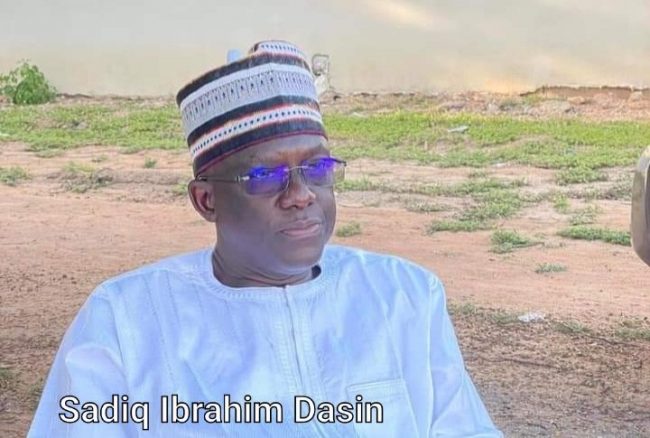
- Dasin is a former member of House of Representatives from Adamawa State

