

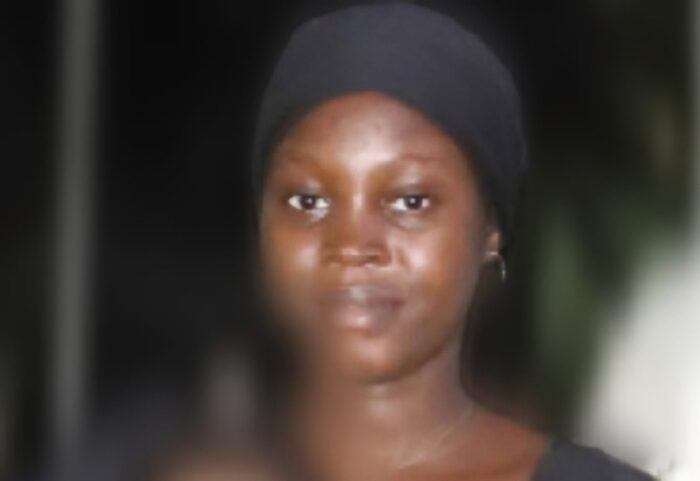
Walida Abdulhadi Ibrahim, the young woman from Jigawa State whose disappearance and subsequent custody by the Department of State Services (DSS) ignited a national debate, has been officially handed over to Governor Umar Namadi of Jigawa State.
The transfer, which took place last night at the DSS headquarters in Abuja, aims to move the resolution of her complex case, involving allegations of abduction, sexual exploitation, and religious conversion, to the courts.


Governor Namadi, flanked by a delegation including the Speaker of the Jigawa State House of Assembly, the Attorney General, and the Commissioner of Women Affairs, assured the public that justice would be served.

He declared Walida “the daughter of Jigawa State” and pledged the government’s commitment to ensuring her safety and recovery from any trauma she may have endured.
The governor stated that Walida and her infant daughter, fathered by DSS operative Ifeanyi Onyewuenyi, will remain in Abuja under state protection for the time being.
He added that “Taking her into our custody does not automatically mean that she will be taken back to Jigawa. Walida will be kept in Abuja for now. She will be provided with adequate security. Her case is a state matter and will be treated as such.”
Namadi also said the issue of Walida’s her age, a point of contention, will also be decided by the courts.
The Director General of the DSS, Adeola Oluwatosin Ajayi, supervised the handover. Ajayi explained that the DSS had maintained custody of Walida since her recovery in January 2026 to “respect what the law says” and ensure her safety during an inter-agency investigation.
He highlighted the involvement of various groups, including the Nigerian Medical Association (NMA) for mental status assessment, and confirmed that the DSS, police, Civil Defence, FIDA, and the Federal Ministry of Women Affairs will remain involved in her case.
Ajayi also confirmed that Ifeanyi Onyewuenyi is still in DSS custody and “will face the music when found wanting.”
The controversy surrounding Walida began when she went missing in 2023. Her father received a call from Onyewuenyi in December 2025, informing him she was with him.
Efforts by her relatives to retrieve her proved futile, leading to a petition at the DSS headquarters and a court order in Jigawa for her release. However, the DSS filed a counter-motion, citing an ongoing investigation.
The story gained significant traction after a “Weekend Trust” exclusive interview with Walida on February 21, 2026, detailing her harrowing experiences, including alleged abduction by one Mariam, sexual exploitation, and living with Onyewuenyi before giving birth in November 2025.
The prolonged custody by the DSS, particularly given allegations of religious conversion, drew sharp criticism from various civil society organizations. A coalition including the Abuja chapter of MURIC, FOMWAN, MSO, and Women in Da’awa held a press conference, calling for Walida’s transfer to neutral ground.
Ustaz Yunus Salahudeen, representing the Concerned Coalition for Walida Abdulhadi, emphasized that the matter transcended religion, touching on “justice, constitutional order, and human rights,” and highlighted the “unimaginable distress” her disappearance caused her family, who even performed funeral rites believing her dead.
Barrister Haroun Muhammad, representing the Nigerian Supreme Council of Islamic Affairs (NSCIA), stressed the potential for the situation to “throw the country into chaos” and deepen existing Muslim-Christian divisions, emphasizing the importance of a resolution that sends “the right or wrong signal to society.”
Notably absent from the late-night handover were Walida’s parents, adding another layer of complexity to a case that has captivated and concerned Nigerians across religious and social divides.

