
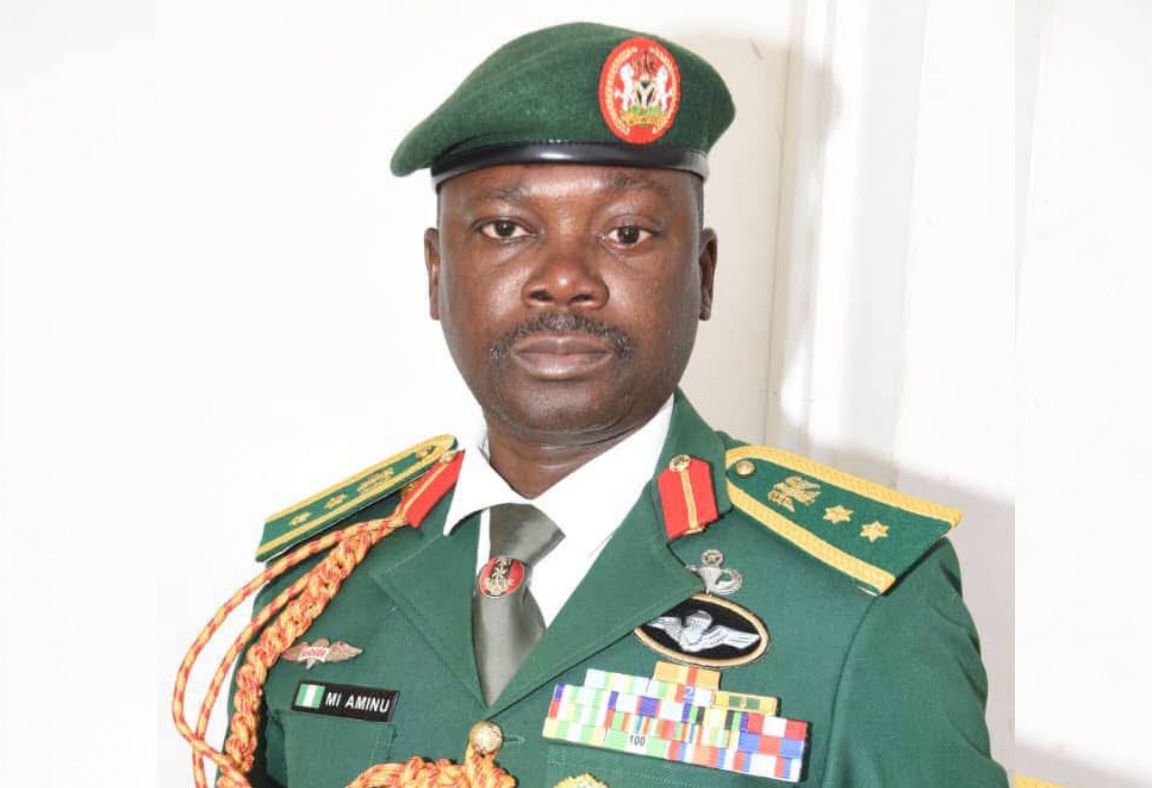
There is an old saying in the Nigerian Army that every officer learns sooner or later: soldier go, soldier come, barracks remain. It is the military’s way of reminding you that no individual is indispensable, that the institution is a river that keeps flowing long after you have stepped out of it. But every so often, a man comes along who makes the barracks feel a little emptier when he leaves. Colonel Murtala Ibrahim Aminu is one of those men.
Today, Colonel Murtala Ibrahim Aminu bids farewell to the National Drug Law Enforcement Agency to continue another important chapter of his military journey. To the casual observer, it is simply another posting, another entry in the long tradition of military assignments. Those of us who have worked within the system know it is much more than that. Colonel Aminu departs after nearly five years at the side of Brigadier General Mohamed Buba Marwa (Rtd), CON, OFR, one of Nigeria’s most accomplished soldier-statesmen, whose distinguished career spans decades of military service, public administration, diplomacy and national leadership.


From his years in uniform to his transformative stewardship of Lagos State, his diplomatic assignments and now his widely acclaimed leadership of the NDLEA, General Marwa has built a legacy defined by discipline, courage, innovation and unwavering service to Nigeria. Serving such a leader demands far more than loyalty. It requires uncommon judgment, absolute discretion, relentless dedication and the rare ability to translate vision into action every single day. For nearly half a decade, Colonel Aminu carried that responsibility with quiet distinction.
But when you ask of Col Aminu among military officers, they will tell you about the jump master who conquered the air.
He is a man who has literally thrown himself out of aircraft for the sake of his country. Basic Airborne Course in 2004. Advanced Airborne Course in 2007. Basic Rigger Course in 2006. The man has spent more time falling through the sky than most of us have spent in traffic. In the army, there is a joke among paratroopers that the only thing worse than jumping out of a perfectly good airplane is having to explain to a civilian why you did it. Colonel Aminu never needed to explain. He simply did the work. And when the insurgency in the Northeast reached its most terrifying peak, he was not behind a desk writing memo. He was at the front line.
Talk to officers who served in Borno during the darkest days of Operation Lafiya Dole, and the name Murtala Aminu comes up with a certain reverence. They speak of Malam Fatori, that remote and brutal corner of Abadam Local Government Area where Boko Haram and ISWAP fighters once roamed with impunity. They speak of a commander who did not flinch, who led from the front, who understood that in counterinsurgency, the map is not the territory and the PowerPoint presentation is not the battlefield. The army has a saying: no plan survives contact with the enemy. Colonel Aminu learned that truth in the dust and heat of Borno, commanding troops under conditions that would break lesser men. He earned his medals the hard way. UNAMSIL. ECOMIL. UNMIL. UNAMID. MINUSMA. The General Operations Medal. The MNJTF Operation Yancin Tafki Medal. The Operation Lafiya Dole Medal. These are not souvenirs from a gift shop. They are receipts from a life spent in harm’s way.
But here is what makes the man truly remarkable. After surviving the hell of the Northeast, after commanding the 118 Task Force Battalion (later redesignated 68 Battalion) in the teeth of the insurgency, after serving as Military Assistant to the Chief of Training and Operations at Defence Headquarters, he could have easily settled into a comfortable staff appointment and continue from the desk. Instead, he came back to the seat of power to fight a war that is, in many ways, even more audacious than the one he left behind. Because the war against drugs never sleeps. It does not observe public holidays. It does not retreat during the rainy season. And it does not surrender.
In April 2021, Colonel Aminu arrived at the NDLEA as Military Assistant to the Chairman and Chief Executive Officer. In February 2024, he was elevated to Chief of Staff to the Chairman. Now, to the outsider, that title sounds ceremonial. But inside the NDLEA, we know better. The Office of the Chief of Staff is the engine room of the Agency in human form. It is where the Chairman’s vision is translated from grand strategy into the grinding, daily reality of execution. It is where priorities are aligned, where crises are extinguished before they become headlines, where inter-agency relationships are nurtured with the patience of a diplomat, where international engagements are prepared with the precision of a surgeon, and where the impossible scheduling of one of Nigeria’s busiest public institutions is somehow made to look effortless. When your principal is a man of General Marwa’s stature and intensity, that engine room does not idle. It roars. And Colonel Aminu was the man who kept it running.
He carried that responsibility with a calm that never once betrayed the weight upon his shoulders. And let us be clear about what that weight looked like. In Nigeria’s civil and military service, there is a familiar cliché about burning the midnight oil. You hear it at every valedictory. “He burned the midnight oil.” It has become so routine that it has lost its fire. But I tell you, while others in government service were content to burn midnight candles, Colonel Aminu’s were engulfed in flames. The man did not merely work late. He worked as though the night itself was insufficient for the task at hand. The NDLEA is not a ministry where files can wait until morning. This is an agency at the frontline of a war against drug trafficking, a war that does not pause because the clock has struck midnight. In that furnace, Colonel Aminu was not merely present. He was the firekeeper.
And yet, here is the miracle: he never let the fire consume his humanity.
It is one thing to be efficient. Nigeria’s bureaucracy is full of efficient men who leave behind them a trail of bruised egos and broken spirits. Efficiency without empathy is merely cruelty wearing a tie. Colonel Aminu understood what many in high office forget: that an institution is not made of org charts and policy papers. It is made of people. Junior officers with anxieties about their careers. Staff members with problems that do not appear in any official correspondence. Young men and women who need someone to see them before they learn to see themselves.
He saw them.
In an office where “busy” is not merely a description but a condition of survival, Colonel Aminu somehow found time to listen. Not the hollow listening of obligation, but the kind that made junior officers and staff members walk away believing their concerns had genuinely been heard. He mentored without announcing that he was mentoring. Sometimes it was a quiet word of advice. Sometimes it was the confidence he placed in a young officer before that officer had fully learned to believe in himself. These moments do not appear in annual reports, but they shape careers. They shape lives. Mine included.
What strikes me most is how naturally he held together two identities that, in lesser men, tear apart. He was every inch a soldier: disciplined, organised, decisive, and uncompromising when duty demanded it. But he never lost the human touch. He could enforce discipline without humiliating the disciplined. He could command without crushing. He could supervise without suffocating. Many can wear the uniform. Few can wear it while keeping their heart intact.
As Chief of Staff to one of the most demanding and distinguished leaders in Nigeria’s public service, he helped coordinate the heartbeat of one of the nation’s busiest institutions. As a leader, he quietly invested in the people who kept that institution moving. As a man, he earned something that no rank can confer and no appointment can bestow: respect. Real respect. The kind that remains long after the office changes hands.
Today, as he proceeds to a course in the Nigerian Army (yes, the man already holds a Masters in International Affairs and Defence Studies from the Nigerian Defence Academy, a Master of Philosophy in Defence and Security Studies, an Executive MBA in Political and Strategic Studies, and he is currently pursuing a PhD, all while fighting insurgents and coordinating a national drug agency under a legendary chairman; some of us struggle to finish a single degree while working from home), the Nigerian Army gains once again what the NDLEA has been privileged to experience.
We do not celebrate simply because an officer is moving to another assignment. We celebrate because we witnessed service in its finest form: service with discipline, with humility, with excellence, and above all, with humanity.
Thank you, Colonel Murtala Ibrahim Aminu. Thank you for proving that one can wear the uniform of a soldier without losing the soul of a mentor. Thank you for showing that a man who has jumped out of airplanes, fought insurgents in the hellish terrain of Borno, and commanded troops in the most dangerous corners of the world can still find the patience to listen to a junior officer worried about his submitted assignment. Thank you for serving with distinction under a chairman who demands nothing less. May the road ahead be as impactful as the one you leave behind. Nigeria will continue to benefit from your service. And those of us whose paths crossed yours will remain forever grateful that, for a season, we had the privilege of learning from the man who quietly kept the engine running, who never let the fire burn out his human touch, and who proved that the jump master who conquered the air can still walk with his feet firmly on the ground.

