
On this June 12, 2026, while the airwaves fill with tributes to democracy, I find myself unable to join the chorus. Not out of bitterness, but out of an honest reckoning with where we stand as a nation.
Our children have become bargaining chips. A two year old toddler was among 46 persons, including seven teachers and 39 students, kidnapped from schools in Oriire Local Government Area of Oyo State on May 15, 2026 . Three months later, 176 Kwara villagers, mostly women and children, remain in captivity after a terrorist invasion of Woro Village in Kaiama Local Government Area, with all the government has offered being promises.


In less than two years, at least 10 school kidnappings have taken place across Nigeria, affecting about 670 children , and around 19 million children, 27 percent of all Nigerian children, no longer attend school at all because of the threat of kidnapping .
And it does not stop at our children. Even our military’s own are no longer safe. As I write this, retired Major General Rabe Abubakar, former Director of Defence Information of the Nigerian Army, and his wife remain in the custody of bandits after being ambushed in Katsina State on May 30, 2026. His abductors have since released a video demanding the release of detainees and the return of confiscated livestock. This marks the second time in a year that a retired General has been abducted in Katsina State, following the 56 day captivity of retired Brigadier General Maharazu Tsiga in 2025 .
What strikes me most is the silence. In the past, the death of even a single soldier could trigger swift and visible military reprisals. Today, top serving and retired officers are being killed and abducted, and we hear of “ongoing investigations” and “search and rescue operations” that yield little. Where is the outrage that once defined our military’s response to attacks on its own?
The economic picture is no less grim. An estimated 10 million more Nigerians fell into extreme poverty in 2025 alone, pushing the share of the population living below the international poverty line to 50.9 percent, up from 47.7 percent in 2024.
In rural Nigeria, the poverty rate has reached an alarming 75.5 percent . More than half of all Nigerians, about 54 percent, now live in poverty, while corruption continues to divert public resources away from education, healthcare and infrastructure . This, in a nation that calls itself one of Africa’s largest economies.
Meanwhile, businesses shut their doors as power refuses to stay on. Roads remain death traps. Hospitals lack basics. Transportation now costs more than the food people are traveling to buy.
And then there is the matter of human rights. Citizens perceived to be critical of those in power, journalists, activists, and ordinary social media users, are routinely picked up and held for days or weeks without being charged to court, without recourse to the due process our constitution guarantees. Many languish in detention simply for voicing an opinion. If this is not a form of state intimidation, what should we call it?
So today, instead of singing democracy’s praises, I ask:
1. Is democracy truly serving us as a people, or has it become a costume worn by a few to loot in our name?
2. Comparing the gains and losses of this Fourth Republic, are we making progress or progress in reverse?
3. If a system cannot protect a child walking to school, or a retired General driving on our roads, can it still be called a system that works?
4. When citizens can be detained indefinitely without trial for criticising the government, what exactly is left of the freedoms democracy promised us?
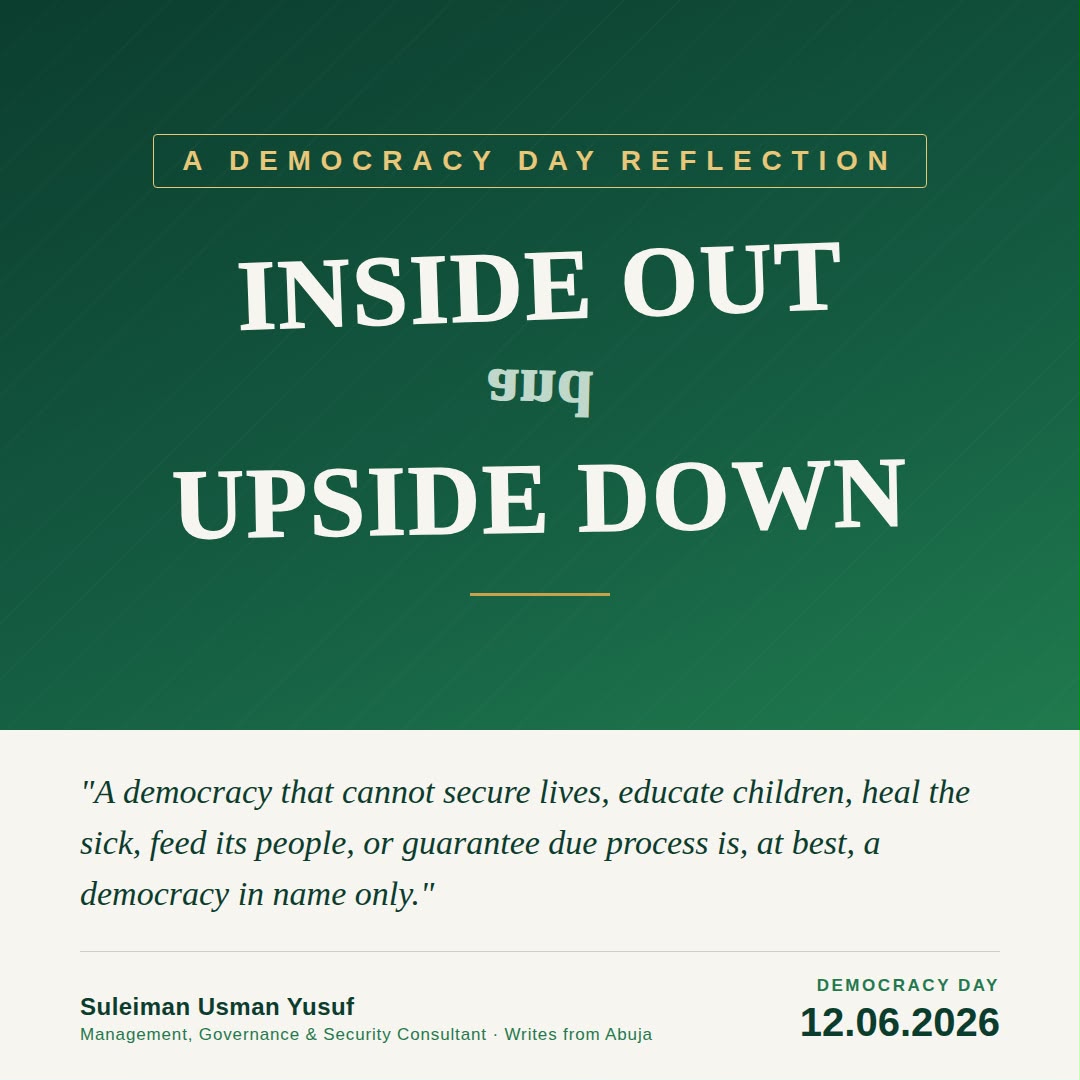
Perhaps the answer is not to abandon democracy, but to stop mistaking its form for its substance. A democracy that cannot secure lives, educate children, heal the sick, feed its people, or guarantee due process is, at best, a democracy in name only.
Until we’re honest about that, June 12 will remain a date we mark, not a day we truly celebrate.
But if we choose to pull the blanket over our heads in pretense, then I would say HAPPY DEMOCRACY DAY.
- Suleiman writes from Abuja. He is a Management, Governance, and Security Consultant, and also an AI Policy and Governance enthusiast. Could be reached via [email protected]

