

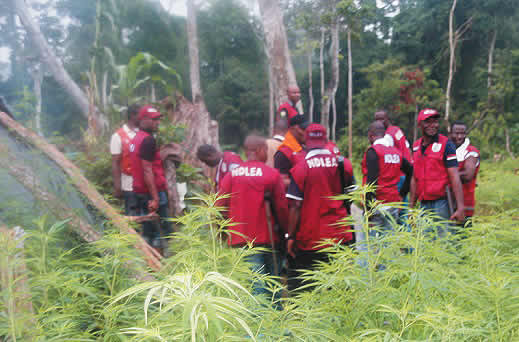
There has been a clarion call in recent times for legalised cultivation of the psychotropic plant. It is Pandora’s box Nigeria should not open.
June 7-8, 2021 was a historic moment in Nigeria for the movement for controlled cultivation of Cannabis sativa. At a two-day stakeholders roundtable titled “Benefits and Opportunities of Cannabis Plant in Nigeria” held in Akure, capital of Ondo, the state governor, Arakunrin Rotimi Akeredolu, speaking to the panellists urged the Nigerian government to give legal backing to the cultivation of cannabis in the country.


Read Also: NDLEA intercepts 12,385kg drugs smuggled into Lagos on waterways
“Cannabis is a multi-billion naira industry that can help diversify the Nigerian economy if judiciously utilised,” he submitted.
In the words of Gov Akeredolu, “the medical and economic merits of the use of cannabis outweigh its demerits.” He attributed the neg- ative perception of cannabis and the lukewarm reception accorded pro-cannabis advocacy to igno- rance of the numerous benefits of the plant.
“Just like every other crop or plant, Cannabis sativa has both CBD and THC content which we can put to good and bad use,” he explained, noting that: “Products with extract of Cannabis sativa are already in our pharmaceutical sales outlets across the country. They are being imported with foreign exchange, and sold at exorbitant prices.”
Lest the governor is perceived as being impulsive, it is instructive to note that he led a team from his state to Thailand in 2019 to understudy the country’s legal reform that facilitated the decriminalisation of the cultivation, processing and export of Cannabis sativa.
Describing the “Thai Cannabis Utopia,” as an eye-opener, he recounted: “We saw forest reserves used in the past to cultivate and process hard drugs transformed to be meaningfully utilised in an environmentally-friendly way for healthy ventures. We saw people previously sold to hard drugs engaged in legitimate business ventures.”
Akeredolu was clear and unwavering in his submission: “What we are 19, therefore, advocating for in Nigeria is simply controlled cultivation of pharmaceutical standard cannabis, strictly for medical purposes. I am saying necessary laws must be amended to give room for it. I am not saying it should be a free-for-all venture. Those investing in it must be licensed under strict control.”
THE BOTTOMLINE IS ECONOMIC GAIN. And if that wish is granted, Ondo, the largest can- nabis-planting state in Nigeria, can create a million dollars industry for the country.
Statistics can be called upon to support this argument. In 2019, for example, the global market of cannabis was estimated at $52.8 billion. Going by the market forecast of an average annual increase of 14.5% from 2020, the cannabis market is expected to peak at $103.9 billion by 2024. From an economic point of view, cannabis could become a panacea to the economic woes of Nigeria.
The chief panellist at the roundtable, Hon. Benjamin Okezie Kalu, member of the House of Representatives from Bende Federal Constituency, opined that it has become imperative for Nigeria to review the legislation prohibiting the farming and production of cannabis for medicinal and industrial use in Nigeria.
He spoke of the Dangerous Drugs Act [Amendment] Bill 2020, a legislative battering ram that could be used to break the door open for a new era of cultivation of medicinal cannabis in Nigeria. That legislative effort will be the second time cannabis entered into the stream of political discourse.
The first time was back in 2019, during the build-up to the general elections, when “legit cannabis” was a major item on the manifesto of the presidential candidate of African Action Congress (AAC), Omoyele Sowore, who brashly proclaimed that Nigeria will export marijuana if he were elected president.
“We have to start taking care of our weed (Igbo) such that we can also contribute to the GDP of the world,” said a swaggering Sowore who further sent a swashbuckling message to the NDLEA: “Our NDLEA (National Drug Law Enforcement Agency) should get the notice memo in advance that Nigeria will be exporting weed to cure cancer in other parts of the world.”
Proponents of legal cannabis are also quick to point to Canada, the North American country where cannabis has achieved legal status, becoming an over-the-counter product after the government approved it for recreational use in November 2018.
If you listen long to the cannabis rhetoric, the argument begins to appear water-tight, and you are likely to fall for the delusion of seeing the psychotropic substance in a new light and believing there is no harm in legalising its cultivation in Nigeria.
BUT WAIT FOR THE OTHER SIDE of the argument. Cannabis is still by far the most extensively grown, traded, and abused illicit substance. Every year, cannabis seizures account for half of all illicit drugs seized worldwide in almost every country on earth.
The plant in its various forms – flower, seed, leaf and stem – is consumed by at least 200 million people, which constitute more than 2.5% of the global population, compared to 0.2% who use cocaine and opiates respectively. Cannabis abuse increased at a faster rate than the abuse of any other illicit substance in the last decade.
Beyond the damning statistics, the flipside of cannabis use is much more complicated. But the red-herring arguments of advocates focus public attention on the vaunted economic and medicinal benefits of the psychotropic plant while downplaying the dire and dirty repercussions of its use and abuse.
But On June 26, the UN International Day Against Drug Abuse and Illicit Trafficking, the Chairman/Chief Executive of the National Drug Law Enforcement Agency, NDLEA, Brig. Gen. Mohamed Buba Marwa, in no uncertain terms, warned that Nigeria runs the risk of becoming a nation of junkies if the government legalises cannabis.
He merely stated the obvious because Nigeria already has an acute cannabis problem. With at least 10.6 million of the country’s population abusing illicit substance, Nigeria holds an unenviable record as the country with the highest number of cannabis abusers.
This fact has a tincture of irony: a country where cannabis is outlawed but has more people using cannabis than in countries where the substance is legalised. What’s worse, Nigerians do not use cannabis for therapeutic or religious purposes. The use is purely recreational.
This is one of the reasons NDLEA secretary, Shadrach Haruna regards the call for legalisation of cannabis as one borne “out of the poverty of knowledge.”
Describing as “not well informed” promoters of legalisation of cannabis cultivation, Haruna counterargues:
“There is no plant in the forest that has no medicinal value. Even the World Health Organization agreed cannabis has medicinal value but still considered it a very harmful drug. It is the most abused of all the drugs, not just because it’s available, but also because it’s very cheap. You can even grow it in your room. So, its medicinal or commercial value notwithstanding, the impact of cannabis on public health is huge.”
He further points out that countries allowing regulated growth of cannabis for commercial purposes are cultivating the variant with little or no tetrahydrocannabinol.
“Just the way cassava leaves look similar, cannabis leaves with tetrahydrocannabinol and the ones without it, are alike. Many countries, including developed countries, cannot still make a distinction by merely looking at the leaves. So the best thing to do it, to stay safe, is to not go near it,” he stresses.
As to the global status of cannabis as a psychotropic substance, he clarifies: “The UN Commission on Narcotic Drugs, move cannabis from Schedule 4 to Schedule 1, where it will be made available for research purposes and medicinal use, but countries still have the right to maintain strict control over cannabis.”
Indeed, when in December 2019, the 53-member UN
Commission on Narcotic Drugs voted to delete cannabis from Schedule 4 (Prescription Only Medicine), nine of the 11 African members, including Nigeria, had voted against it. Nonetheless, it remains under Schedule 1 (drugs with no currently accepted medical use and a high potential for abuse) and therefore still under strict international control.
The NDLEA secretary finds the argument about the economic value of cannabis rather galling: “Here in Nigeria, the focus is on the commercial value of canna- bis. What commercial value are we looking at? Money at the expense of the health of citizens?”
For him, there is a need for discretion in the utterances of cannabis advocates, some of whom are in high offices. Unbridled statements on their part could be misconstrued by gullible youths as an endorsement of an illegal act, he cautions. “This is important because cannabis is still illegal,” Haruna stresses.
Nigeria’s UNDOC country representative, Oliver Stolpe also punches a hole in the pro-cannabis argument.
“My understanding of the proposal is basically to legalise the production of cannabis in a very controlled manner, in order to commercialise it for medical and scientific use. As far as I understand it, it would not contradict and would be possible under the international drug control framework,”observes Stolpe.
The critical issue, however, he says, borders on the country’s capability to regulate access, distribution and production of cannabis.
Stolpe reflects: “We should never forget that in Nigeria, the second biggest drug being used are medical products that are theoretically regulated in terms of access, that should not be accessible without prescription. We should keep that in mind because that means this is probably also going to happen when we are legalising the production of cannabis, that we will have trouble controlling the production process; we will have trouble at preventing diversion into illegal markets and as a result, regulatory and control gap is likely to occur. We should be very cautious going forward with such legislative intervention.”
The health implications of the use of cannabis, he also stresses, “should also be taken into account before any move dealing with cannabis cultivation.”

