

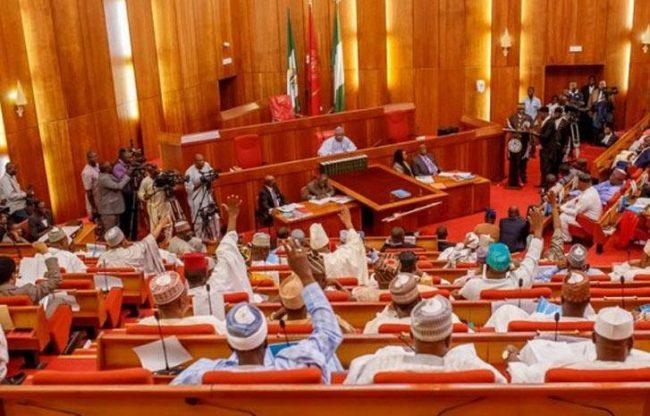
The Senate on Tuesday passed for a second reading a bill which prescribes a five-year jail term, with an option of fine of not less than five million naira, for any importer or exporter of any nuclear material or proscribed substances without a license from the Nigerian Nuclear Regulatory Authority (NNRA).
In the case of a corporate body, the bill prescribes a fine of not less than N20 million on conviction.


The bill for an Act to Repeal the Nuclear Safety and Radiation Protection Act 1995 is essentially to regulate nuclear sources of energy in the country.
The bill provides that an offending Director or officer of the corporate body shall on conviction be liable to imprisonment for a term of not less than five years or an option of fine of not less than five million naira or to both such fine and imprisonment.
It also provides that any operator of nuclear installation, who fails to take measures to secure any nuclear material in such a manner as to result in unauthorized access, theft or loss of control of such materials or sources commits an offence and shall in the case of an individual, be liable on conviction to imprisonment for a term of not less than five years or a fine of not less than N10 million or to both; and in the case of a corporate body, be liable on conviction to a fine of not less than N50 million.
Consequently, the upper chamber, in the bill under consideration, is proposing the re-establishment and composition of the Nigerian Nuclear Regulatory Authority (NNRA), with membership from relevant Ministries, Departments and Agencies of government.
Sponsor of the bill, Senator Robert Ajayi Boroffice (APC – Ondo North), in his lead debate explained that the bill seeks to reestablish an already existing legal framework for the Nigerian Nuclear Regulatory Authority by expanding its mandate to include security and safeguards for the nuclear industry in Nigeria.
“Although Nigeria does not generate electricity from nuclear sources, it is considering doing so in the nearest future because research shows that nuclear power offers one of the cleanest source of energy, reduces the amount of energy generated from fossil fuels and provides stable base load of energy at relatively lower costs.”
“It is one of the promising forms of alternative energy. Due to advancement in technology, it has become one of the safest sources of energy”, Boroffice explained.
The lawmaker, however, warned that Nigeria stands to be exposed to the risks of radioactive and nuclear sources of energy, should the country fail to immediately introduce enabling laws that would regulate nuclear technology.
Citing Chernobyl in Russia as example, he cautioned that, “the uses of radioactive and nuclear sources may involve great risks including the dangers associated with accidents and leakage of large amounts of nuclear waste to the environment which remains hazardous for thousands of years.
He added, “even though Nigeria does not currently generate electricity from nuclear sources, she is already using radioactive sources in the fields of agriculture, medicine and mining. And there are great possibilities that she might add nuclear energy to its energy mix in the nearest future.”
The bill when passed into law, according to Boroffice, will make provision for the Nigerian Nuclear Security Committee (NNSC) and the National Research Institute for Nuclear Safety and Radiation Protection.
Contributing to the debate, Senator Ibrahim Yahaya Oloriegbe (APC – Kwara Central) said, “the current legislation is not effective.”
The lawmaker noted that “it is critical and important to look at the 1995 Act to understand the deficiencies”, adding that contributions by stakeholders will enrich the bill.
The bill after consideration, was referred by the Senate President, Ahmad Lawan, to the Senate Committees on Science and Technology; and Petroleum Upstream to report back in four weeks.

