

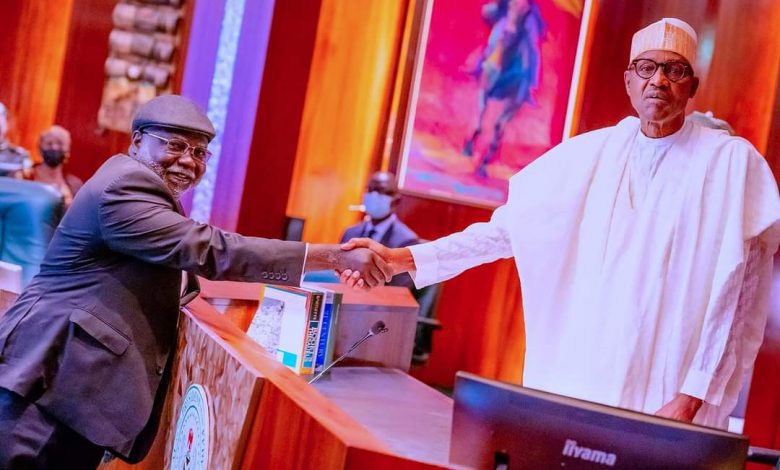
Why is it that it is always the president who swears-in the Chief Justice of Nigeria CJN? Since that has been the case from Nigeria’s independence, why did Justice Abubakar Idris Kutigi who (with just a day to his retirement as CJN swore-in Justice Aloysius Katsina-Alu as a new CJN?
This happened during president Umaru Musa ‘Yar’adua. President Umaru Musa Ya’adua had forwarded the name of Justice Aloysius Katsina-Alu to the senate for confirmation as CJN as Justice Kutigi was set to retire. The senate confirmed the name quite alright.


Unfortunately before the retirement of Justice Kutigi and swearing-in of Justice Katsina-Alu, president Yar’adua was rushed to Saudi Arabia for medical treatment and remained there incommunicado. No body could speak with him and unfortunately also he had not handed over power to Vice President Goodluck Jonathan as acting president as required by the constitution.
So the Vice President could not do anything when the office of the CJN was about to become vacant with no president ‘Yar’adua in sight and nobody could speak with him. Goodluck Jonathan was at that time neither the president nor acting president and could therefore not perform the constitutional function of the president.
Unfortunately again, Justice Kutigi had one day to clock the age of 70 and would be caught by S. 291. (1) of the constitution which says –
“A judicial officer appointed to the Supreme Court or the Court of Appeal MAY retire when he attains the age of sixty-five years and he SHALL cease to hold office when he attains the age of seventy years”.
And you know “shall” in law means “must”.
So Justice Abubakar Idris Kutigi (with just a day to his retirement as CJN) swore-in Justice Aloysius Katsina-Alu as a new CJN?
In an attempt to answer the question in the first paragraph above, it is correct to say that even though it has always been the president who swears-in the CJN in Nigeria, it is just a mere tradition. This happens because the president was always available when a new CJN was to be sworn-in.
But truly under our law, an outgoing CJN can swear-in an incoming CJN because S. 290 (2) of the constitution says –
“the oaths aforesaid shall be administered by the person for the time being AUTHORISED BY LAW to administer such oaths”.
Though the constitution did not specifically say any person other then the president can administer oath on the CJN, S. 290 as quoted above says-
“the oaths aforesaid shall be administered by the person for the time being AUTHORISED BY LAW to administer such oaths”.
So where is the AUTHORISED LAW? In search of thsi law, we resort to S. 2 of the Oath Act 2004 which provides that –
“A person appointed to an office set out in the second column of the 2nd Schedule to this Act shall take the oath specified in the first column of the said Schedule which shall be administered by the authority specified in the third column of the said Schedule”.
In the SECOND SCHEDULE, Persons to take Judicial Oath Oath includes CJN and Justices of the Supreme Court while the persons to administer the oath on them are the PRESIDENT OR THE CJN. As grammatically OR is disjunctive not conjunctive, an outgoing CJN can administer oath on an incoming CJN because the word OR means ‘either’.
Ok but let me ask you this. Could it not be right in law to say that since for the one day left for Justice Kutigi to retire, he was the CJN when he swore-in Justice Katsina-Alu as CJN and that since Justice Kutigi was CJN at the same time with Justice Katsina-Alu, Nigeria had two CJNs at a particular point in time and therefore illegal for Nigeria to have two CJNs at the same time?
- Dasin is a former House of Representatives member from Adamawa State

