
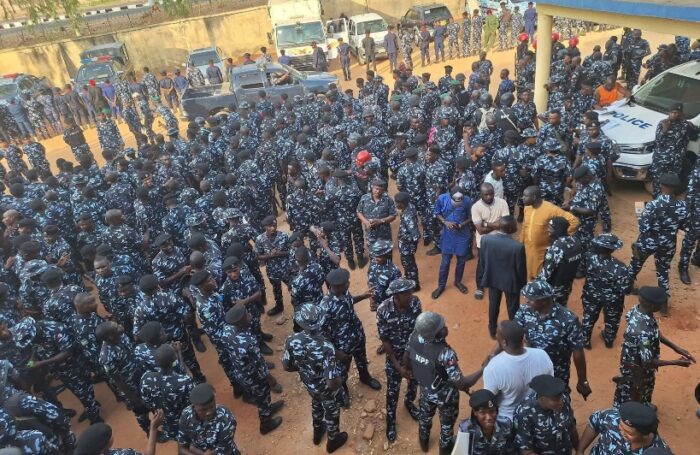
It was the 24th of June 2026, I was at the National Assembly complex on a different mission, and to my surprise, while I was aware that both assemblies are on recess, I was surprised to realize that the Senators were all on ground and in an emergency, session discussing the State Police. That sight reminded me of a book on Police Reform and National Security that I started writing ever since the beginning of this administration. Some of the ideas in that book are part of this piece.
On that same Wednesday, June 24, 2026, the Nigerian Senate passed the Constitution Alteration Bill establishing State Police Services, an act its sponsors called a ‘historic milestone.’ The applause in the chamber was immediate. Several State governors who had lobbied hard for the bill were in the gallery, watching the vote go their way. By the next morning, commentators and columnists were falling over each other to describe the development as the dawn of a new security architecture. Let me say this clearly at the outset: I do not oppose the idea of decentralised policing. In a country as vast, as ethnically layered, and as chronically insecure as Nigeria, the centralised federal police model has demonstrably failed. Communities in the Lake Chad Basin, the Middle Belt, and across the Northwest have watched their villages burn while waiting for security responses that never came, or arrived too late and too few. The demand for a more responsive, locally embedded security structure is legitimate, urgent, and overdue.


But passing the right idea through the wrong hands, at the wrong time, under the wrong conditions, does not make it right. It makes it reckless. And this State Police Bill, as currently constituted and as passed by the Senate on June 24, 2026, is the right idea handed to exactly the wrong people.
This article is not a rejection of decentralisation. It is a demand that we be honest about who we are decentralising power to , and what the evidence tells us they have done with every instrument of power they have been given so far.
I. The Bill in Brief: What Was Actually Passed
The legislation that passed the Senate replaces the existing Nigeria Police Force with a Federal Police Service and creates a dual policing structure. State Commissioners of Police will be appointed by governors, subject to confirmation by State Houses of Assembly. No State will commence operational policing until its legislature passes the necessary enabling law and the new force is certified against national standards. The Federal Government retains emergency override powers in defined circumstances.
At least 24 of the 36 State Houses of Assembly must still ratify the constitutional amendment before it takes full legal effect. That process is ongoing. But the political momentum is real. And with the Governors’ Forum squarely behind it, ratification is a near certainty. So we must ask the question now, before the ink dries, should we entrust men who have consistently weaponised every instrument of authority within their reach, with their own dedicated, uniformed, armed police forces?
II. The Precedent of Abuse: What the Record Shows
The question of whether Nigerian governors can be trusted with State police is not speculative. The answer is already written in the record of what they have done with every security-adjacent power they already possess.
ABUSE OF SECURITY VOTES
Every month, Nigeria’s 36 State governors receive what are called ‘security votes’ , discretionary monthly cash allocations officially earmarked for urgent security interventions. These funds are not audited. They have no expenditure breakdown. They are shielded from legislative oversight and independent scrutiny. In a functional democracy, this arrangement would be considered extraordinary. In Nigeria, it has become routine entitlement.
The numbers are staggering. According to Transparency International, Nigeria allocates an estimated #241.2 billion annually in security votes , more than the Nigerian Army’s annual budget, 70 percent more than the Nigerian Police Force’s annual budget, and more than the combined budgets of the Navy and Air Force. In 2021 alone, State governors and local government chairmen across the federation collected over #375 billion from the public treasury under this heading. A former EFCC Chairman alleged that some governors deliberately fuel insecurity in their States to justify larger security vote appropriations. The Court of Appeal, in the case of FGN v. Jolly Nyame, ruled that a governor’s failure to account for security votes ‘amounts to stealing or criminal misappropriation.’
“Security vote is like a bottomless pit in terms of hugeness.” , Senior Nigerian official speaking to BusinessDay, on condition of anonymity
The former Governor of Taraba State, Jolly Nyame, was convicted in 2018 partly for collecting billions of naira in security votes without accounting for them. One former South-South governor was accused of diverting #4.5 billion meant for the Army, Navy, Civil Defence, and DSS. In Osun State, the sitting governor reportedly receives #600 million monthly in security votes , #7.2 billion annually, #28.8 billion over a single term. By 2024, despite FAAC allocations to States having jumped by over 60 percent following subsidy removal , states received #5.81 trillion that year , attacks, killings, and abductions multiplied rather than declined. These are not theoretical possibilities of abuse. This is documented, adjudicated, convicted abuse. These are the men who will appoint their own Commissioners of Police.
WEAPONISING EXISTING SECURITY STRUCTURES
Beyond the financial dimension, the record of how governors have used security structures that already report to them , or that they have created , is deeply alarming. Several States, in response to insecurity they often failed to prevent, established regional security outfits. In the South-East, the Ebubeagu was linked to at least 12 documented incidents of violence against civilians between January 2021 and February 2023. The Amotekun in the South-West , though operationally better , has also been cited for incidents of abuse. These outfits, reporting directly to governors, operated with near-total impunity. The US State Department’s Human Rights Reports have repeatedly noted that ‘State-sponsored vigilante groups operate with near impunity’ in Nigeria.
In Kaduna State, documentation from human rights organisations records that under a previous administration, security forces were deployed selectively against peaceful protesters while response to documented extremist violence was delayed and inadequate, with communities in southern Kaduna repeatedly reporting that they gave advance warning of impending attacks and received no protection. In Imo State, Amnesty International documented 62 cases of arbitrary arrest, ill-treatment, and torture linked to security operations in the South-East. In Rivers State, INEC accused soldiers , coordinated partly through the State security architecture , of intimidation and unlawful arrest of election officials during the 2019 governorship elections. In 2010, the Governor of Imo State at the time sent a team of armed police to abduct an internet journalist from his home. The use of State security offices to beat journalists, seize their equipment, and silence coverage of political events has been documented across multiple States. These incidents are not isolated. They constitute a pattern of behavior stretching across administrations, parties, and geopolitical zones.
ELECTORAL VIOLENCE AND POLITICAL WEAPONISATION
Perhaps the most dangerous dimension of the State police question is the electoral one. Nigeria’s elections have historically been the theatre in which political violence by State actors is most concentrated. According to ACLED’s analysis of the 2023 elections, party militias, criminal gangs, and armed groups were engaged to suppress opponents, deter rival candidates, and influence the process , with governors identified as either direct sponsors or complicit enablers. Human Rights Watch’s reporting on Nigerian elections has documented a culture of ‘godfather’ politics in which governors exercise near-total control of State-level institutions, including police, to advance their preferred outcomes. Rivers State alone recorded the highest incidents of violence in the 2015 elections. In Kano, post-election violence in 2011 was traced partly to the political mobilisation of State-level security networks. The question is not whether a Nigerian governor would use a State police force to influence an election. Based on the documented pattern, the question is which governors would not.
III. The Deeper Structural Problem: State Police Is Still Centralisation
Here is the argument that its proponents often miss, or deliberately obscure: State Police is not decentralisation. It is the relocation of a centralisation monopoly, from Abuja down one floor to the Government House. The problem with Nigeria’s federal police model has never been simply that it is federal. The problem is that it is centralised, distant from communities, politically directed at the top, under-resourced at the bottom, and structurally disconnected from the local knowledge that makes effective policing possible. State Police replicates every structural deficiency of the federal model, simply at a smaller geographic scale. A Commissioner of Police appointed by a governor and confirmed by a House of Assembly the same governor controls will face the same political directives, the same pressure to serve power rather than people, the same immunity from accountability , just from a different political patron.
If we are serious about decentralising security in this country, truly serious, , we must decentralise it to where the insecurity actually lives: the ward, the community, the local government area. Every kidnapping, every herder-farmer clash, every bandit attack, every communal eruption this country has suffered in the last two decades has its roots in dynamics that are fundamentally local. The response must be proportionately local.
The governance vacuum in the hinterlands created the breeding ground for banditry and insurgency. Without functioning local councils to maintain security or roads, farmers abandoned their fields, directly fuelling the food inflation crisis of 2023-2024., The Guardian (Nigeria), May 2026
IV. The Alternative: Revive the Local Government, Revive the Country
There is a better path. It is not new, it is not untested, and it does not require us to hand guns to men who have already demonstrated they cannot be trusted with unaccounted cash. What it requires is political will to reverse a deliberate, decades-long assault on Nigeria’s third tier of government.
A. RESTORE GENUINE LOCAL GOVERNMENT AUTONOMY , AND ENFORCE IT
On July 11, 2024, the Supreme Court of Nigeria delivered what constitutional lawyers described as one of its most consequential rulings in decades. It ruled that local governments must receive their statutory allocations directly from the Federation Account , that the long-standing practice of routing funds through State governments was unconstitutional. The ruling barred governors from dissolving democratically elected local councils and replacing them with caretaker committees. One year after that landmark judgment, State governors had collectively retained control of #4.5 trillion in local government allocations. Some States passed laws designed to superficially comply with the ruling’s letter while gutting its spirit. Anambra State passed a law requiring that local government allocations first be deposited into a State-controlled joint account. In January 2025, the CBN itself diverted #361.754 billion in LGA funds through State governments, citing a requirement for LGAs to produce two-year audited accounts, a requirement not mentioned in the Supreme Court ruling. As of mid-2026, the ruling is still substantially unimplemented.
This tells us everything we need to know about what governors will do with police forces they control. They will resist every mechanism of accountability. They will route every resource through channels that keep power in their hands. The same governors who are today celebrating the passage of the State Police Bill are the very governors who, for over a decade, have been systematically starving, hollowing out, and politically capturing the local government system that the constitution designates as the third tier of governance.
The simple demand this country must make, before any further security reform, is this: implement the Supreme Court’s July 2024 ruling. Fully. Without loopholes. With contempt proceedings against every governor who defies it. Let local governments breathe. Let them receive their funds, conduct their elections, and begin the process of building functional institutions at the grassroots. That is the first reform.
B. REVIVE AND STRENGTHEN THE LOCAL GOVERNMENT PEACE AND SECURITY COMMITTEES
During the administration of President Ibrahim Babangida, Nigeria operated a framework of Local Government Peace and Security Committees , grassroots bodies that embedded conflict prevention and security response at the council level. This was not a perfect framework. Nothing produced by a military administration is beyond critique, and the IBB era was not without serious contradictions. But the structural logic of that framework was sound: insecurity in Nigeria is, at its core, a local phenomenon that demands local architecture. Academic research published as recently as 2025 confirms what experienced practitioners in Nigeria’s security sector have known for years: where local peace committees have been established and properly resourced, they have facilitated early intervention in conflicts before they escalated into violence. The limitation has not been the concept, it has been insufficient resources, corruption at the local level, and the systematic undermining of local government by State governments that treat councils as political extensions of the Government House.
These committees, if properly revived and legally grounded, can serve as the institutional framework through which community security intelligence is gathered and acted upon, inter-community conflicts are mediated before they turn violent, traditional leaders and religious authorities are formally integrated into the security architecture, and local police, whether reformed federal police or eventual community constables , are embedded in and accountable to the communities they serve. The key difference between this proposal and the State Police Bill is accountability. A Commissioner of Police appointed by a governor is accountable to the governor. A community security committee drawn from the local government, civil society, traditional institutions, and security agencies is accountable to the community itself. That is not a cosmetic distinction. It is the foundational distinction between policing that serves power and policing that serves people.
C. REFORM AND PROPERLY RESOURCE THE NIGERIA POLICE FORCE
The predictable objection to police reform as an alternative to state police is: we have been reforming the NPF for decades and nothing has changed, so why should we believe reform will work now? It is a fair challenge, and it deserves a direct answer. The Nigeria Police Force has not failed simply because its personnel are inadequate, though recruitment practices have been notoriously poor, often favouring political cronies, the economically desperate, and in documented cases, individuals with serious character deficiencies. The NPF has failed primarily because of structural problems: severe underfunding, political interference from Abuja, deployment practices that concentrate officers in the capital while leaving rural communities unprotected, and the complete absence of community embedding.
What genuine reform would look like is different from what has been attempted before. It begins with a radical change in recruitment: officers drawn systematically from each state, deployed to their home local government areas where they have cultural and linguistic knowledge of the communities they serve, and left there, not rotated to the next posting on political whim. A police officer who grew up in Birnin Gwari, is deployed to police Birnin Gwari, and whose family still lives in Birnin Gwari, has a fundamentally different relationship with that community than an officer posted there from Lagos who counts the days until his transfer. This requires money. A substantial, ring-fenced, independently audited portion of the national budget must go to the police, not to security votes that disappear into governors’ accounts, but to salaries, equipment, training, welfare, and infrastructure. According to SBM Intelligence, between 2016 and 2020, over $11 million was paid in ransoms alone in Nigeria. The 2023 Global Terrorism Index ranked Nigeria as the fourth most terrorised nation in the world, after Afghanistan, Iraq, and Somalia. The 2024 defence allocation was #1.54 trillion , the highest in history. Yet the ICRC still tracks 23,000 missing persons in Nigeria, the highest of any single country it operates in. Money, without structure and accountability, does not buy security. A reformed NPF, properly funded, locally recruited and embedded, with independent oversight and meaningful accountability mechanisms including community-level oversight boards, addresses the actual structural failures of Nigerian policing. State Police merely replaces one political principal with another.
V. On the Irony of the IBB Framework: Addressing a Fair Challenge
A sharp reader will notice, and some critics will raise, what appears to be an irony in this argument. The Local Government Peace and Security Committee framework I am championing was introduced under a military administration. How can I invoke a military-era structure as the democratic alternative to a bill that was passed through the democratic legislature of the Federal Republic of Nigeria? The answer is that the origin of a framework does not determine its democratic validity. The 1976 Local Government Reform that formally institutionalised the LGA system in Nigeria was also a product of military governance , under General Murtala Muhammed. Yet no one argues that local government is inherently undemocratic because it was formalised under military rule. What matters is the logic of the framework, whether the structure, if properly empowered and properly overseen, serves democratic governance and public welfare. The logic of grassroots peace and security committees is not military logic. It is the logic of subsidiarity , the principle that decisions and responses should be made at the lowest effective level of governance. It is the same logic that underlies community policing models across the democratic world, from Japan’s koban system to Kenya’s Nyumba Kumi initiative to Colombia’s post-conflict reconciliation committees. The fact that IBB established something resembling this framework does not taint the framework. It simply means that even a flawed administration, in a particular moment, got the structural logic right.
What is democratically suspect is not the grassroots framework. What is democratically suspect is handing armed police forces to men who have repeatedly defied Supreme Court orders, siphoned security votes without accountability, weaponised existing security structures against journalists and political opponents, and systematically stolen the financial autonomy of the local government tier that the constitution explicitly designates as the third tier of governance. That is the democratic problem. And the State Police Bill does not solve it. It deepens it.
VI. The Fiscal Scandal Behind the Security Failure
It is worth pausing to place this conversation in its full fiscal context, because the scale of what has been extracted from the Nigerian public, ostensibly in the name of security, while insecurity worsens, is one of the most damning indictments of the political class this country has produced. Nigeria’s 36 governors take their monthly security votes, billions of naira, unaudited, unaccountable, shielded from legislative scrutiny. They control the Joint State-Local Government Account through which they intercept funds constitutionally designated for local councils. They take from FAAC. They take from Internally Generated Revenue. They borrow externally. And despite all of this, they arrive at federal government meetings to complain about insecurity and demand more resources.
The absurdity is systemic. Transparency International estimated that Nigeria allocates approximately $670 million annually in security votes, more than what the US and UK have cumulatively spent on security assistance to Nigeria over multiple years. Security analysts have estimated that over $60 billion has been expended in security votes across all tiers of government since the return to democracy in 1999. Yet the ICRC tracks 23,000 missing Nigerians. Kidnappings are a growth industry. Farmers cannot reach their fields in the Middle Belt. Communities in the Northwest have been displaced for years.
This is not a resource problem. This is a governance problem. And no amount of structural reorganisation of the police, whether federal, state, or community, will solve a governance problem. What solves a governance problem is accountability. Monitoring. Consequences for failure. Transparent audit of every naira spent in the name of security, by every official at every tier. State Police, as currently conceived, adds a new structure to this accountability vacuum without closing the vacuum. It gives governors a new instrument of power without imposing new obligations of transparency. That is not reform. That is expansion.
VII. What Must Happen Instead: A Practical Roadmap
This is not an argument for the status quo. The status quo is unsustainable. Every day that passes without structural change is a day that more Nigerians are killed, kidnapped, or displaced. The demand is not for inaction. The demand is for the right action, grounded in evidence, accountability, and a genuine commitment to grassroots governance. Here is what that looks like:
First: Implement the Supreme Court’s July 2024 ruling on LGA financial autonomy, fully, immediately, with enforcement mechanisms that impose real consequences on any governor who continues to intercept local government funds. Contempt proceedings, withholding of FAAC allocations to the State, whatever it takes. The constitution has spoken. The Supreme Court has spoken. The governors must comply.
Second: Revive and legally ground the Local Government Peace and Security Committees, drawing membership from locally elected officials, traditional rulers, civil society organisations, religious leaders, women’s groups, and community security stakeholders. Establish these committees as the primary interface between communities and formal security agencies at the grassroots level. Fund them from local government allocations with independent oversight.
Third: Undertake genuine police reform with a radical localisation of recruitment and deployment. Officers should be recruited from their home states, trained to national standards, and deployed to their home local government areas. Rotation across distant states should be the exception, not the rule. The officer who polices his own community is accountable to his community in ways that no disciplinary board can replicate.
Fourth: Establish an independent, publicly audited National Security Expenditure framework. Every naira expended in the name of security, at every tier, by every official , must be accounted for. Security votes should be either abolished or converted into transparent line-item appropriations subject to full legislative and public scrutiny. The Court of Appeal already established that failure to account for security votes is criminal misappropriation. It is time the EFCC and ICPC applied that ruling consistently.
Fifth: If State police is to be considered in the future, it must come after a demonstrated record, not a promised record,, of governors respecting LGA autonomy, accounting for security votes, conducting free and fair council elections, and refraining from weaponising existing security structures for political ends. Trust must be earned through demonstrated accountability. It cannot be granted on the basis of legislative passage and good intentions.
Conclusion: Decentralise Power, Not Danger
The Nigerian Senate was not wrong to recognise that the current policing structure has failed the Nigerian people. It was wrong to conclude that the solution is to hand that failure to thirty-six governors who have provided no evidence that they will manage it better.
The insecurity devastating this country is local in its roots, local in its manifestations, and local in its solutions. Bandits do not emerge from nowhere. They emerge from communities with no economic prospects, from governance vacuums where the state has never shown up, from spaces where the closest thing to local authority is a vigilante group funded by a distant governor for purposes that have nothing to do with community protection. The answer to that is not a State Commissioner of Police appointed in the capital of the state. The answer is a functioning local government that maintains roads so farmers can reach markets, that operates basic health infrastructure, that has a peace and security committee where community members can report tensions before they become attacks, and that has police officers who are from the community, know the community, and are accountable to the community.
What Nigeria needs is not decentralisation that stops at the Government House. Nigeria needs decentralisation that goes all the way to the ground, to the ward, the village, the council. That is not what the State Police Bill delivers. That is what a serious commitment to local government revival, genuine LGA autonomy, community security infrastructure, and reformed, locally-embedded policing would deliver. The Senate acted with enthusiasm this week. What the country needed was wisdom. Enthusiasm without wisdom, in the hands of those with a documented record of abuse, is not a milestone. It is a warning sign.
Nigeria must build security from the ground up. Not from the Government House down.
Suleiman Usman Yusuf is a governance, peace and security consultant with over 17 years of professional experience spanning PCVE, counterterrorism strategies, programme/project design, development research, and policy development across Nigeria and the Lake Chad Basin region. He writes from Abuja and can be reached via [email protected]

