
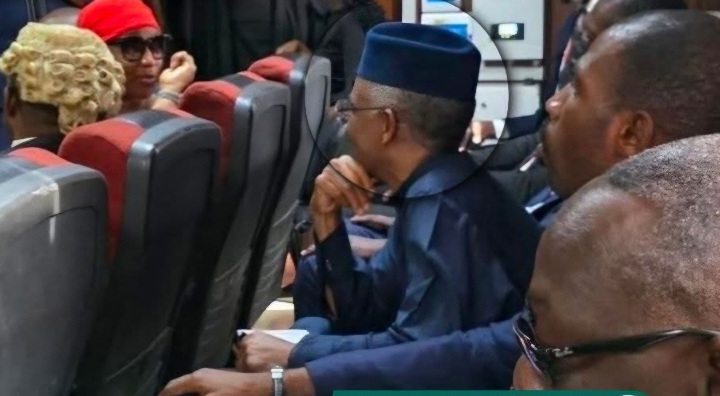
The ongoing legal tribulations surrounding Malam Nasiru El-Rufai have sparked a fierce debate that cuts to the very heart of Nigeria’s democratic experiment. When an individual is confronted not just with one legal challenge, but with a dizzying barrage of cases spanning multiple courts and jurisdictions, it ceases to look like routine law enforcement. Instead, it begins to resemble a coordinated strategy of legal attrition: a calculated effort to ensure that as soon as one legal hurdle is cleared, another is instantly erected.
The onerous and near-impossible conditions attached to El-Rufai’s bail applications serve as a deeply troubling pointer. When the conditions for freedom are made so prohibitively high that they mimic detention in all but name, the judiciary risks sending a dangerous signal to the public: that it is no longer a neutral, blindfolded arbiter of justice, but rather an asymmetric instrument of state discomfort.


The fundamental pillar of our criminal justice system is the presumption of innocence. Bail is not a benevolent favour granted by the state; it is a constitutional right designed to ensure that an accused person can adequately prepare their defence while maintaining their liberty. However, the current attitude of key prosecuting agencies, notably the Independent Corrupt Practices and Other Related Offences Commission (ICPC) and the Department of State Services (DSS), has been decidedly adversarial and less than friendly.
By inundating the former governor with a plethora of concurrent cases, the state apparatus appears intent on orchestrating a scenario where admission to bail becomes a statistical impossibility. This multi-front legal warfare seems less about the swift, fair administration of justice and more about ensuring that, one way or another, El-Rufai remains constrained. When the machinery of the state is deployed with such overwhelming, overlapping force against a single citizen, it naturally invites public skepticism and erodes trust in the impartiality of our temples of justice.
Faced with such an aggressive onslaught, it is entirely understandable that El-Rufai’s defence team might feel overwhelmed. Managing a mountain of high-stakes cases simultaneously across different jurisdictions is a logistical and intellectual nightmare for any legal team. Yet, despite the immense pressure and the glaring provocations, the temptation to abandon the courtroom for the theater of public sensationalism must be fiercely resisted.
Whenever a court of law delivers a flawed ruling, whether through an outright refusal of bail or by imposing excessively prohibitive and onerous conditions, the remedy does not lie in political agitation or media grandstanding. The remedy lies strictly within the architecture of the law itself.
The defence team must aggressively explore the options of appeal or applications for review in the appellate courts. Letting this matter degenerate into a media circus is a slippery slope that yields no sustainable legal victories. Already, we are witnessing worrisome interventions being sought from strange quarters, including public clamorings and political actors calling on the President to directly step in and order his release.
To ask the executive arm of government to interfere in an active judicial matter is to invite a cure that is far worse than the disease. We cannot logically demand judicial independence on one hand while begging for executive interference on the other. Such a move would only further damage the fragile separation of powers that holds our democracy together, setting a precedent where political privilege trumps constitutional process.
The battle for Malam Nasiru El-Rufai’s freedom must be fought and won within the walls of the higher courts. The judiciary may currently be facing a profound crisis of perception, but the only way to compel it back to strict neutrality is through rigorous, unyielding, and sophisticated legal advocacy. The defence must trust the appellate process to correct the excesses of the lower courts, ensuring that the rule of law, rather than political expediency, carries the day.
- Mr Abdulkadir is a legal consultant and can be reached via [email protected]

