
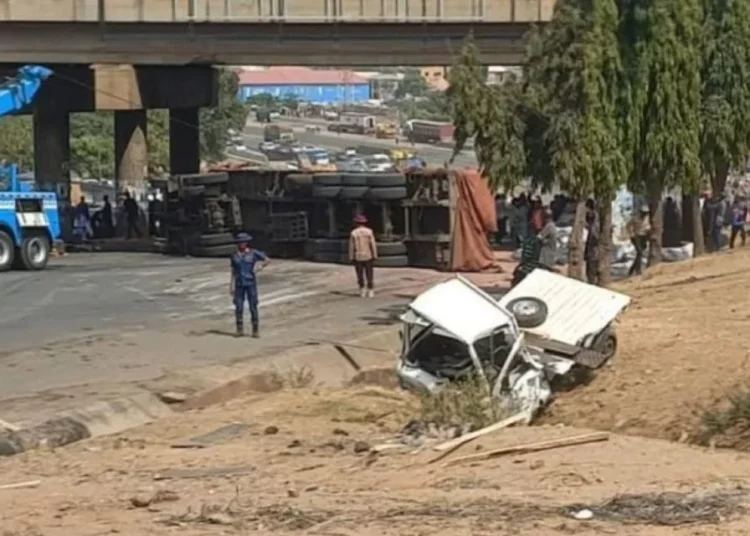
There was a time when many motorists approaching the Kugbo outbound corridor of the Federal Capital Territory (FCT) Abuja did so with quiet but unimaginable anxiety and panic.
The fear was not imaginary.


It was born from a recurring pattern that had become painfully familiar: massive articulated trucks struggling through peak hour traffic, smaller vehicles trapped beside them, impatient motorists competing for limited road space, and all too often, another devastating crash that would leave families shattered and communities in mourning.
For years, the narrative barely changed Until March 18, 2026.
On that day, the Federal Road Safety Corps (FRSC), under the leadership of the proactive Corps Marshal Shehu Mohammed , chose not to wait for another tragedy before acting. Instead, the Corps launched what has now become one of the most remarkable preventive road safety interventions in recent years, “Operation Safe Kugbo”.
The mission was straight forward, game-changing but bold. Keep articulated vehicles off the Kugbo outbound Abuja–Nasarawa corridor during the most rush hours of the day.
No complicated theories. No expensive infrastructure. No dramatic public spectacle. Just a carefully planned, intentional deployments and intelligence-driven intervention built on one simple belief: if the greatest source of danger is removed at the time the risk is highest, lives will be saved.
Outcomes have proved that belief right.
Since the commencement of Operation Safe Kugbo on 18th March 2026, not a single fatal road traffic crash has been recorded on the affected corridor. Not one.
In a country where road crashes involving heavy-duty vehicles have become one of the most difficult transportation safety challenges, that statistic deserves more than applause. It deserves careful understudy.
The operation, implemented in accordance with Section 223 of the National Road Traffic Regulations (2022) and the FCT Traffic Regulations, targets one of Abuja’s busiest commuter routes during evening peak periods between 3:00 p.m. and 9:00 p.m., when traffic density is at its highest and the consequences of a single mistake can be catastrophic.
Rather than allowing articulated trucks to compete for limited road space with thousands of commuters rushing home, FRSC personnel enforce temporary movement restrictions until traffic eases. Of course, this pin down operation is driven by mutual understanding between the Corps and fleet operators.
The impact has been extraordinary.
Within just 100 days, over 7,000 articulated vehicles were successfully restricted from operating during the designated peak hours, the outcome of engagement and resilience in road traffic management.
Even more remarkable is what did not happen. No fatal crash. No mass casualty involving articulated vehicles.
No heartbreaking headlines from a corridor once associated with avoidable tragedy. Behind those numbers lies a far bigger story. Every truck temporarily held back, represented a potential disaster prevented.
Every evening of uninterrupted enforcement represented hundreds of families reunited safely at home. Every commuter who arrived without sad incident became part of a silent success story they may never be fully appreciated. Road safety management is unique among public services because its greatest achievements often go unnoticed.
Society celebrates heroic rescue operations after disasters occur but rarely recognises the invisible victories that prevent disasters from happening in the first place. Operation Safe Kugbo belongs firmly in that second category. Its success was not built on overwhelming manpower or sophisticated technology.
Only six Officers, twenty two Marshals, two patrol vehicles and four motorcycles deployed on consistent shift basis in the last 100 days, sustained the operation across the entire reporting period. Through professionalism, consistency and disciplined coordination under the leadership of the Nyanya Unit Command, the exercise recorded full compliance from articulated vehicle operators without significant operational challenges. That is effective public service at its finest.
The intervention also reflects a broader shift in the philosophy of road safety administration. Modern road safety is no longer about responding faster after crashes occur, preventive in lieu of responsive measures. It is about ensuring that crashes do not occur at all. That distinction matters.
When emergency responders arrive at a crash scene, they may save lives but when preventive strategies eliminate the crash altogether, every life is saved.
Operation Safe Kugbo is a practical demonstration that the most successful road safety strategy is not measured by the number of offenders prosecuted or patrols conducted. It is measured by empty accident registers, fewer emergency calls, hospital wards that never receive crash victims and children who never become orphans because a tragedy was prevented.
Perhaps the most profound lesson from the Kugbo experience is that leadership still matters. Decisive leadership. Visionary leadership. Leadership willing to confront long-standing problems before they become breaking news.
The Corps Marshal’s directive transformed what had become an earlier accepted danger into a manageable safety challenge. Rather than reacting to another fatal collision, the FRSC anticipated the risk, deployed targeted enforcement and remained consistent enough for the results to become undeniable. That is what proactive governance looks like.
As Nigeria continues to grapple with the enormous human and economic cost of road traffic crashes, Operation Safe Kugbo offers a blueprint worthy of replication across other high-risk corridors. It proves that with data-driven planning, sustained enforcement and institutional commitment, lives can be protected without waiting for another tragedy to justify action. Interestingly, the FRSC high Command is presently working towards extending the Kugbo formula to other “troublesome” corridors of the nation’s highways.
Road crashes are often described as accidents. Many are not.
They are predictable consequences of identifiable risks. And when those risks are confronted with courage, strategy and consistency, the outcome can be extraordinary.
For over 100 consecutive days, and counting, the Kugbo corridor has told a different story. It is no longer a symbol of recurring tragedy. It has become proof that when prevention, consistency and resilience leads, lives are saved. Sometimes, the greatest public safety success is not the crash that made the news. It is the crash that never happened.
It is strongly envisaged that with the Corps’ renewed drive and commitment towards achieving permanent safer motoring environment along the Kugbo corridor, similar impacts will be felt across the FCT and other corridors, nationwide.
- Osondu Ohaeri, a Fellow of the Nigerian Institute of Public Relations, is a Deputy Corps Commander and Corps Public Education Officer at the FRSC National Headquarters, Abuja.

