
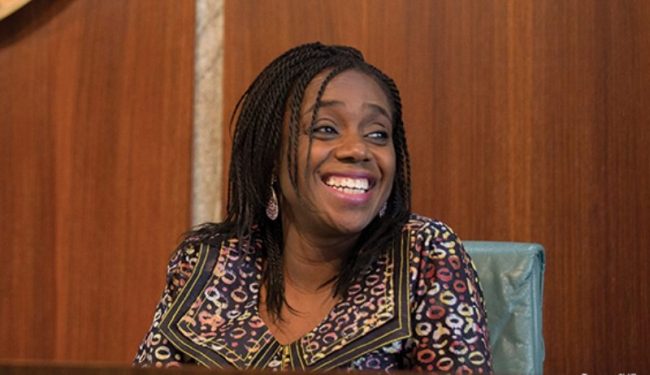
The trust Nigerians repose in authorities to scrutinise and decide on the capable hands who will assist in steering the ship of governance should not be taken with a pinch of salt. The recent interview granted by the former Minister of Finance, Kemi Adeosun, which once again stirred public debate around her resignation, compelled me to reflect on the critical role of the National Assembly, particularly the Senate, and the security agencies tasked with conducting background security checks on nominees for political appointments. Her attempt to reshape the narrative of what led to her exit in 2018 has forced me to look beyond her case and revisit a broader question: how effective are our vetting and verification systems, and who truly protects the public interest during appointments into public office?
Recently, I wrote an opinion on the controversies surrounding the new tax laws. In that article, I raised a critical question: what would have happened if Honourable Dasuki, the legislator who discovered discrepancies between the gazetted tax law and the version passed by the National Assembly, had chosen indifference instead of diligence? What if he did not bother to obtain the gazetted copy, compare documents, and raise the alarm? The feedback I received from professional bodies, columnists, and concerned citizens across Nigeria confirmed that the issue resonated widely. It spoke to a shared anxiety Nigerians have about oversight, accountability, and the cost of institutional negligence. That same anxiety sits at the heart of this conversation.


The screening of political appointees is one of the most important safeguards in any democracy. It is meant to ensure that only individuals of proven competence, integrity, and credibility are entrusted with public power. In Nigeria, this responsibility largely falls on the National Assembly during confirmation hearings, supported by security agencies expected to conduct background and credential checks. However, time and again, these mechanisms embarrassingly fail. Each failure chips away at public confidence and reinforces the belief that due process is either weak, compromised, or treated as a mere formality in Nigeria.
The case of Kemi Adeosun is one of the most glaring examples of this failure. She was appointed Minister of Finance, cleared by the Senate, and served at the highest levels of economic management of the largest black nation in the world before it was discovered that she forged her National Youth Service Corps (NYSC) exemption certificate. Amidst speculations, the NYSC National Headquarters officially confirmed that the certificate she presented was not issued by the scheme. What makes this case more disturbing is not just the compromise per se, but the fact that it took the investigative work of a journalist to uncover what multiple state institutions failed to detect. The question then was: what exactly was verified during her screening?
Another embarrassing case was that of Uche Geoffrey Nnaji, who served as Minister of Innovation, Science, and Technology under President Bola Tinubu between 2023 and 2025. He presided over one of the most critical ministries responsible for driving Nigeria’s technological and innovation agenda. At a time when Nigeria needs competent leadership to compete globally, it was later confirmed that the degree certificate he claimed was forged, as established by the university he purportedly attended. That such an individual could seamlessly assume office, make policy decisions, and represent Nigeria without detection is nothing short of a national shame.
These cases are leaning towards institutional failures rather than personal scandals. They underscore deep cracks in the systems designed to protect Nigerians from incompetence and deceit in public office. More importantly, they raise a frightening possibility that the individuals exposed so far are just those whose cases happened to be discovered. If thorough, independent investigations were conducted across board, how many more appointees or even elected officials would be unable to retain their seats?
Since Nigeria’s return to democracy, controversies of this nature have surfaced numerous times. When wrongdoing moves from being occasional to recurring, it ceases to be accidental. It becomes structural. The persistence of forged certificates, falsified records, and questionable credentials suggests that something is fundamentally wrong with the vetting process. Either the responsible institutions lack the capacity to do their job, or worse of it, which is most likely, they lack the seriousness to do it well.
This erosion of standards has consequences beyond national embarrassment. It discourages capable and honest citizens from public service, normalises mediocrity, and weakens governance outcomes. When people of questionable competence occupy strategic positions in a country that struggles with myriad governance challenges, policies suffer, institutions stagnate, and public trust collapses. Nigerians begin to ask whether rules exist only on paper, and whether integrity is not a necessity at the highest levels of leadership.
There is a need for reform. The vetting process for political appointees must be structurally strengthened. This may require a complete overhaul of the legal and institutional frameworks that assign screening responsibilities to the National Assembly and security agencies. Verification of academic and professional credentials should be mandatory, independent, and transparent, not rushed through in the name of political convenience.
People of questionable competence should have no business in governance or public service. The loopholes in the vetting process, and the apparent recklessness or disinterest of the authorities responsible, are what continue to attract such individuals into public office. Until these loopholes are closed, the confidence Nigerians place in democratic institutions will continue to erode, and governance will remain vulnerable to avoidable failures. Nigeria deserves better. And it starts with taking vetting seriously as a duty owed to the people.
- Isah Kamisu Madachi is a policy analyst and development professional. He writes from Abuja and can be reached via: [email protected]

