
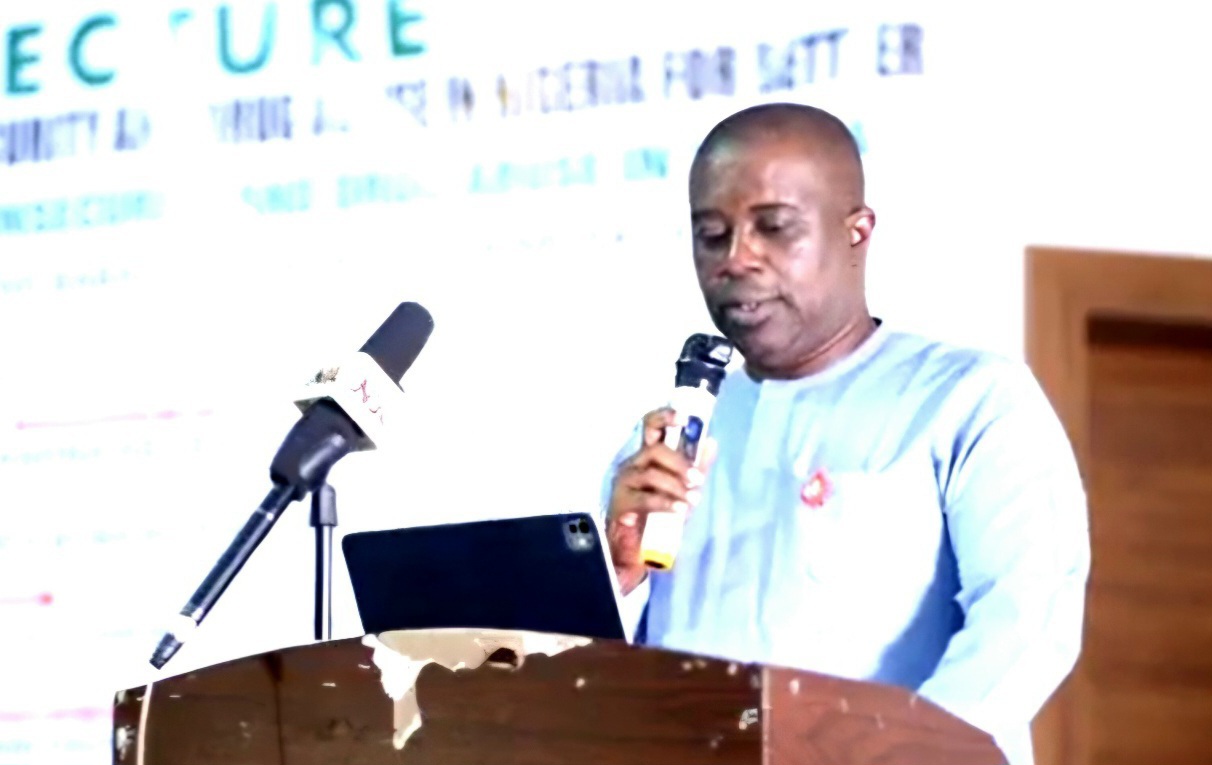
A paper presented by Mr. Femi Babafemi, the Director, Media and Advocacy, National Drug Law Enforcement Agency (NDLEA) at a public lecture organised by Muslim Rights Concern (MURIC), Abuja chapter, held at the Conference Hall, National Mosque, Abuja on Saturday, January 17, 2026
PROTOCOL:


It is a profound honour to stand before this gathering of spiritual guides and community pillars. On behalf of the Chairman/Chief Executive Officer of the National Drug Law Enforcement Agency (NDLEA), Brig. Gen. Mohamed Buba Marwa (Rtd) CON, OFR, who I also represent here, I want to express our deepest gratitude to the Muslim Rights Concern (MURIC) for organizing this timely lecture.
We are here because we recognize a fundamental truth: the fight for a secure Nigeria begins with the moral and spiritual fortitude of her people. I want to begin by thanking our religious leaders for consistently lending your voices to the fight against illicit drugs. We appreciate your continued spiritual guidance and community leadership in promoting peace, morality, and discipline.
You possess an enormous influence that no law enforcement agency can replicate. You shape minds, guide behaviors, and hold the trust of millions across all segments of society. While the NDLEA works tirelessly on enforcement, we believe that prevention, empowerment, and moral reorientation are the true keys to long-term success. In these areas, your role is not just helpful—it is indispensable.
The nexus between drug abuse and criminal behaviour
Many times, we have said this at different fora, that there is a connection between drug use and the challenge of criminality in our country, like other places.
This may at first seem far-fetched for the average Nigerian, but for students of criminology or military history, and the personnel of various government security agencies, this is not a baseless assumption. The relationship between substance abuse and crime is a fact. Sociologists and psychologists have been studying these for ages. What is clear is that no sane human being will rise against society to commit the kind of gross atrocities as we are witnessing in recent years, except such an individual has first hardened his heart with mind-altering substances.
Will anyone in his right senses assemble lethal weapons and say to others: “Let’s go and kidnap 300 children today?” Will anyone whose mind is working correctly wake up and say, “Today, we have to kill a lot of people?” No one in his right sense will storm a school hostel, kidnap innocent young people and kill some of them while holding the rest for ransom. These extreme actions can only be perpetrated by someone under the influence of drugs.
So, beyond speculations and armchair theories, there is ample evidence, from report statistics and from empirical data from the field, to conclude that the use of illicit substances is a contributing factor to the security situation in Nigeria.
Troubling drug abuse statistics
Let’s give you an insight into the drug abuse statistics in our country. Based on the 2018 drug use survey report by UNODC and NBS, the report shows our country has one of the highest drug use prevalence in the world. The drug use prevalence in Nigeria, for ages 15 to 64 is approximately 14.4%, which is almost three times the global drug use prevalence of 5.6. This translates to 14.3 million of our compatriots aged 15 and 64 using illicit drugs other than tobacco and alcohol.
The complex nature of the security challenges facing the country calls for a holistic approach. Today, it is clear to us all that the survival of Nigeria is the collective responsibility of all Nigerians.
In this regard, we are doing our best in our area of responsibility in the NDLEA. In the past 12 months, NDLEA operatives nationwide have carried out non-stop offensives against drug cartels, barons and traffickers, leading to 19,944 arrests; seizure of 4.9million kilograms of illicit drugs; successful prosecution and conviction of 3,653 offenders and treatment and rehabilitation of 10,395 drug users, while we conducted 4,496 WADA advocacy lectures in schools, worship centres, markets, motor parks, workplaces and communities, among others. We shall not relent in our objective of having a drug-free Nigeria. We have the conviction that if we can shut down the drug pipeline, cancel out the drug demand-drug supply equation and mop up the cache of illicit substances in our territory, the insecurity problem will be half solved.
More importantly, our National Drug Control Master Plan (NDCMP) has been tweaked to also focus on drugs from the perspective of public health and education issues. This way, we will be able to provide a balanced solution to the drug scourge.
Due to the complex nature of the drug problem, we are also aware that we wouldn’t go far on this mission without the support of the public. That is why we are encouraging the public to buy in and own the fight against illicit substances. We have decided to make the campaign the people’s war, so to speak. A case of the people of Nigeria vs. drug barons, traffickers and abusers.
Drug Abuse as a Crisis of the Soul, Not Just the Law
We must be honest with ourselves: drugs have no religious boundaries. The scourge of substance abuse and illicit drug trafficking is not merely a law enforcement issue; it is a moral, social, and spiritual crisis that threatens the very soul of our nation.
Today, we see homes in ruin. Many families, especially our youth, are being destroyed by the cycle of drug dependence or addiction.
In our rural communities, poverty and ignorance are driving many to cultivate illicit drugs as a means of survival. It is also a glaring fact that there is a direct, undeniable link between drug abuse and the security challenges we face across the country. A mind clouded by substances is a mind easily recruited for violence and crime.
For us at the NDLEA, we seek your collaboration to address this challenge. We are calling on the Ummah to use your worship centers to enlighten followers and offer guidance toward legitimate and productive lifestyles. Through your sermons (Khutbahs), teachings, and community outreach, let the message ring loud: hard work and “Halal” (licit) earnings are the only paths to true prosperity.
We urge you to advertise the War Against Drug Abuse (WADA) initiative. Encourage repentance and rehabilitation for drug users rather than stigmatization.
Also encourage individuals with financial capabilities within your congregations to empower young people. Providing a young man with a skill or a start-up tool is a powerful form of crime prevention.
We ask for your support in ensuring that NDLEA’s drug control development interventions are accepted and embraced within your communities.
The NDLEA is not just asking for your prayers; we are asking for your partnership. We are committed to working hand-in-hand with religious institutions under our WADA social advocacy initiative and the National Drug Control Master Plan (NDCMP).
In conclusion, Together, we can build a Coalition of Faith for a Drug-Free Nigeria. Let the message go forth from every pulpit and mosque: Drugs destroy lives, families, and the future of our youth.
We are all custodians of the nation’s moral and spiritual fabric. We count on your leadership to redefine community values and restore the moral standards that discourage drug trafficking and abuse.
With your support, the NDLEA’s vision of a drug-free, productive, and peaceful Nigeria is not just a dream—it is achievable. Through faith, compassion, and cooperation, we will transform Nigeria into a model of lawful and sustainable development.
Compatriots, distinguished Ladies and Gentlemen of the Ummah, don’t let us fall into utter despair thinking we are helpless and at the mercy of the agents of disruptions. There is something every one of us can do to ameliorate the unacceptable state of insecurity and drug abuse in our country.
The least you can do is to join the NDLEA in the advocacy against drug trafficking and abuse. That little effort, from all of us, put together, adds up to a momentous contribution that can tilt the balance against agents of destruction and destabilisation working against the interest of this great country.
Thank you for your time, your leadership, and your commitment to this cause.

