
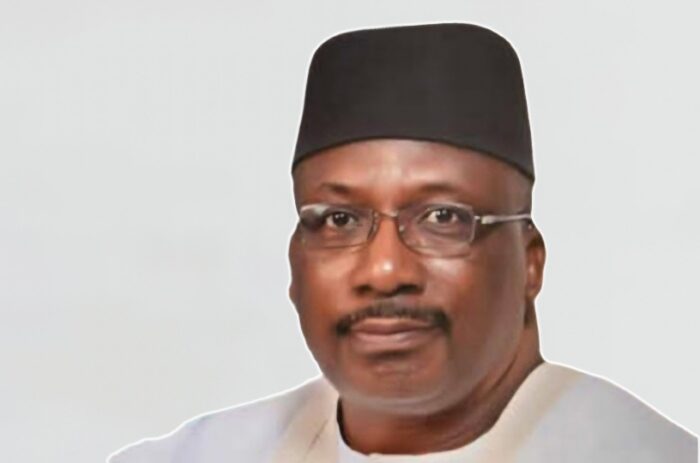
A former Chief of Army Staff (COAS), retired Lt.-Gen. Abdulrahman Dambazau has said that non-state actors in the Sahel region possess 14 million firearms.
Dambazzau, the Nigerian Ambassador designate to China, made this known in an interview with the News Agency of Nigeria (NAN) in Abuja on Tuesday.


He said that out of the number, 11 million are within the stretch of West Africa towards Central Africa
He said that insecurity in Nigeria was a complex and regional problem that required a regional approach to address it.
He added that the problem was not unique to Nigeria, adding that one of the major contributors to insecurity in the country and the Sahel region was the proliferation of firearms, and a partnership was therefore needed to fight it.
According to him, the issue of proliferation of firearms within the Sahel, as of the last count, the statistics shows that there are over 14 million firearms in the hands of non-state actors in the region.
“Out of this 14 million, about 11 million are within the stretch of West Africa towards Central Africa.
“You can guess that because of the activities of non-state actors within Nigeria and because of our population, quite a lot of these firearms are also in Nigeria. And these firearms are not manufactured here. In fact, they are not manufactured in Africa.
“They come from somewhere. So you need a partnership to deal with that proliferation, but first, you have to identify the source and block the source.
“Again to be able to sweep the excess firearms in the hands of non-state actors will require some technology, which we may not have.”
The ambassador designate also said that cross-border issues were another major contributor to insecurity in the country as Nigeria was a signatory of the ECOWAS protocol on the movement of people, goods, and services.
“Although this movement, a lot of things are happening. We have a border, for instance, with Niger of 1,400 kilometres. It’s impossible for us to physically protect this border. So what do we do?
“We need to fill the gap. So we need modern technology, high-tech, to fill the gap.
“For instance, probably looking at this, I could leverage my position as ambassador to bear in mind that the Chinese have such technology in monitoring movements and activities, and so on.
“We can leverage on that to be able to fill the gap. But also, monitoring activities is not enough without the capacity to respond. So as you are monitoring, you see activity of the enemy, then you must have the capacity to respond.
“So that itself, will require maybe procurement of weapons, like specific types of weapons and equipment. Maybe weapons that can carry out surgical operations, that can target a soldier to reduce collateral damage, correct life victims, and so on,” he added.
The former COAS further said that there was the need for state governments to develop rural areas, as it was also key to eradicating insecurity.
He noted that most of the non-state actors live within communities, adding that in view of that, it meant that the country was not fighting a conventional war, but an asymmetric war.
According to him, this is because the non-state actors employ all kinds of things to fight this war, and because it’s not a war of attrition, this makes it unique, and so it requires specialised equipment, specialised training, and so on.
“If you note most of their targets are those in the rural communities. Most of these rural communities within the states do not have much government presence, so quite a number of solutions must come from state governments.
“State governments will have to carry out development programmes within these rural communities.
“For instance access routes. A lot of these rural communities don’t have access. They don’t have health care, and you know that by virtue of the constitution, some of these are the responsibilities of state governments.
“State governments need to do more, a lot of that. The fact of the matter is that development, human security is key to solving security problems in the country.”
He added that it was not just by deploying soldiers to go out and carry out operations and come back.
“Some of the insecurity situations are tied to socio-economic issues, and so are complex.
“If you look at some of these foot soldiers of these non-state actors, insurgents, they are young people who either are coerced into doing what they are doing or doing it because of lack of anything to do.
“So it needs not just the central government, it needs efforts from state governments to carry out development in the areas of education, health care, environment, agriculture among others.
“We need to engage people in those areas, otherwise, it’s not just about war fighting, but also about development, carrying out development in some of those areas.
Speaking on Nigeria enlisting the support of counties like U.S Turkey, and China, to tackle insecurity, the diplomat said that he believed the partnership was working.(NAN)(www.nannews.ng)

