

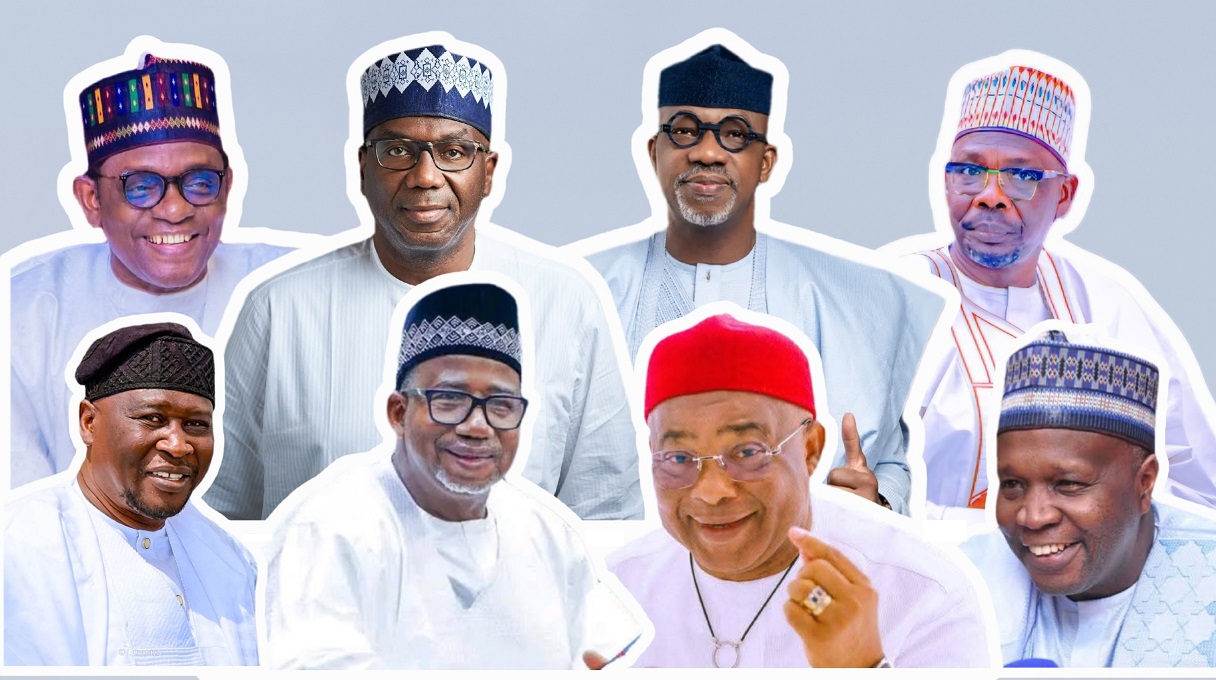
Dateline Nigeria reports that at least eight outgoing governors – seven in the All Progressives Congress (APC) and one in the Allied Peoples Movement (APM) – have secured tickets to contest Senate seats in 2027. Most cited “pressure from constituents” and a desire to continue serving at the national level. Here’s the rundown:
1. Hope Uzodimma – Imo West


Imo State Governor Hope Uzodimma is set to complete his second term but appears keen to return to the Senate, where he served from 2011 to 2019 before becoming governor. He won the APC primary on May 18, 2026, polling 230,464 votes to defeat former Governor Rochas Okorocha, who got 1,098 votes. Senator Osita Izunaso, who is the incumbent for the zone, stepped down before the primary. If Uzodimma wins in the general election, he will forfeit the remainder of his second term in office, which will elapse by January 2028, as the next Senate is expected to be inaugurated in June 2027.
2. Mai Mala Buni – Yobe East
Yobe State Governor Mai Mala Buni will move to the Senate after eight years in office. He was adopted as the consensus APC candidate by party stakeholders in Yobe East and affirmed as the sole candidate at an exercise in Damaturu. Incumbent Senator Musa Mustapha earlier withdrew from seeking a second term in the Senate and declared support for Governor Mai Mala Buni to contest for the seat in 2027.
3. Ahmadu Umaru Fintiri – Adamawa North
Adamawa State Governor Ahmadu Fintiri, who defected to the APC from the PDP in February 2026, clinched the APC ticket for Adamawa North unopposed on May 18, 2026. The incumbent senator, Amos Yohanna, declined to contest for a second term. Party officials described it as a strategic consensus to present a unified front. President Bola Tinubu called the defection a “big political investment” for the APC.
4. Abdullahi A. Sule – Nasarawa North
Nasarawa State Governor Abdullahi Sule will complete two terms on May 29, 2027. Sule won the APC senatorial primary election for Nasarawa North Senatorial District, polling 47,393 votes to defeat his only opponent, Silas Ali Agara, who scored 2,915 votes. The results were declared by the Returning Officer, Musa Shuaibu Guri, at the VIP Lodge in Akwanga. He received a unanimous endorsement from Nasarawa North APC stakeholders in 2025. His Director-General for Pensions, Suleiman Musa Nagogo, said the governor agreed to run following pressure from leaders and people of the zone.
5. Dapo Abiodun – Ogun East
Ogun State Governor Prince Dapo Abiodun was officially declared the winner of the APC Ogun East Senatorial District primary election. According to figures announced by the Chief Returning Officer for Ogun East, Dr. Wale Bello, Abiodun scored 75,550 votes out of a total of 99,503 votes cast to emerge victorious. Former Governor Otunba Gbenga Daniel polled 398 votes, while Bukola Braimoh secured 29 votes. The primary was however boycotted by supporters of incumbent Senator Gbenga Daniel, who cited security concerns. But Ogun East APC had earlier adopted Abiodun as its consensus candidate.
6. Abdulrahman Abdulrazaq – Kwara Central
Kwara State Governor Abdulrahman Abdulrazaq will contest the Kwara Central Senate seat in 2027. He won the backing of APC ward chairmen in the district and contested the ticket against incumbent Senator Saliu Mustapha. Reports said Mustapha did not participate, citing irregularities and lack of fairness. The Patriots of Good Legacy (PGL) led by Comrade Abdulmajeed AbdulWahab Temidire (Aburo Gomina) has since congratulated Governor Abdulrazaq.
7. Inuwa Yahaya – Gombe North
Gombe State Governor Inuwa Yahaya will run for Gombe North, a seat currently held by former governor Ibrahim Dankwambo of the PDP. Chairman of the APC Gombe State Primary Election Committee, Mallam Labiru Musa Kafur, mni, announced that Governor Inuwa Yahaya, who was earlier endorsed as consensus candidate, polled a total of 131,009 certified affirmation votes to clinch the party’s ticket. The contest for the seat is expected to set up a high-profile rematch with Dankwambo in 2027.
8. Bala Mohammed – Bauchi South
Bauchi State Governor Bala Mohammed defected from the PDP and joined the APM, picking the party’s nomination form for Bauchi South at its National Executive Committee (NEC) meeting presided over by the National Chairman, Yusuf Mamman Dantalle. In 2007, Mohammed contested and won the election to represent Bauchi South Senatorial zone on the platform of the defunct All Nigeria Peoples Party (ANPP). In 2010, he left the Senate and became FCT Minister in 2010 and dumped the ANPP shortly after. He emerged Bauchi governor in 2019 and is set to serve out his second term by 2027. Before joining APM, Mohammed was courted by both the APC and the opposition African Democratic Congress (ADC).
Why governors are running for Senate
The penchant for outgoing Nigerian state governors to transition into the Senate has become a norm in the country’s politics. As a result, citizens and political analysts now refer to the red chamber of the National Assembly as a “Governors’ Retirement Home.”
Several reasons explain the trend. Unlike the executive branch, where governors are constitutionally barred from seeking a third term, the National Assembly has no term limits, making it attractive for politicians exiting office.
“Governors are retiring to the Senate because, after wielding enormous power in their states, they don’t want to go into political oblivion,” said political analyst Mohammed Sani. “They want to remain visible, because losing a political office often means a rapid decline in national influence and local relevance.”
For public affairs commentator Michael Odidille, some governors who enjoyed immunity while in office see the Senate as a buffer. “They believe that by securing a seat in the Senate, they can benefit from the institutional weight of the National Assembly to tie up active prosecutions or slow down investigations,” he said. “Yet, others see the Senate as a gateway to remain active within federal circles, positioning ex-governors for ministerial appointments or eventual presidential bids.”
Dateline Nigeria reports that after securing the ticket of their party the governors will still need the votes of their constituents in the general elections to realise their ambition.

