
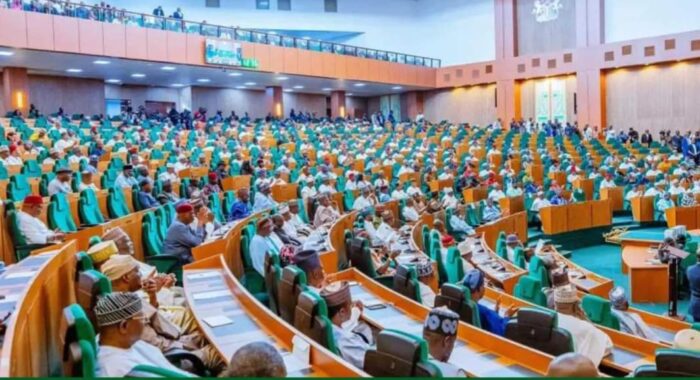
- Lawmakers recommend wider, multi-sectoral, measures
The House of Representatives has made recommendations for Multi-Sectoral approaches and wide ranging measures to tackle insecurity in the form of insurgency, kidnappings, terrorism, treason and other criminal acts across the country.
The lawmakers considered and debated 54 resolutions on Wednesday, which were later consolidated to 47 after seven were either dropped or merged during the deliberations at the Committee of the whole presided by the Deputy Speaker, Hon. Benjamin Kalu, which lasted for hours.


Suggestions on some of the resolutions were made during the debate and deliberations which led to the stepping down of four resolutions, deletion of two while two others were merged to become one due to their similarities.
The seven resolutions affected include; 42, 43, 45 and 46 which were stepped down, 35 and 50 were deleted while resolutions 34 and 38 were merged to become one.
According to the House, it arrived at the resolutions having dedicated the entire legislative week of Tuesday 25 to Thursday 27 November 2025 to a comprehensive national debate on the rising insecurity across the Federation.
The House informed that, the intense debate on the security issues involved Principal Officers, Zonal and Regional Caucus Leaders, Chairmen of Committees on Defence, National Security and Intelligence, Police Affairs, Interior, Emergency Preparedness, Human Rights, Women Affairs and Youth Development, and all Honourable Members.
The House recalls that the debates were enriched with constituency-level testimonies, committee briefs, expert submissions and field assesaments undertaken in affected states.
It added, “The House acknowledges the decisive measures recently taken by His Excellency, President Bola Ahmed Tinubu, including; immediate additional enlistment into the Armed Forces and the Nigeria Police Force; Recruitment of 20,000 additional police personnel; the use of NYSC camps as temporary police training centres; redeployment of VIP-attached officers to critical policing duties; deployment and expansion of trained forest guards by the Department of State Services; and enhanced federal support for state-level security outfits.
It added, “The House commends the President’s decision to postpone his participation in the G20 Summit to address domestic security challenges directly, and notes the high-level delegation dispatched to interface with the Government of the United States”.
See Full details of the resolutions below.
DRAFT RESOLUTIONS OF THE HOUSE OF REPRESENTATIVES ON NATIONAL SECURITY REFORM AND ENHANCEMENT, AS ADOPTED FROM THE SECURITY DEBATES
preamble
- The House of Representatives, having dedicated the entire legislative week of Tuesday 25 to Thursday 27 November 2025 to a comprehensive national debate on the rising insecurity across the Federation involving Principal Officers, Zonal and Regional Caucus Leaders, Chairmen of Committees on Defence, National Security and Intelligence, Police Affairs, Interior, Emergency Preparedness, Human Rights, Women Affairs and Youth Development, and all Honourable Members—recalls that the debates were enriched with constituency-level testimonies, committee briefs, expert submissions and field assessments undertaken in affected states.
- The House acknowledges the decisive measures recently taken by His Excellency, President Bola Ahmed Tinubu, including:
(a) Immediate additional enlistment into the Armed Forces and the Nigeria Police Force;
(b) Recruitment of 20,000 additional police personnel;
(c) The use of NYSC camps as temporary police training centres;
(d) Redeployment of VIP-attached officers to critical policing duties;
(e) Deployment and expansion of trained forest guards by the Department of State Services; and
(f) Bnhanced federal support for state-level security outfits.
- The House commends the President’s decision to postpone his participation in the G20 Summit to address domestic security challenges directly, and notes the high-level delegation dispatched to interface with the Government of the United States.
4 Following exhaustive deliberations, the House therefore resolves as follows:
- Fiscal Measures for Security Enhancement
- All security expenditure should be placed on ‘First Line Charge’ to guarantee Predictable and timely funding, and all approved security budgets must be fully and promptly disbursed.
6 That, in recognition of the established link between cash-based economies andthe financing of terrorism, banditry, ransom payments and other criminal/enterprises, the House recommends a phased strengthening of cashless transaction frameworks nationwide, Accordingly, the House urges the Executive, the Central Bank and financial institutions to expand and upgrade secure e-banking infrastructure, particularly in rural and underserved arena, ensure reliability, accessibility and public confidence.
7 That enhanced digital payment systems, transaction monitoring mechanism and financial-crime analytics be integrated into national security operations, while ensuring that the transition remains inclusive, does not exclude vulnerable populations, and is implemented in a manner that balances security imperatives with economic realities,
II. institutional and Operational Reforms
- That the military ‘super-camp’ strategy be formally reviewed, given its Operational imitations, including reduced territorial presence and increased community vulnerability; and that the Armed Forces consider a return to forward operating bases and sustained community-level deployment as a more effective doctrine for securing affected areas.
- That new Army formations, Police divisions and Civil Defence units be established or expanded in volatile regions, high-risk areas and strategic locations,
- Security coverage for schools, worship centres, markets and other soft targets should be strengthened through coordinated preventive measures and improved rapid-response capacity. This should include enhanced implementation of the Safe Schools Initiative, with attention to risk assessments, perimeter protection, CCTV, early-warning systems and community-based reporting to protect pupils, teachers and other vulnerable groupe.
- That the national security architecture be modernised through reforms in training, doctrine, ICT, command, procurement and welfare standards.
- All public CCTV systems should be reactivated, upgraded, and, where necessary, complemented with new installations, and integrated into a national and sub-national surveillance grid.
- Actionable intelligence generated by the Department of State Services and other security agencies, including intelligence shared across agencies, should be proactively operationalised by all security formation, with strengthened inter-state collaboration, particularly along border corridors and other high risk zones.
- That the process to establish State Police be expedited through Constitutional amendments, placing policing on the Concurrent Legislative List.
- That deployment of police and military personnel for VIP protection should be significantly reduced, with a clear downscaling of security Details attached to political officeholders, in full compliance with the presidential directive. The released personnel should be reassigned to strengthen critical oppositions nationwide.
III. Intelligence, Technology and Surveillance
- That intelligence gathering be strengthened at the community bevel ang systematically linked to national systems,
- Border security should be treated as a national emergency, with deployment of modern technologies such sas drones, biometric systems, sensors, satellite imagery, AI-enabled predictive analytics and integrated early warning systems, alongside physical deterrents such as mosts = vulnerable border corridors.
- That a central Joint Intelligence Fusion Centre be established for real time inter agency coordination.
- That the Multi-Agency Anti-Kidnap Fusion Cell be expanded, structured and better resourced.
- The House underscores the urgent need to curb fake news, misinformation, harmful content and deceptive Al-generated material, especially content that threatens national security. In line with global best practice, the House calls for a balanced regulatory framework that protects free expression while requiring digital platforms to remove harmful content promptly, adopt transparent moderation practices, strengthen user verification, and promote digital literacy. The framework should also strengthen law enforcement capacity ond impose Clear sanctions for coordinated disinformation and malicious Al contest.
- The House calls for an effective national tracking mechanism for all arms, Weapons and security equipment held by security agencies. This should include a unified inventory system, digital tracking tools, periodic audit, and Strict accountability measures to prevent diversion, loss, or misuse. and to strengthen operational integrity and public safety,
IV. Human Capital and Welfare
- That, in line with the recent presidential directives on strengthening national security capacity, massive recruitment into the Armed Forces, the Police and other security agencies shall commence without delay to meet current operational demands; and that clear recruitment timelines and implementation schedules be developed and submitted to the National Assembly for effective legislative oversight.
- That the welfare of security personnel be strengthened through improved salaries, insurance, housing, medical care and compensation frameworks,
- That officers approaching retirement who possess specialised operational or technical skills be formally co-opted to support security agencies in a structured, clearly regulated manner that does not alter or interfere with existing command hierarchies or lines of authority; and that such officers may, where appropriate, be integrated into auxiliary units such as forest-guard services and other approved support formations to strengthen national security capacity while preserving institutional knowledge.
- The House recognises the need to develop a clear legislative framework to regulate the operations of private security outfits and enable them, under strict conditions, to bear arms for authorised protective duties. This framework should establish rigorous licensing standards, robust oversight mechanisms, mandatory training requirements, and safeguards to prevent misuse, while ensuring that such entities operate as a complementary force to national security agencies in protecting lives, property and critical infrastructure.
- The House recognises and honours the officers who have paid the ultimate price in the service of the nation and extends its deepest condolences to their families. The House further calls for the establishment of a National Fallen Heroes Support Fund to provide sustained assistance to the families of deceased servicemen and women, including automatic employment opportunities and scholarships for their immediate family members.
V. Legal and Judicial Reforms
- That financiers of terrorism, banditry and kidnapping be publicly named, sanctioned and prosecuted.
- That terrorism-related prosecutions be open, expeditious and transparent,
29 That a Special Court for terrorism, banditry and kidnapping be established,
- That penalties for arms trafficking and illegal possession of weapons be strengthened and strictly enforced,
- That a Truth, Justice and Reconciliation Commission be established to address extremist, communal and religiously motivated violence.
- That a National Drone (UAS) Operations and Oversight Act be enacted to regulate drone operations, protect civilians and ensure compliance with global norms.
VI. Community and Socio-economic Interventions
- That governments at all levels priorities job creation, vocational training, agricultural support, and anti-poverty programmes to tackle the root causes of insecurity,
- That community policing, neighbourhood watch structures, traditional institutions and religious leaders be formally integrated into Nigeria’s security matrix under clear, regulated frameworks.
- A strengthened and well-funded victims support system should be established across both federal and sub-national levels, leveraging and reforming existing institutions, with a dedicated National Victims Support and Recovery Fund to ensure coordinated and sustained assistance to victims nationwide.
- That ransom payments and informal amnesty negotiations by government entities should be prohibited, and a cleat legal framework should be enacted to outlaw such practices while regulating any authorised amnesty processes. Only lawful criminal-justice procedures shall prevail.
- That peacebuilding and community cohesion mechanisms be institutionalised at the local government and state levels,
VI. Regional and International Cooperation
- That Nigeria deepens security cooperation with ECOWAS, the African Union and neighbouring states for join patrols, intelligence sharing and border Control,
39 Thet ongoing bilateral engagement with the Government of the United States be strengthened, particularly in intelligence, surveillance, counter-terrorism training, and financial network disruption.
- That, henceforth, all security-related engagements between the Executive branch of the Federal Government and the Government of the United States = including with the US Congress or executive shall include an official Parliamentary delegation of the National Assembly This is necessary given the influence of US Congressional deliberations on American foreign and security Policy, and will ensure policy coherence, unified national representation and effective legislative diplomacy.
41 The House affirms the vital role of NGOs in humanitarian and development Work and calla for a modem regulatory framework that ensures transparency and accountability while supporting their operational independence. The framework should provide clear registration and reporting requirements, financial transparency standards, and safeguards against misuse, in line with international best practice. It should also promote constructive cooperation between the government and civil society.
VIII. Oversight, Investigations and Accountability
- That the House revisit and review the implementation of the Resolutions and Security Summit Reports of the 9th and 10th National Assemblies.
- That investigations be conducted into reported withdrawals of security personnel from schools and communities prior to attacks,
- That relevant service chiefs and commanders be invited to brief the House on operational orders, communication logs and utilisation of intelligence.
- That an independent audit mechanism be established for all security funds, including the Police Trust Fund and private-sector contributions.
- That the Ministry of Finance adopt a Financial Action Task Force-style framework to trace insurgent financing.
IX. Emergency and Humanitarian Response
- That emergency relief, trauma care and stabilisation programmes be rapidly deployed to affected communities,
- Local hunters, vigilantes, forest-guard networks and ranger units should be regularised, trained, funded and integrated into a formal national framework that ensures lawful operations and strengthens community-based security support.
- That a Religious Protection Council be established under the National Security Adviser to monitor attacks, promote interfaith dialogue and submit annual reports to the Notional Assembly
X. Strategic Coordination and Governance
- That a Joint National Security Operation Taskforce be established, comprising the Armed Forces, Police, DSS, NIA, NSCDC and other stakeholders under ‘ unified command with clear accountability,
- That weapons mop-up operations continue across all affected regions.
- That a national early-warning system he institutionslised, integrating technology-driven surveillance and community intelligence networks.
Conclusion
- This Resolution shall be transmitted to the Executive Arn of Government, all security agencies, State Governments and other relevant institutions for urgent implementation in the interest of national stability and public safety.
- That the foregoing resolutions be transmitted to the Senate for concurrence, 90 that they may stand as unified resolutions of the National Assembly.

