
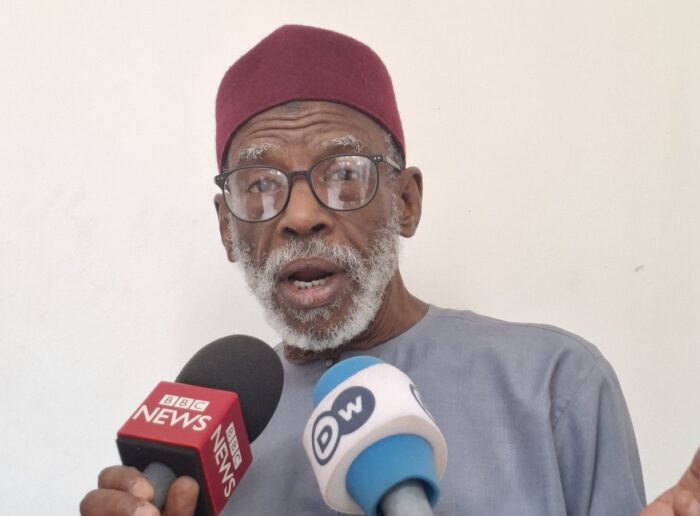
The Supreme Council for Shari’ah in Nigeria (SCSN) has issued a strong condemnation of recent legislative actions and narratives emanating from the United States Congress, which it describes as falsely alleging a “Christian genocide” in Nigeria and unjustly singling out Senator Rabiu Musa Kwankwaso.
In a statement released by its Secretary General, Nafiu Baba Ahmad, the Council unequivocally asserted that there is no Christian genocide in Nigeria. While acknowledging the severe security challenges facing the nation, including terrorism and banditry, the SCSN maintained these issues are not driven by state policy or a religious agenda of extermination.


The Council labelled the reduction of Nigeria’s complex security crisis to a “simplistic and emotive genocide narrative” as both false and “dangerously irresponsible.”
The SCSN expressed deep concern that such significant legislative positions appear to be based on “poorly generated, sensational, and unreliable data,” pointing to narratives allegedly referenced by the New York Times from individuals with “toxic mindsets and little understanding of Nigeria’s conflict dynamics.”
The Council particularly criticized the reliance on commentary attributed to a trader in Onitsha, questioning the seriousness of the foundation for these grave accusations.
Furthermore, the Council strongly condemned what it called the “awkward and reckless call” by the Nigerian First Lady for increased U.S. bombing in Northern Nigeria.
The SCSN argued that such calls betray a “shocking insensitivity to human life” in civilian-majority Muslim populated regions and would lead to “catastrophic humanitarian consequences.”
While open to genuine international assistance like technical or intelligence support, the Council categorically rejected “ill-informed, militaristic, and punitive approaches” driven by false narratives.
The SCSN also found it “inexplicable and unjust” that Senator Kwankwaso was singled out in the alleged U.S. legislation. The Council suggested that Kwankwaso’s “principled opposition” to designating Nigeria as a “Country of Particular Concern (CPC)” – a designation based on the same debunked genocide narrative – is the true reason for his targeting. It stated that to ignore Nigeria’s economic devastation, which fuels crime and violence, while “scapegoating one individual reflects bias, not justice.”
Reiterating its absolute condemnation of terrorism and criminal violence in all forms, the Council highlighted that criminal killings in Nigeria affect both Muslims and Christians. However, it emphasized that Muslim communities, particularly in the North, have “suffered disproportionately from insurgency and banditry,” calling for honest discourse that recognizes this shared pain rather than weaponizing religion for political ends.
The statement concluded with a call for the United States government and its legislature to “exercise restraint, intellectual honesty, and due diligence,” urging them to engage with credible Nigerian institutions and abandon narratives that inflame tensions, advocating instead for sincere partnership grounded in mutual respect.

