
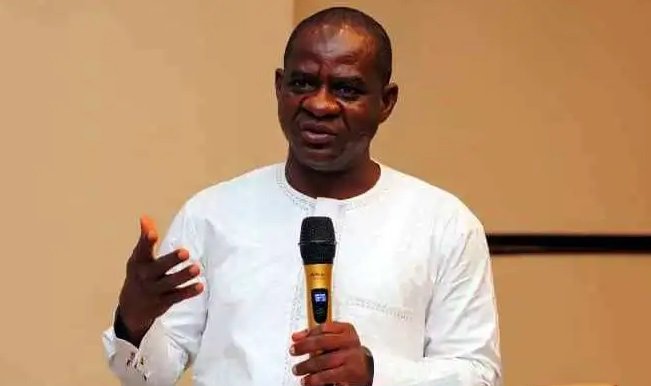
Welcome Address by Musikilu Mojeed, President, IPI Nigeria, at the 2025 IPI Nigeria Conference and Annual General Meeting – 2 December 2025.
Your Excellency, the Vice President of the Federal Republic of Nigeria
The Honourable Minister of Information and National Orientation
Distinguished guests, colleagues, friends of the press, good morning.


It is my honour to welcome you to the 2025 Conference and Annual General Meeting of the International Press Institute (IPI) Nigeria. This gathering is more than a routine annual event. It is a critical moment for sober reflection on the state of journalism in our country and for collective action to defend what remains of our civic space.
Today, we meet not only as professionals but as custodians of an essential democratic institution—journalism. And at a time like this, when our freedoms are under growing pressure, our responsibility becomes even more urgent.
Let me especially acknowledge our Chairman for today’s event, His Excellency, Vice President Kashim Shettima (GCON). Thank you for your presence and steady support.
I also welcome our Special Guest of Honour, the Honourable Minister of Information and National Orientation, Alhaji Mohammed Idris. Your participation today signals openness to continued dialogue, and, we hope, a commitment to meaningful reform.
To our keynote speakers, moderators, panelists, and colleagues present: thank you. Your voices, perspectives, and courage are the lubricants sustaining this profession.
Before we continue, may we all rise for a one-minute silence in honour of our late colleague and treasurer, Rafat Salami. Last year, even in severe pain and confined to a wheelchair, she insisted on attending the conference. She greeted guests, coordinated logistics, took photographs with her phone, and served with grace until her body could no longer carry her. Her commitment was a reminder that journalism is not merely a job; it is a calling. It demands sacrifice. It demands conviction.
To honour her legacy, the Nigerian National Committee of IPI Nigeria will endow a prize in her name at the University of Abuja, her alma mater. We will work with the university to ensure that every year, young journalists are inspired by the values Rafat lived by—integrity, courage, and selfless service.
Ladies and gentlemen, we meet today under a troubling cloud. The Nigerian media landscape is in distress. This year, Nigeria fell ten places—from 112 to 122—in the global Press Freedom Ranking. That steep drop is not the result of one incident. It is the cumulative effect of consistent and aggressive repression across states, across platforms, and across newsrooms.
Nigeria is classified as one of West Africa’s most dangerous and difficult countries for journalists. This is not a beautiful portrayal of our country, but the description is not baseless.
The pattern is unmistakable:
Journalists are monitored, attacked, and arbitrarily arrested: Completely lawful reporting activities (filming a demolition, covering a protest, documenting police misconduct) have become dangerous acts.
Media houses are shut down for political reasons: In Zamfara, four (4) broadcast stations (NTA, Pride FM, Gamji TV, and Al-Umma TV) were once closed simply for airing an opposition rally.
Investigative journalists face targeted intimidation: We recall the harrowing experience of a colleague, Segun Olatunji, who was abducted, blindfolded, chained, and transported hundreds of kilometres away from his base for a controversial reporting.
Online reporters are now frequent victims of cybercrime accusations: The cybercrime law, despite recent amendments, continues to be used to suppress digital journalism. Several journalists have been arrested or prosecuted under this legislation.
Journalists covering protests and elections remain extremely vulnerable: In August 2024 alone, at least fifty-six (56) journalists were assaulted or arrested while covering demonstrations across the country.
These are not abstractions. They have names, faces, and families. The pattern of repression is deepening, and the actors remain largely the same—state agents, political actors, and security operatives who operate with impunity.
This has been said before, and I will say it again: Journalism is not a crime. And journalists are not criminals. The Constitution protects freedom of expression. The courts have affirmed it. But in practice, we continue to see arbitrary arrests, intimidation, censorship, and violence.
To our colleagues across the country: This is not the time for apathy and isolation. We must act as a unified community. When a journalist is arrested in Kano, colleagues in Akwa Ibom must care. When a newsroom is attacked in Niger State, reporters in Lagos must speak out. When a reporter disappears in Lagos, editors in Abuja must raise the alarm. Solidarity is our greatest line of defence.
The stakes are high. Independent journalism is the lifeblood of democracy. When the press is intimidated, elections lose credibility, governance becomes opaque, corruption flourishes, and citizens lose their voice. We must not allow that to become Nigeria’s story.
We therefore urge the Federal Government to call state governors, security agencies, other officials involved in impunity against media and journalists to order.
The government should ensure state governors, security agencies, and public officials stop the harassment of journalists: No democracy can function when those who hold power to account are shielded from scrutiny.
This administration should also strengthen mechanisms for journalist safety: Nigeria has no functioning state protection system for journalists. This must change.
In addition, the time has come for Nigeria to review laws that enable abuse, particularly the cybercrime and outdated criminal defamation provisions.
We are also urging the government to address the culture of impunity in our country. There are too many centres of power routinely deploying state powers against journalists without consequences. When crimes against journalists go unpunished, the message is dangerous – that silencing the press is acceptable.
But let us be clear, ladies and gentlemen, Journalism is a tough, risky and selfless public service. And if they get nothing for their sacrifices for society, they at least deserve respect and protection. Therefore, any further attack on journalists will be fiercely resisted going forward.
I thank you all for listening. Welcome all.
02 December 2025

